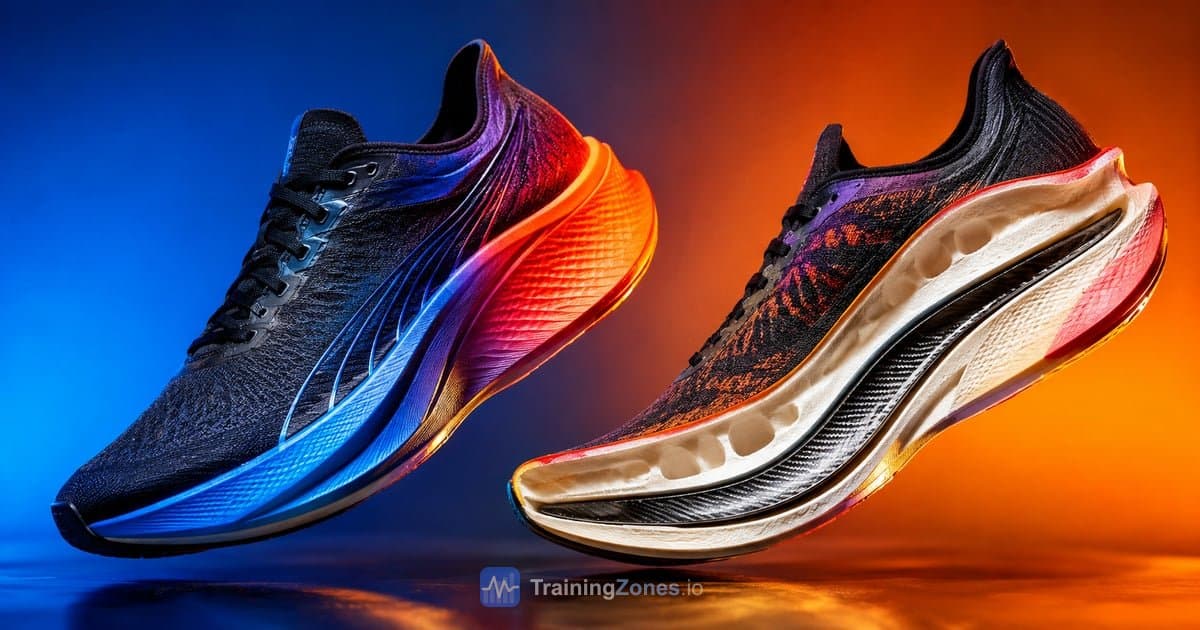
What Are Carbon Plate Running Shoes?
A carbon plate running shoe is a performance running shoe with a stiff, curved plate of carbon fiber embedded inside a thick foam midsole. The plate works like a spring: it stores energy when your foot lands and gives some of it back as you push off, improving running economy by roughly 2 to 4 percent in controlled studies.
That number is where all the hype and all the arguing comes from. Two to four percent sounds tiny until you do the math on a marathon, where it can mean a couple of minutes. But here's the thing most marketing pages skip: that gain isn't the same for everyone, and it isn't free. This guide walks through what the science actually shows, who really benefits, and whether a €250 pair belongs on your feet. At TrainingZones.io we care less about the brand on the shoe and more about whether the physics holds up for a runner like you.
The category exploded after Nike's Vaporfly landed in 2016 and started rewriting road records. Since then, every major brand has its own "super shoe," and the term now covers everything from elite racing flats to cushioned daily trainers that borrow a slimmer plate.
How Do Carbon Plates Work? The Biomechanics Explained
Carbon plates work through a combination of a rigid spring and highly responsive foam that together reduce the energy your legs waste with each stride. The plate stiffens the shoe lengthwise, which limits how much your toe joints bend and reduces the muscular work your calf and foot do to control that motion. The foam does the rest, compressing and rebounding to return energy at push-off.
Think of it like a diving board. When you land, the curved plate and the foam beneath it load up, storing elastic energy. As your weight rolls forward, that energy releases and helps propel you into the next step. The curve, often called a rocker, also rolls you forward so you spend less time fighting your own foot mechanics.
There's a detail that surprises people: the plate is not the main event. In a modern super shoe, roughly 60 percent of the benefit comes from the light, high-rebound foam (usually a Pebax or PEBA type), and only about 40 percent comes from the plate itself. Strip the plate out and keep the foam, and you still get a real, if smaller, boost over a traditional EVA trainer. The plate mostly stabilises that soft, tall foam stack so it doesn't collapse sideways and waste the energy the foam is trying to return.
- The plate: stiffens the shoe, reduces toe-joint bending, saves calf and foot muscle work
- The foam: compresses and rebounds, returning energy at toe-off (the bigger contributor)
- The rocker shape: rolls you forward, smoothing the transition from landing to push-off
- The stack height: taller foam stores more energy, which is why racing stacks keep growing
Do Carbon Shoes Actually Make You Faster?
Yes, carbon plate shoes make most trained runners faster, but the honest answer is "it depends, and by less than you'd hope." Across controlled lab studies the average improvement in running economy is 2 to 3 percent, and that translates into a real but pace-dependent time saving on race day. The faster you run, the more of that economy gain you actually keep.
So how much time are we talking about? That's exactly the question the calculator below answers. Enter your current 10K, half, or marathon time and it estimates how much a carbon shoe could shave off, then shows you how strongly the benefit applies at your pace. A 3-hour marathoner and a 5-hour marathoner do not get the same deal, and the tool makes that gap obvious.
Carbon Shoe Time-Gain Calculator
See how much time carbon plate shoes could realistically save you
Running economy gain
3%, the average across controlled studies
The benefit scales with pace: faster runners keep most of the economy gain, slower runners far less. Estimates are based on running economy research and vary from runner to runner.
A quick reality check on those numbers. Running economy improving by 3 percent does not mean you finish 3 percent faster. Some of that saved energy gets eaten by the extra weight of a tall shoe, by fatigue, by pacing, and by the simple fact that slower runners spend more time on the ground where the spring effect matters less. That's why the tool tapers the gain as your pace drops. If you want to sanity check your target times independently, our race time predictor uses your recent results rather than a shoe's marketing claim.
Let's kill one myth while we're here. The common claim is that carbon plate shoes make everyone faster by the same amount. That's wrong. The gain is real, but it shrinks steeply as pace slows, and a meaningful share of runners barely respond at all. Picture two people buying the same shoe: a runner cruising a 10K at 4:30 min/km pockets most of the 2 to 3 percent, while a friend jogging the same race at 6:30 min/km sees almost nothing on the clock. Same shoe, wildly different result. This is why online reviews contradict each other so violently, one runner feels transformed, the next feels robbed. The shoe amplifies the fitness and mechanics you already have. It doesn't manufacture them out of thin air.
The Science: What 14 Studies Found
A 2022 meta-analysis pooling 14 randomized trials found that carbon-plated shoes improve running economy by an average of 2 to 3 percent on flat ground, with the effect largest at faster paces. This built on the study that started it all: Hoogkamer and colleagues (2018, Sports Medicine) measured a 4 percent reduction in the metabolic cost of running in Nike's prototype compared with a leading racing flat.
The research is unusually consistent for sports science, but it comes with fine print. Barnes and Kilding (2019) confirmed the economy benefit in both men and women, while also noting large individual variation: some runners gained 6 percent, a few gained almost nothing. Response depends on your footstrike, your mass, your mechanics, and how well the shoe's geometry fits your stride.
- Average effect: 2 to 3 percent better running economy on flat terrain
- Pace matters: the benefit grows above roughly 4:00 min/km and shrinks below 5:00 min/km
- Individual variation is huge: "non-responders" exist, and you can't know your number without testing
- Terrain matters: most gains were measured on flat, hard surfaces, not hills or trails
- The foam is the star: about 60 percent foam, 40 percent plate
At TrainingZones.io we read these papers so you don't have to, and the takeaway is refreshingly boring: the shoes work, the average gain is modest, and your personal result is a coin toss around that average. Anyone promising you a guaranteed 4 percent is selling, not citing.
Who Benefits Most from Carbon Plate Shoes?
Fast runners benefit most from carbon plate shoes, and the advantage fades as pace slows. The spring-and-rocker system depends on landing forces and ground contact patterns that are strongest at quick paces. Above about 4:00 to 4:30 min/km the shoes shine; between 5:00 and 6:00 they still help a bit; slower than that, the measurable edge often disappears into the noise.
Here's roughly how it breaks down by runner profile:
- Elite and sub-elite (under 3:30 min/km): clear, repeatable gains. This is where records fall.
- Competitive amateurs (3:45 to 5:00 min/km): a real but smaller benefit, worth it for goal races
- Mid-pack recreational runners (5:00 to 6:00 min/km): modest gains, more about comfort and late-race freshness than raw speed
- Slower or beginner runners (above 6:00 min/km): little measurable speed benefit; you're paying mostly for cushioning
That doesn't make the shoes pointless for slower runners. Many report less leg soreness in the final miles, because the soft foam absorbs impact you'd otherwise soak up yourself. That fresher-legs feeling is a legitimate reason to wear them, it just isn't the same as running faster. Whatever your pace, the shoes don't replace training. If you haven't dialed in your easy and threshold efforts yet, spend time with our running pace zones first, because structure beats gear every single time.
The Downsides: Injury Risk, Cost, and the Fairness Debate
The main downsides of carbon plate running shoes are cost, durability, injury risk, and a genuine ethics debate about fairness in competition. None of these are dealbreakers on their own, but together they explain why plenty of experienced coaches tell runners to hold off.
Start with the body. By changing how your foot and ankle move, carbon shoes shift load onto your calf and Achilles tendon. One 2023 biomechanics study reported a sharp rise in Achilles tendon force during push-off compared with standard trainers. Runners who switch over too fast, or wear racers for every run, have reported calf strains, Achilles niggles, and a new flavour of forefoot ache. The fix is simple: treat them as race and key-workout shoes, not daily drivers.
- Cost: €200 to €350+ a pair, and prices keep climbing
- Durability: the magic foam degrades fast, often 300 to 500 km versus 700+ for a normal trainer
- Injury risk: more load on the calf and Achilles, especially during a rushed transition
- Diminishing returns: little benefit for slower runners paying the most in relative terms
- Fairness: the "technological doping" question that split the sport
That last point is real history, not a talking point. After the Vaporfly era began erasing records, World Athletics stepped in and, in 2020, capped road-racing sole thickness at 40 mm and required shoes to be available to the public. The super-shoe wave is estimated to have lowered elite marathon times by 2 to 4 minutes on average, enough to make officials worry the shoe, not the athlete, was winning.
Are Carbon Plate Running Shoes Worth It for You?
Carbon plate shoes are worth it if you race often at a competitive pace and you've already got your training in order. They're a poor first purchase if you're new to running, rarely race, or run most of your kilometres slower than 6:00 min/km. The value question is really a cost-per-second question, and that answer changes a lot with your speed.
Ask yourself three things. First, do you race? The gains show up in races and hard intervals, not on easy Sunday jogs. Second, how fast do you run those races? A sub-1:40 half marathoner keeps far more of the benefit than a 2:30 half marathoner. Third, can the €250 do more good elsewhere, on a coach, a training camp, or simply more consistent weeks? Honestly, nine times out of ten a beginner's money is better spent on the training than the shoe.
If you do decide to buy, use them with intent. Break them in with two or three shorter workouts so your calves adapt, save the mileage for goal races, and don't chase a shiny new pair every season. Before you commit to a time goal, it's worth checking what's realistic with our race time predictor, so your expectations come from your fitness and not a shoe box.
Our Verdict: Best Carbon Shoes by Runner Profile
Our verdict is that carbon plate shoes are a smart tool for committed racers and an expensive luxury for casual runners. The best pair for you depends less on which brand wins a lab test and more on how the shoe fits your foot and your event. Fit and comfort override spec sheets, because a shoe that doesn't suit your stride can wipe out its own advantage.
For a broad look at what suits different runners, three models cover most needs:
The proven benchmark: The Nike Vaporfly is the shoe that started the super-shoe era and still sets the standard for road racing from the 10K to the marathon. It's the safe pick if you want the most-studied option on the market.
The all-rounder: The Saucony Endorphin Pro pairs a responsive plate with a stable ride that suits runners who want a racer they can also use for longer tempo sessions without feeling twitchy.
The distance specialist: The ASICS Metaspeed Sky leans toward stride-length runners and rewards a smooth, rolling gait over long efforts, a favourite among marathoners chasing a specific time.
Whichever you choose, remember the shoe is the last 2 percent, not the first 98. TrainingZones.io exists to help you build that other 98 percent, the aerobic base, the pacing, the recovery, so the day you lace up a carbon racer, it's amplifying real fitness rather than papering over the lack of it.
Frequently Asked Questions About Carbon Plate Running Shoes
Do carbon plate running shoes make you faster?
Yes, for most trained runners they do, by around 2 to 3 percent in running economy on average. That translates to a real but pace-dependent time saving, larger for fast runners and smaller for slower ones. The benefit is measured in races and hard efforts, not easy runs.
How much faster are carbon plate running shoes?
On average they improve running economy by 2 to 3 percent, which can mean roughly 1 to 2 minutes over a marathon for a competitive runner. Slower runners keep less of that gain. Use a pace-based estimate rather than a flat percentage, because the real time saving shrinks as your pace slows.
Are carbon plate shoes bad for your joints?
They aren't inherently bad, but they do shift more load onto the calf and Achilles tendon by changing your foot mechanics. Runners who transition too quickly or wear them for every run report more calf and Achilles issues. Introduce them gradually and keep them for races and key workouts.
What is the difference between carbon plate and regular running shoes?
Regular trainers use standard foam and no plate, prioritising durability and everyday comfort. Carbon plate shoes add a stiff carbon fiber plate inside a tall, high-rebound foam midsole to return more energy and boost running economy. They're faster but pricier and wear out sooner, around 300 to 500 km.
Are carbon plate shoes worth it for half marathon runners?
For competitive half marathon runners racing under about 1:45, yes, the benefit is worth the cost on race day. For slower or occasional runners, the relative gain is smaller and the money often does more good spent on training. Treat them as a race-day tool, not a daily trainer.
Which carbon plate running shoes are best in 2026?
The best pick depends on fit and your event more than the brand. The Nike Vaporfly remains the most-studied benchmark, the Saucony Endorphin Pro suits runners wanting a stable all-rounder, and the ASICS Metaspeed Sky favours long-distance, stride-based runners. Always prioritise comfort and fit over spec-sheet claims.
References
- Hoogkamer W, Kipp S, Frank JH, et al. (2018). A Comparison of the Energetic Cost of Running in Marathon Racing Shoes. Sports Medicine, 48(4):1009-1019.
- Barnes KR, Kilding AE (2019). A Randomized Crossover Study Investigating the Running Economy of Highly-Trained Male and Female Distance Runners in Marathon Racing Shoes. Sports Medicine, 49(2):331-342.
- Kobayashi Y, et al. (2022). Effects of carbon-fiber plated footwear on running economy: a meta-analysis of controlled trials.
- World Athletics (2020). Technical Rules: Athletic Shoe Regulations (maximum 40 mm sole thickness for road competition).