What Is a Sprint Triathlon and Why Should You Start There?
A sprint triathlon is a multi-sport race consisting of a 750-meter swim, a 20-kilometer bike ride, and a 5-kilometer run, completed back to back. It is the most popular entry point for beginner triathletes because the distances are manageable for anyone with basic fitness.
Unlike longer formats like Olympic (1.5K/40K/10K) or Ironman (3.8K/180K/42K), a sprint triathlon can be completed in 1 to 2 hours. You do not need years of experience or expensive equipment. If you can swim 200 meters without stopping, ride a bike for 30 minutes, and jog for 20 minutes, you already have the foundation to start training.
According to World Triathlon, over 2 million people participate in triathlons each year, and the majority start with the sprint distance. The sprint format keeps the barrier to entry low while still delivering the unique thrill of crossing a multi-sport finish line.
How Fit Do You Need to Be for Your First Triathlon?
You do not need to be an athlete to start training for a sprint triathlon. The minimum requirement is being able to swim 200 meters continuously, cycle for 30 minutes at an easy pace, and run or jog for 20 minutes without stopping.
If you cannot do all three yet, that is perfectly fine. At TrainingZones.io, we designed the 12 week training plan below to build you up progressively from a modest fitness base. Most beginner triathlon training plans assume you can exercise 3 to 4 times per week for 30 to 60 minutes.
The key mindset shift is this: your first triathlon is about finishing, not racing. Forget about pace, splits, or placing. The goal is crossing that finish line with a smile.
Important: If you have any medical conditions or have not exercised regularly in the past 6 months, consult a doctor before starting a beginner triathlon training plan.
What Gear Do You Actually Need for a Beginner Triathlon?
Starting a triathlon does not require thousands of dollars in equipment. Here is the essential gear list for your first sprint triathlon, separated from the nice-to-have upgrades.
Absolute essentials (under $200):
- Tri suit (one outfit for all three legs)
- Swim goggles (anti-fog, comfortable fit)
- A bicycle in good working condition (road bike, hybrid, or even a mountain bike). Referees inspect your bike (brakes, tires, handlebars) at the transition area entrance
- Helmet (mandatory, no exceptions)
- Running shoes (whatever you train in)
- Wetsuit (per World Triathlon rules: mandatory below 16°C, forbidden above 22°C for swims up to 1500 m or above 24.6°C for swims of 1501 m and longer, optional in between)
- Race belt for your bib number
Nice to have (invest later):
- Clipless cycling shoes (clip into the pedals for more efficient pedaling)
- Triathlon-specific shoes with elastic laces
- Heart rate chest strap (for accurate training zone tracking)
- A bike computer or GPS watch
- Aero water bottle for the bike
Our pick: The Garmin Forerunner 265 is an excellent GPS watch for beginner triathletes. It tracks swimming, cycling, and running with dedicated triathlon mode, open water swim tracking, and wrist-based heart rate monitoring.
The most common question beginners ask is whether they need a road bike. The answer is no. Any bike in safe working condition will get you through a sprint triathlon. You can upgrade later once you know you love the sport.
How to Train for a Sprint Triathlon in 12 Weeks?
A beginner triathlon training plan should build gradually from 2 hours per week to about 6 to 7 hours at peak, then taper before race day. The plan below follows a simple structure: Base (weeks 1 to 3), Build (weeks 4 to 7), Peak (weeks 8 to 10), Taper (week 11), and Race (week 12).
12 Week Sprint Triathlon Training Plan
Click a week to see the details
Total: 2h00/week
2 × 20 min
1 × 40 min
2 × 20 min
Focus on consistency, not speed. Just show up.
Get this plan as an Excel spreadsheet
This plan is a general guideline, not personalized coaching. Adjust to your fitness level and consult a doctor if needed. You'll also receive our free training newsletter. Unsubscribe with one click.
Key principles for your training:
- Train each discipline 1 to 2 times per week, ideally 2
- Keep 80% of your training at an easy, conversational pace (Zone 2)
- Do at least 2 "brick" sessions (bike immediately followed by a run) during the Build phase
- Test your race strategy before race day to avoid surprises: equipment, nutrition, hydration, transitions. Everything should be rehearsed in training
- Rest days are training days: your body adapts during recovery, not during exercise
- Consistency beats intensity: five 30-minute sessions beat one 3-hour weekend warrior session
Use our Heart Rate Zone Calculator to find your personal training zones and make sure you are training at the right intensity.
How to Survive the Open Water Swim?
The swim leg is the most intimidating part of a triathlon for beginners, and for good reason. Open water swimming is fundamentally different from pool swimming: there are no lane lines, no walls to rest on, and you cannot see the bottom.
Tips to prepare for open water:
- Practice in open water at least 2 to 3 times before race day
- Learn "sighting": lift your head every 6 to 8 strokes to spot the buoys
- Start at the back or side of the group to avoid the washing machine chaos at the front
- If you panic, flip on your back, breathe, and recover. It is allowed and it works
- Wear your wetsuit during practice, not just on race day
The most important skill is not speed but comfort. If you can swim 750 meters in a pool without stopping, you can do it in open water. It will just feel different. The TrainingZones.io team recommends building water confidence gradually over several weeks before race day.
Calculate your swim training zones with our Critical Swim Speed Calculator and structure your pool sessions with our Swim Training Zones.
What Are Transitions and How Do They Work?
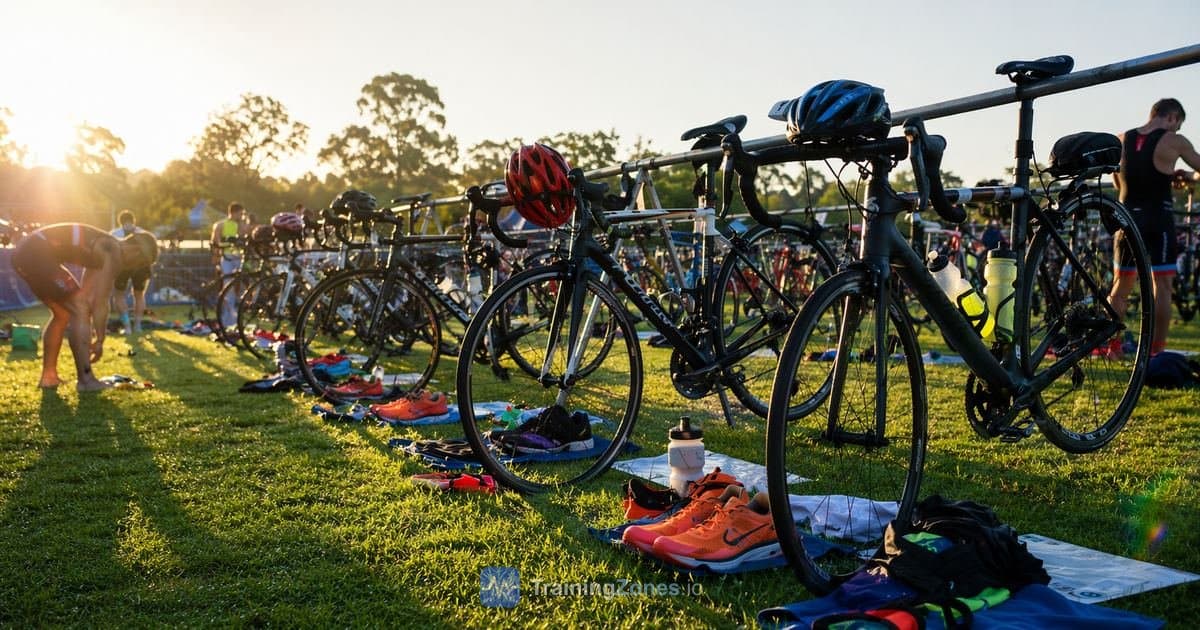
Transitions are the periods between each discipline where you switch gear. There are two transitions in a triathlon, often called the "fourth discipline" because they can make or break your race.
T1 (Swim to Bike):
- Exit the water and run to the transition area
- Remove wetsuit, goggles, and swim cap
- Put on helmet (must be buckled before touching your bike)
- Put on cycling shoes and sunglasses
- Grab your bike and run to the mount line (no riding in transition)
T2 (Bike to Run):
- Dismount at the dismount line (before entering transition)
- Rack your bike in your designated spot
- Remove helmet (only after bike is racked)
- Switch to running shoes
- Grab your race belt and go
Pro tip: Lay out your gear the night before in the exact order you will need it. Use a small towel as your "station" to keep everything organized. Practice transitions at home at least twice before race day.
How Should You Pace Yourself on Race Day?
The biggest mistake first-time triathletes make is starting too fast. Adrenaline kicks in at the swim start, you push hard on the bike because it feels easy, and then your legs turn to jelly on the run.
Pacing strategy for your first sprint triathlon:
- Swim: Start at 70% effort. Find your rhythm in the first 200 meters, then settle into a sustainable pace. Save energy for the bike.
- Bike: Ride at a steady, moderate effort (RPE 5-6 out of 10). Resist the urge to chase faster riders. You need your legs for the run.
- Run: The first kilometer will feel awful because of the bike-to-run transition (your legs are confused). Walk for 30 seconds if needed, then ease into a jog. Gradually build pace in the second half.
Use the free TrainingZones.io tools to plan your race: the Triathlon Race Time Calculator to estimate your finish time based on your current fitness level, and the Race Nutrition Planner to dial in your fueling strategy.
What Should You Eat Before and During a Triathlon?
Nutrition can make or break your race. For a sprint triathlon lasting 1 to 2 hours, you do not need complex fueling strategies, but you do need to get the basics right.
The day before:
- Eat a normal, balanced dinner with carbohydrates (pasta, rice, potatoes)
- Hydrate well throughout the day
- Avoid trying new foods or heavy, fatty meals
Race morning (2 to 3 hours before start):
- Light breakfast: oatmeal with banana, toast with peanut butter, or a bagel with jam
- Drink 500 ml of water with a pinch of salt
- Avoid high-fiber foods (they cause stomach issues during exercise)
During the race:
- Sprint distance: water on the bike is usually enough
- Take a few sips at every aid station on the run
- If it is hot (above 25°C), add electrolytes to your bike bottle
Plan your race nutrition in detail with our Race Nutrition Planner.
What Are the Most Common Beginner Triathlon Mistakes?
Learning from other people's mistakes is the fastest way to have a good first race. Here are the errors that trip up most first-time triathletes.
- Going out too fast in the swim. Start at the back, find your rhythm, and gradually move up if you feel good.
- Not practicing transitions. You do not want to figure out T1 and T2 for the first time on race morning.
- Forgetting to buckle the helmet. You will be disqualified instantly. Helmet on and buckled before you touch your bike, helmet off only after the bike is racked.
- Skipping brick sessions. Running off the bike feels completely different from a standalone run. Your legs need to experience it at least twice before race day.
- Wearing brand new gear on race day. New shoes, new tri suit, new goggles: all of these can cause blisters, chafing, or discomfort. Race in what you trained in.
- Ignoring hydration. Even for a 1 to 2 hour race, dehydration hurts performance. Drink on the bike.
- Comparing yourself to others. Your only competition is the finish line. Experienced athletes on $5,000 bikes are irrelevant to your race.
- Not having fun. You are doing something incredible. Smile, high-five the volunteers, and enjoy every moment.
What Happens on Race Day? A Timeline From Morning to Finish Line
Race day nerves are normal. Having a clear timeline eliminates surprises and helps you stay calm. Here is what a typical sprint triathlon morning looks like.
3 hours before start: Wake up, eat your pre-race breakfast, drink water.
2 hours before: Arrive at the venue. Pick up your race packet (bib number, swim cap, timing chip) if you have not done so the day before.
90 minutes before: Set up your transition area. Rack your bike, lay out your gear in order. Walk through the transition to memorize entry and exit points.
60 minutes before: Put on your wetsuit (if applicable). Do a short warm-up swim of 5 to 10 minutes.
30 minutes before: Use the restroom. Do a light jog and dynamic stretches. Listen to the race briefing.
5 minutes before: Line up at the swim start. Take deep breaths. Remember: you trained for this.
During the race: Follow your pacing plan. Swim steady, bike smart, run strong. Take water at every aid station.
After the finish: Collect your medal, drink, eat, and celebrate. You are now a triathlete.
TrainingZones.io has all the calculators you need to prepare your first triathlon: from estimating your race time to planning your training zones and swim pace.
Frequently Asked Questions About Beginner Triathlon Training
How long does it take to train for your first triathlon?
Most beginner triathlon training plans are 8 to 12 weeks long. With 3 to 5 hours of training per week, you can go from basic fitness to sprint triathlon ready in about 12 weeks. If you are already active in one sport (running or cycling), 8 weeks may be sufficient.
Can I do a triathlon if I cannot swim well?
Yes, but you need to be able to swim 750 meters without stopping before race day. Most sprint triathlons allow any stroke, so you can use breaststroke if front crawl is not comfortable yet. Consider taking a few swimming lessons to improve your technique and build confidence.
Do I need a road bike or can I use a mountain bike?
You can use any bike in safe working condition for your first triathlon, including a mountain bike, hybrid, or old road bike. A road bike is faster but not required. Many first-time triathletes complete their race on hybrid bikes. Lock out the suspension if you use a mountain bike to avoid wasting energy.
How much does it cost to enter a triathlon?
Sprint triathlon entry fees typically range from $50 to $150 depending on the event and location. Combined with basic gear (goggles, helmet, running shoes), you can get started for under $300 total if you already own a bike. National federation membership may be required in some countries.
What is a triathlon transition and how does it work?
A transition is the area where you switch between disciplines. T1 is the swim-to-bike transition and T2 is the bike-to-run transition. Your gear is set up in a designated spot in the transition area before the race. You run to your spot, change gear, and head out for the next leg.
How many hours per week should I train for a sprint triathlon?
Beginners should train 3 to 5 hours per week across 4 to 6 sessions. A typical week includes 2 swim sessions (30 minutes each), 1 to 2 bike rides (45 to 60 minutes), and 2 runs (25 to 35 minutes). Rest days are essential for recovery and adaptation.
References
- Migliorini, S. (2020). Triathlon Training and Injury Prevention. Sports Medicine and Arthroscopy Review, 28(1):e1-e6.
- Vleck, V. et al. (2014). Pacing during an elite Olympic distance triathlon. International Journal of Sports Medicine, 29(3):199-205.
- Bentley, D. et al. (2008). Specific aspects of contemporary triathlon. Sports Medicine, 38(7):587-607.