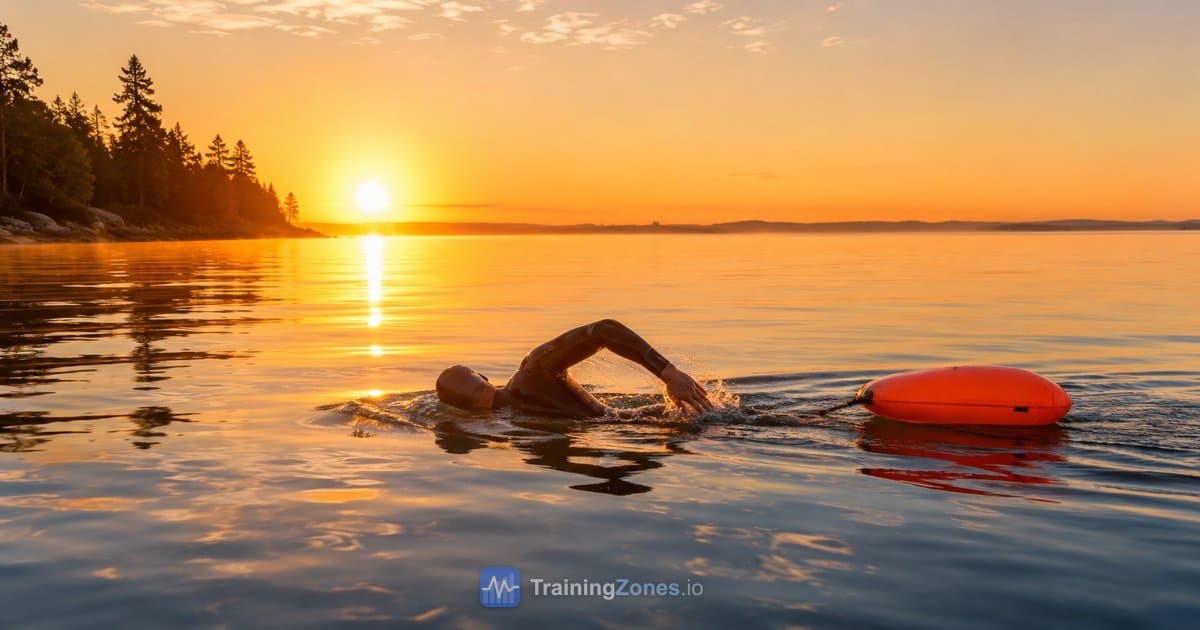
What is open water swimming?
Open water swimming is swimming in natural water like lakes, rivers, or the sea, instead of a pool. It throws challenges at you that the pool never does: no walls to push off, no black line to follow, plus waves, currents, cold, and the small matter of swimming in a straight line. Master a few skills and it becomes the best part of your week.
The good news? You don't need perfect technique. Open water swimming rewards calm breathing, smart navigation, and steady pacing far more than a textbook stroke. At TrainingZones.io we break it down into three skills you can actually practice: choosing a wetsuit, sighting, and pacing.
Open Water Skills
Wetsuit, sighting and pace, in one tool
Cool water
A wetsuit is recommended for most swimmers.
Suggested thickness: 3-4 mm
Triathlons usually require a wetsuit below ~16°C and ban it above ~24°C.
Most pool swimmers feel a jolt of panic on their first open water swim. That's normal. The water's darker, colder, and you can't see the bottom. Everything below is about turning that panic into control.
How to start open water swimming safely
To start open water swimming safely, never swim alone, pick a supervised or known spot, get in slowly to adapt to the cold, and stay close to shore until you're comfortable. Safety first, performance later.
Here's how to ease into it:
- Find a lifeguarded lake, a swim club, or a buddy. Never swim alone, this is the one non-negotiable rule.
- Wade in slowly and splash water on your face and neck so your body adapts to the cold before you submerge.
- Start with short loops parallel to the shore, where you can stand up if you need to.
- Practice putting your face in and breathing calmly before you try to swim hard.
- Use a brightly colored tow float so boats and paddlers can see you (it also gives you something to grab).
- Build distance gradually over several sessions, not all at once.
Cold water shock is the real danger, not fatigue. Getting in slowly and keeping your first swims short is what keeps you safe.
Sighting: how to swim straight in open water
Sighting is the skill of lifting your eyes just above the waterline to check your direction, and it's what keeps you swimming straight without a black line to follow. The classic method is called "alligator eyes."
Do it like this:
- Every 5 to 10 strokes, lift your head forward just enough to get your goggles above the surface.
- Keep your nose and mouth in the water (alligator eyes), so you don't lift too high and sink your hips.
- Take a quick snapshot of a fixed landmark: a buoy, a tree, a building.
- Drop your head back down and breathe to the side on the next stroke.
The less often you sight, the more you drift, and drifting adds distance you didn't sign up for. New swimmers usually sight too rarely. Try the sighting tab in the tool above to see how much extra distance poor navigation costs you.
Breathing and staying calm
The number one open water swimming skill is relaxed breathing, because panic, not lack of fitness, is what ends most first swims. Slow your breathing down and everything else falls into place.
If you feel anxious, roll onto your back and float for a few seconds. Bilateral breathing (every 3 strokes) helps you see both sides and adapt to chop coming from either direction. On rougher days, breathe away from the waves. Honestly, most beginners overthink the stroke and underthink the breathing, get the breathing calm and the rest follows.
Do you need a wetsuit for open water swimming?
You need a wetsuit when the water is cold, roughly below 20°C, for warmth and buoyancy, and many triathlons require one below about 16°C. Above 24°C, races usually ban wetsuits because they make you too warm and too fast.
A wetsuit does two big things: it keeps you warm, and it lifts your hips and legs so you float higher and swim with less effort. For nervous beginners, that extra buoyancy alone is worth it. Use the wetsuit tab in the tool above to see what's recommended for your water temperature.
How to choose an open water wetsuit
Choose a wetsuit that fits snugly without restricting your shoulders, with the right thickness for your water temperature and the right sleeve style for your comfort. Fit matters more than brand.
What to look for:
- Fit: snug everywhere, no gaps at the neck or lower back where water pools. A loose suit drags and chafes.
- Thickness: thicker neoprene (4-5 mm) means more warmth and float; thinner (2-3 mm) means more flexibility.
- Sleeves: full-sleeve for warmth, sleeveless if you want more feel for the catch on your forearms.
- Chafe protection: apply anti-chafe cream to the neck, armpits, and inner thighs before every swim.
Our pick: the Zone3 wetsuit range is a reliable starting point for triathletes and open water swimmers, with options across temperatures and budgets.
Pool vs open water: why you swim slower
Most swimmers are 5 to 15% slower in open water than in the pool, mostly because of sighting, chop, currents, and no walls to push off. So don't panic when your watch shows a slower pace, it's expected.
Sighting alone costs time: every time you lift your head, your hips drop and you slow down. Add drafting (or the lack of it), wetsuit drag, and a wavy line, and the gap makes sense. To turn your pool numbers into a realistic open water target, run them through our swim time predictor, and check your training paces with our critical swim speed calculator.
Open water swimming tips for beginners
The best beginner tip is to practice the skills (sighting, calm breathing, wetsuit comfort) in calm, shallow water before you ever race or swim far. Confidence is built, not found.
A few quick wins:
- Get a brightly colored swim cap and tow float for visibility and safety.
- Defog your goggles, and use tinted lenses for sunny days so you can sight without squinting.
- Swim with people slightly faster than you to practice staying calm in churn.
- Warm up on land if the water is cold, you'll handle the entry better.
At TrainingZones.io we always say the same thing: nail the basics in friendly conditions, and open water stops being scary and starts being addictive.
Frequently Asked Questions About Open Water Swimming
Do you need a wetsuit for open water swimming?
You need a wetsuit when the water is cold, roughly below 20°C, for warmth and buoyancy. Many triathlons make wetsuits mandatory below about 16°C and ban them above roughly 24°C. In warm water you can swim safely without one.
How cold is too cold for open water swimming?
Below about 12°C is genuinely cold and risky for inexperienced swimmers, mainly because of cold water shock. With a wetsuit and slow acclimatisation, trained swimmers handle colder water, but always get in gradually and keep early cold swims short.
How do you sight in open water swimming?
Sighting means lifting your goggles just above the surface (alligator eyes) every 5 to 10 strokes to spot a fixed landmark, then dropping your head and breathing to the side. It keeps you swimming straight without a pool line to follow.
How long does it take to swim a mile in open water?
For most recreational swimmers, a mile (1.6 km) in open water takes 35 to 50 minutes, depending on fitness, conditions, and navigation. It's usually a few minutes slower than the same distance in a pool.
How much slower is open water swimming than the pool?
Most swimmers are 5 to 15% slower in open water than in a pool. The slowdown comes from sighting, waves, currents, and no walls to push off. Use our swim time predictor to estimate your own open water pace.
How do I start open water swimming as a beginner?
Start by swimming with a buddy or a club at a safe, known spot, get in slowly to adapt to the cold, and stay close to shore. Practice sighting and calm breathing in shallow water before building distance gradually.
References
- Tipton, M. J., et al. (2017). Cold water immersion: kill or cure? Experimental Physiology, 102(11):1335-1355.
- Royal Life Saving Society UK (2023). Open Water Safety Guidance.
- U.S. Masters Swimming (2023). Open Water Swimming Guide.