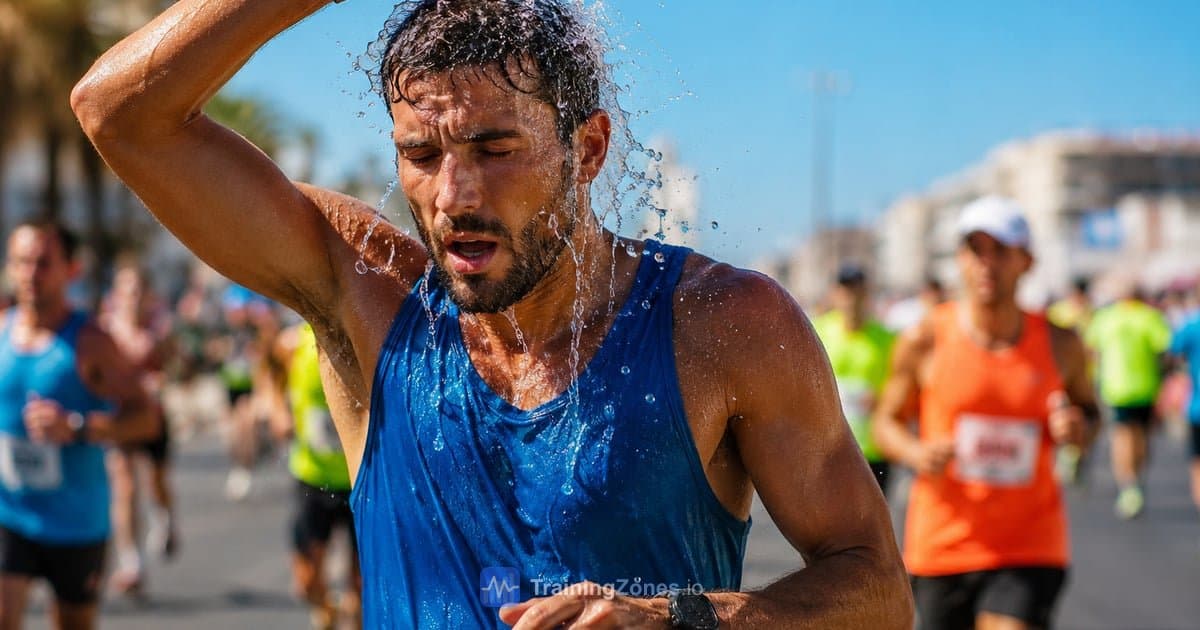
How much slower should you run in the heat?
How much you slow down in the heat depends more on humidity than on temperature. On a warm but dry day you might barely notice it; on a hot, sticky one you can lose 10 to 15 percent of your pace or more. The best single number to check is the dew point, a simple gauge of how muggy the air is: the higher it climbs, the harder it is for your sweat to cool you.
As a rough guide, expect about 1 percent slower at a 55 to 60 F dew point, 2 to 3 percent at 60 to 65 F, 3 to 5 percent at 65 to 70 F, 5 to 8 percent at 70 to 75 F, and a brutal 12 to 15 percent once it passes 75 F.
Above an 80 F dew point, forget pace targets and just run by feel. The calculator below also shows a heat-stress score called WBGT (short for Wet Bulb Globe Temperature) that blends temperature, humidity, and sun into a single number, which we unpack further down.
That widget does the math for you, but it's worth understanding what it's actually adjusting for. Air temperature alone is a poor predictor of how badly a run in hot weather will go.
Dew point (the temperature at which air becomes saturated with moisture) tells you how much water vapor is already sitting in the air around you, and that number, more than the thermometer reading, decides how efficiently you can cool yourself. A 30 degree C day with a low dew point can feel almost manageable; a 27 degree C day with a high dew point can wreck an easy run.
And here's the part a lot of runners get wrong: the slowdown from running in heat isn't distributed evenly. Ely et al. (2007) found that at the marathon distance, elite runners lose only about 0.9% of pace per 5 degrees C of WBGT, while mid-pack runners lose closer to 3.2% per 5 degrees C, more than three times as much.
Why? Slower runners spend longer on the course accumulating heat stress, and they typically carry a higher body mass to surface area ratio, which makes cooling less efficient. So if you're using a training partner's "just slow down 5%" rule of thumb and you're not an elite, you're probably still going too fast.
Treat every number here as an estimate, not gospel; heat tolerance varies by individual, by fitness level, and by how acclimatized you already are. If you're building toward a specific finish time, it's worth pairing this with the pace calculator or the race pace calculator so you know what your cool-weather baseline actually is before you apply a heat adjustment on top of it.
Punch in your goal pace there first, then let the heat tool tell you what that same effort actually looks like once you factor in dew point.
A classic beginner mistake is picking a training-log pace from a cool October morning and trying to hold it on a sticky July afternoon. It isn't a fitness problem, it's a physics problem: your body simply cannot dump heat as fast when the surrounding air is already saturated, so something has to give, and it should be your pace, not your health.
At TrainingZones.io, we built this heat pace tool specifically because generic "just go slower" advice isn't useful when you're standing on a start line trying to pick an actual number.
Why does humidity slow you down more than temperature?
Humidity slows you down more than temperature because sweat only cools you when it evaporates, and humid air blocks evaporation. In dry conditions a large share of the sweat on your skin turns to vapor and pulls heat away with it; in humid air, much of that sweat just drips off uselessly, so your core temperature keeps climbing and your pace has to drop to compensate.
This is the mechanism people miss when they check "temperature" and ignore "feels like." Sweating is your body's primary cooling system on a run; it's essentially evaporative air conditioning powered by your fluid reserves.
When the surrounding air is already saturated with moisture, there's nowhere for that sweat vapor to go, so the cooling effect collapses even though you're sweating just as much, or more, than on a dry day.
Dew point is the single best number to check before a hot run because it reflects the absolute amount of moisture in the air, not a relative percentage that shifts with temperature.
Two 30 degree C days can feel completely different: one at 40% relative humidity might be perfectly runnable, the other at 80% relative humidity will feel brutal, even though the thermometer reads identical. Relative humidity alone is misleading because the same percentage means different things at different temperatures.
That's why coaches and exercise scientists increasingly talk about WBGT instead of either number alone. Wet Bulb Globe Temperature combines air temperature, humidity, and radiant heat from the sun into a single heat-stress figure, and it's the standard used by sports medicine bodies to set go or no-go thresholds for endurance events.
It was originally developed for military and industrial settings where heat casualties were a real operational problem, which tells you something about how seriously it should be taken on a race course too. We'll come back to those specific WBGT flags shortly, because they matter more for your safety than for your pace.
What does running in the heat do to your body?
Running in the heat forces your body to do two demanding jobs with the same blood supply at once: cool your skin and fuel your working muscles. Blood gets diverted toward the skin to shed heat, which means less is available for the muscles, so your heart has to work harder just to maintain the same pace, and that extra strain builds gradually over the course of a run rather than hitting you all at once.
This shows up as cardiac drift: at a fixed pace, your heart rate can climb by roughly 1 beat per minute for every 1 degree C that WBGT sits above 15, even though your actual effort output hasn't changed. That's a big reason a run that felt like an easy zone 2 effort in spring suddenly reads as zone 3 in July, and it's exactly why "just keep your heart rate in zone 2" stops being reliable advice once summer arrives.
At TrainingZones.io, we'd recommend revisiting your heart rate zones periodically through the summer rather than assuming last month's numbers still apply, because heat-inflated heart rate isn't the same signal as genuine fitness loss, and treating it that way is a fast route to overtraining.
There's also a fluid-shift response worth knowing about, even briefly: heat exposure triggers an expansion of blood plasma volume, typically by around 10 to 25%, with roughly two-thirds of that expansion showing up within the first 24 hours of heat exposure. It tends to peak around days 3 to 5 and then partially decays by days 8 to 14 if the heat stimulus isn't sustained, so it's a genuinely transient adaptation, not something that locks in permanently after one hot week.
This is a deep topic on its own, and we're building a dedicated heat acclimatization guide that walks through the full protocol; for now, the takeaway is simply that your body does adapt, just not instantly and not forever without upkeep.
When is the best time to run in hot weather?
The best time to run in hot weather is early morning around dawn, or shortly after sunset, because both air temperature and solar radiation are at their lowest point of the day, which pushes WBGT to its daily minimum. Avoid the window roughly between 11am and 4pm, when direct sun adds a significant radiant-heat load on top of whatever the thermometer says.
Here's the detail that trips people up: relative humidity is actually at its highest right around dawn, not its lowest. If you only looked at a humidity percentage, dawn would look like the worst possible time to run.
But dew point, remember, stays fairly constant across the day; it's temperature and direct sun exposure that swing the most. So the reason dawn works isn't lower humidity, it's lower temperature and no sun beating directly on your skin. That's the actual lever you're pulling when you move your run earlier.
If dawn isn't realistic for your schedule, look for shade instead. A tree-lined route or a loop that runs past buildings casting shadow can meaningfully cut your radiant heat load even at a less-than-ideal hour, and for a lot of runners that's a more practical fix than rearranging the whole day around a 5am alarm.
Treadmill and indoor sessions are also a perfectly legitimate option on the worst days, and there's no shame in swapping a scheduled outdoor tempo run for an air-conditioned one when the WBGT forecast is ugly. Nobody looks back at a summer of training and wishes they'd toughed out more sessions in dangerous heat; they wish they'd banked the fitness safely and shown up healthy on race day.
How to dress and stay cool running in the heat?
How you dress and cool yourself during a hot run genuinely changes how it feels and how fast you can sustain effort. The goal is to help your body do the two things it's already trying to do: shed heat through evaporation, and avoid absorbing extra heat from the sun in the first place. None of this is complicated or expensive, it's mostly small habits stacked together.
- Wear light-colored, loose-fitting technical fabric that wicks moisture away from your skin. Skip cotton entirely; it holds sweat against you instead of letting it evaporate.
- Wear a cap or visor you can soak at a fountain or hose, and pour water over your head, neck, and wrists whenever you get the chance. These are areas with blood vessels close to the surface, so cooling them cools you fast.
- Carry ice where you reasonably can, tucked in a cap, held in your hand, or packed into a bandana around your neck. Cooling the neck and face feels disproportionately good relative to how little ice it actually takes.
- Try a menthol spray or a quick mouth rinse for a cooling sensation. Menthol activates cold-sensing TRPM8 receptors on your skin and tongue, so you feel cooler almost instantly, even though it doesn't actually lower your core temperature. It's a perception tool, not a physiological one, but perception matters when you're deciding how hard you can push.
- For races, consider pre-cooling in the 30 minutes before the start: an ice slurry drink or a cold beverage can lower your core temperature by roughly 0.4 to 0.7 degrees C before you even start moving, which buys you real time before you hit your overheating threshold.
- Start conservatively and begin cooling early, before you feel overheated, not after. Once your core temperature has climbed, it's much harder to bring back down mid-run than it is to prevent in the first place.
Our pick: a dedicated cooling towel for running is one of the cheapest, most effective additions to a hot-weather kit. Soak it, wring it out, and drape it around your neck before or during a run for near-instant relief.
At TrainingZones.io, we treat cooling gear as part of the pacing plan, not an afterthought. Fluid loss also spikes when you're running hot, and dressing smart only solves half the problem. Pairing your cooling strategy with an actual estimate of how much you sweat, using the sweat rate calculator, gives you a realistic number to plan around instead of guessing at the aid station.
When should you stop chasing pace and run by effort?
You should stop chasing a pace target and switch to running by effort once conditions cross into the Red or Black WBGT flag zones used by sports medicine guidelines. Below that, pace adjustments are usually enough; above it, holding a fixed pace becomes actively risky.
The American College of Sports Medicine's position stand on exertional heat illness (Armstrong et al., 2007) outlines flag thresholds that most race organizers and coaches still use today:
- Green, WBGT below 18C (about 65F): normal training and racing conditions.
- Yellow, WBGT 18 to 23C (about 65 to 73F): increased caution, especially for less-acclimatized runners.
- Red, WBGT 23 to 28C (about 73 to 82F): back off intensity and shift to effort-based pacing rather than a fixed target.
- Black, WBGT above 28C (about 82F): cancel hard continuous efforts; this isn't a day to chase a workout.
Keep in mind that the WBGT estimate our calculator, and most weather-based tools, gives you is exactly that, an estimate, built from regional weather data rather than a sensor standing on your actual route. A parking lot start line with no shade and a lot of reflective asphalt can run noticeably hotter than the forecast station a few miles away, so use the estimate as a strong guide, not a precise instrument, and adjust further based on direct sun exposure, humidity spikes, or how you're genuinely feeling that day.
At TrainingZones.io, we'd rather you finish a hot run slow and safe than fast and in trouble; there's always another race.
It's also worth knowing, briefly, what you're watching for if things go wrong. Heat exhaustion feels like dizziness, nausea, clamminess, and unusually heavy legs; the response is to stop, get to shade, cool down, and sip fluids.
Exertional heat stroke is a medical emergency, and the decisive sign isn't the thermometer, it's central nervous system dysfunction: confusion, disorientation, or collapse, typically alongside a very high core temperature commonly cited as above 40C (104F) by ACSM or above 40.5C (105F) by NATA.
Don't wait for a tidy progression of symptoms to confirm it; heat stroke can strike suddenly with little warning, so if you or someone near you shows brain-function signs in the heat, stop, start cooling immediately, and call emergency services. We go deeper into recognizing and preventing this in our heat safety guide (coming soon).
How do you hydrate when running in the heat?
Hydrate by drinking to thirst and replacing roughly what you've actually lost, not by forcing down a fixed volume every mile. Overdrinking plain water during a long hot run is a real risk, not a theoretical one; it can dilute the sodium in your blood and cause hyponatremia, which is genuinely more dangerous than moderate dehydration.
On long or particularly hot efforts, add sodium to what you're drinking rather than relying on water alone; plain water alone replaces volume but not what you're actually losing in sweat. The easiest way to plan this properly is to figure out your actual fluid loss with the sweat rate calculator: weigh yourself before and after a representative run, account for what you drank, and you'll have a real number instead of a guess pulled from a generic chart.
We cover the full picture, sodium targets, gut tolerance, timing, in our hydration and electrolytes guide, but the calculator alone will get most runners most of the way there. At TrainingZones.io, hydration and pacing go hand in hand, especially once the dew point starts climbing, so treat the two as one plan rather than two separate decisions.
Frequently Asked Questions About Running in the Heat
How much slower should you run in the heat?
It depends mainly on dew point, not air temperature: roughly 1% slower around a 55 to 60F dew point, climbing to 12 to 15% slower once dew point passes 75F. Slower runners lose proportionally more than faster ones, so treat any percentage as a starting estimate and adjust to how you actually feel that day.
Is it safe to run in hot weather?
Yes, for most healthy runners, as long as you adjust pace, hydrate sensibly, and know the warning signs of heat exhaustion and heat stroke. It becomes genuinely risky once WBGT climbs into the Red or Black flag range, particularly for runners who aren't yet heat-acclimatized.
How long does it take to get used to running in the heat?
Meaningful heat acclimatization begins within the first few days of consistent heat exposure and continues building over roughly one to two weeks. Some adaptations, like the early rise in plasma volume, show up within 24 hours, while others take longer and fade if the heat stimulus isn't maintained.
What should you wear for running in hot weather?
Light-colored, loose, moisture-wicking technical fabric, never cotton, plus a cap or visor you can soak with water. Beyond clothing, small additions like ice in a bandana or a cooling towel around your neck make a bigger difference than most runners expect.
What is the best time of day to run in the summer?
Early morning around dawn or shortly after sunset, when air temperature and solar radiation are both at their daily lowest. Avoid the late morning through mid-afternoon window, roughly 11am to 4pm, when direct sun adds a significant heat load on top of the air temperature alone.
Does running in the heat make you fitter?
It clearly makes you fitter for running in the heat: your plasma volume expands, your sweat response improves, and your heart doesn't have to work as hard at a given pace. Whether that heat training also makes you faster in cool weather is a more debated claim, and it hasn't been reliably replicated across studies, so don't count on it as your main strategy for a cool-weather goal race.
References
Ely MR et al. (2007). Impact of weather on marathon-running performance. Med Sci Sports Exerc, 39(3):487-493.
Periard JD, Racinais S, Sawka MN (2015). Adaptations and mechanisms of human heat acclimation. Scand J Med Sci Sports, 25(S1):20-38.
Armstrong LE et al. (2007). ACSM Position Stand: Exertional Heat Illness. Med Sci Sports Exerc, 39(3):556-572.