What is lactate threshold?
Lactate threshold is the exercise intensity at which lactate starts to build up in your blood faster than your body can clear it. Push harder than this point and lactate accumulates, your breathing gets ragged, and the clock starts ticking on how long you can hold the effort. It's one of the best predictors of endurance performance we have, often better than VO2max.
Most coaches today split it into two points, LT1 and LT2. That split is the whole reason this article exists, because once you understand both, your training zones suddenly make sense. At TrainingZones.io we treat your lactate threshold as the anchor for everything from easy runs to race pace.
Lactate Threshold Visualizer
How LT1 and LT2 split intensity into training zones
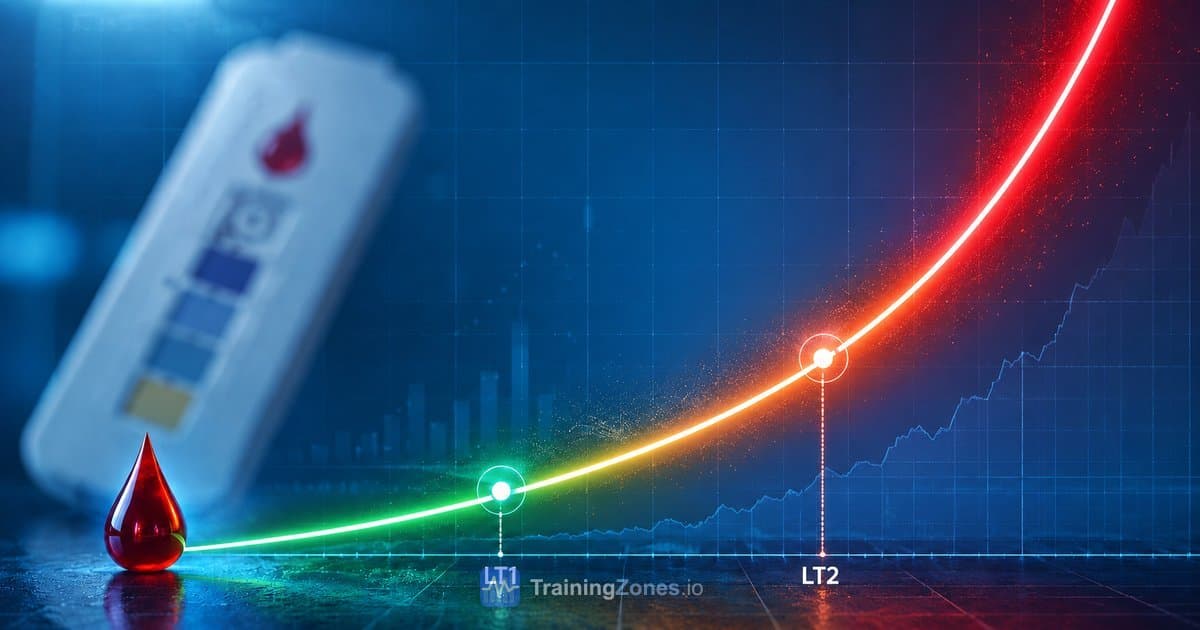
Here's the mental picture. At rest and easy efforts, lactate sits low and steady. Run a bit harder and it nudges up slightly but stays controlled. Keep pushing and at some point it shoots up like a hockey stick. Those two bends in the curve are your two thresholds.
LT1 vs LT2: the two thresholds
LT1 and LT2 are the two points where your blood lactate curve changes shape: LT1 is where lactate first rises above resting levels, and LT2 is where it starts climbing out of control. Everything between them is your "threshold zone."
Quick comparison:
- LT1 (aerobic threshold): around 2 mmol/L of lactate, sits near the top of Zone 2, an all-day comfortable pace, trained with easy aerobic volume.
- LT2 (anaerobic threshold / MLSS): around 4 mmol/L, roughly your one-hour race pace, the hardest effort you can hold in a steady state, trained with tempo runs and cruise intervals.
The thing most people get wrong: these two move independently. You can push LT1 up with months of easy mileage while LT2 barely budges, or sharpen LT2 with tempo work without touching LT1. That's why a smart plan trains both, not just the hard stuff.
What is the aerobic threshold (LT1)?
The aerobic threshold (LT1) is the intensity where blood lactate first creeps above its resting baseline, usually around 2 mmol/L. Below it, you're burning mostly fat and you could keep going for hours. It marks the ceiling of true easy training.
This is the pace that should feel almost too easy. You can hold a full conversation, your breathing is relaxed, and you finish feeling like you could have done more. Most of your weekly volume should sit at or just below LT1, and that's exactly what the polarized model (Seiler) is built around. Train here and you build mitochondria, capillaries, and fat-burning machinery without digging a fatigue hole.
Want to put real numbers on this zone? Map it out with our running training zones calculator so you know the exact pace that keeps you under LT1.
What is the anaerobic threshold (LT2)?
The anaerobic threshold (LT2) is the highest intensity at which lactate production and clearance still balance out, often near 4 mmol/L. It's also called the maximal lactate steady state (MLSS), the highest intensity where blood lactate holds steady instead of climbing. In practice you can hold MLSS for roughly 30 to 45 minutes before fatigue forces you to slow. Go above it and lactate rises relentlessly until you have to back off.
In practice, LT2 is close to the fastest pace you could race for about an hour. It feels "comfortably hard", you can speak only in short phrases, and you're very aware that you couldn't hold it much longer. This is the single most trainable performance marker for most endurance athletes, and raising it directly lets you race faster. According to research compiled at TrainingZones.io, LT2 typically lands around 80 to 90% of maximum heart rate in trained athletes.
How lactate thresholds define your training zones
Your two lactate thresholds carve the whole intensity range into three physiological zones, and that's exactly how most training-zone systems are built. The thresholds aren't just numbers, they mark where your body changes fuel and gears.
- Below LT1: the aerobic zone. Easy, conversational, fuelled mostly by fat. This is Zones 1 to 2 in a 5-zone model.
- Between LT1 and LT2: the threshold zone. Comfortably hard, burning a fat-and-carbohydrate mix. This is roughly Zone 3, tempo.
- Above LT2: the anaerobic zone. Lactate climbs fast and you run almost entirely on carbohydrate. This is Zones 4 to 5, threshold intervals and VO2max work.
That fat-to-carbohydrate shift is why intensity matters so much: the higher you go, the more you lean on limited carbohydrate stores. This is also why TrainingZones.io anchors your zones to your thresholds rather than to a single guessed max heart rate. The thresholds are where your physiology actually shifts, so they make far better zone boundaries than a generic formula.
How to find your lactate threshold
The gold standard is a lab test with finger-prick blood samples, but you can estimate your LT2 heart rate at home with a simple 30-minute time trial. Here's the field test most coaches use (Friel's protocol):
- Warm up easy for 10 to 15 minutes.
- Run, ride, or row a hard, steady 30-minute time trial, alone, as if it were a race.
- Press lap exactly 10 minutes in.
- At the end, take your average heart rate for the final 20 minutes only.
- That average is a solid estimate of your lactate threshold heart rate (LTHR).
- Use that number to set your zones, and retest every 6 to 8 weeks.
A couple of honest caveats. Do it solo, because chasing someone else wrecks the pacing. And go in fresh, not the day after a hammering session. Once you have your LTHR, turn it into proper zones with our heart rate zones calculator, and if you run, cross-check the pace side with our critical speed calculator.
Our pick: for accurate threshold testing you want a real chest strap, not a wrist optical sensor. The Polar H10 is the reference for steady, lab-grade heart rate data during a 30-minute test.
Lactate threshold heart rate and pace
Your lactate threshold heart rate (LTHR) is the heart rate you can sustain right at LT2, and it's the anchor for setting training zones. Pace and power versions exist too, but heart rate is the easiest to measure without a lab.
Once you know your LTHR, the classic zone breakdown (Friel) hangs off it: easy work well below it, tempo just under it, threshold intervals right around it, and VO2max work above. Heart rate has one quirk worth knowing: it drifts upward on long efforts even at the same pace, so don't panic if your threshold HR looks lower on a fresh day than on a hot, tired one.
How to improve your lactate threshold
You improve your lactate threshold mainly by training right around LT2 with tempo runs and cruise intervals, while keeping the bulk of your volume easy below LT1. The two-pronged approach beats hammering hard every session.
What actually moves the needle:
- Tempo / threshold runs: 20 to 40 minutes at or just below LT2. The bread and butter.
- Cruise intervals: repeats of 6 to 12 minutes at LT2 with short rests, which let you spend more total time at threshold.
- Lots of easy volume: builds the aerobic base that supports a higher LT2 and lifts LT1.
- Patience: threshold gains come over weeks and months, not days.
The Norwegian double-threshold method takes this idea to the extreme with two controlled threshold sessions in a single day, keeping lactate around 2 to 3 mmol/L to pack in volume without burning out.
What is a good lactate threshold?
A good lactate threshold is less about the raw lactate number and more about how high a percentage of your VO2max you can sustain at LT2. Trained endurance athletes typically hold LT2 at 80 to 90% of VO2max, while untrained people fade around 60%. The higher that percentage, the faster you race at a given fitness.
Don't get hung up on hitting exactly 4 mmol/L either. That value is an average, and real thresholds vary from person to person. As we always say at TrainingZones.io, the only benchmark that matters is your own LTHR trend over time. If your threshold pace at the same heart rate is getting quicker, you're winning.
Frequently Asked Questions About Lactate Threshold
What is lactate threshold in simple terms?
Lactate threshold is the effort level where lactate piles up in your blood faster than you can clear it. Below it you can keep going a long time; above it, fatigue comes quickly. It's a key marker of endurance fitness.
What is the difference between LT1 and LT2?
LT1 (aerobic threshold) is where lactate first rises slightly above rest, around 2 mmol/L, near the top of easy Zone 2. LT2 (anaerobic threshold) is where lactate climbs out of control, around 4 mmol/L, near one-hour race pace. The gap between them is your threshold zone.
How do I calculate my lactate threshold?
Without a lab, run or ride a hard 30-minute solo time trial and take your average heart rate over the final 20 minutes. That number is a reliable estimate of your lactate threshold heart rate, which you can turn into training zones.
Is lactate threshold the same as zone 4?
Roughly, yes. In most 5-zone systems, LT2 sits at the boundary between zone 3 and zone 4, so threshold work lands in the lower part of zone 4. The exact line depends on which zone model you use.
How long can you run at lactate threshold?
Most trained runners can hold LT2 effort for about 40 to 60 minutes in a race. That's why LT2 is often described as your one-hour pace. In training, you usually break it into shorter tempo blocks or intervals.
Does Garmin measure lactate threshold accurately?
Garmin estimates your lactate threshold heart rate from a guided run using heart rate variability and pace. It's a decent ballpark for tracking trends, but it's an estimate, not a blood test, so treat it as a guide rather than an exact value.
References
- Faude, O., Kindermann, W., & Meyer, T. (2009). Lactate threshold concepts: how valid are they? Sports Medicine, 39(6):469-490.
- Seiler, S. (2010). What is best practice for training intensity and duration distribution in endurance athletes? International Journal of Sports Physiology and Performance, 5(3):276-291.
- Jones, A. M., et al. (2019). The maximal metabolic steady state. Journal of Applied Physiology, 127(2):513-522.