What Is Training Intensity Distribution?
Training intensity distribution is how an athlete divides their total training time across three physiological zones: low intensity (below LT1), moderate intensity (between LT1 and LT2), and high intensity (above LT2). According to Seiler (2010), this distribution matters more than total volume for endurance performance.
Three models dominate the science: pyramidal, polarized, and threshold. Each splits time differently across zones, and choosing the wrong one can mean months of stagnation instead of progress. A fourth approach, double threshold training, has gained momentum thanks to Norwegian distance runners.
TrainingZones.io breaks down each model so you can train smarter, not just harder.
What Are the 3 Physiological Intensity Zones?
Exercise intensity divides into three domains based on two lactate thresholds, LT1 and LT2 (Seiler & Kjerland, 2006). Every training model uses these same boundaries, only the time spent in each zone differs.
- Zone 1 (below LT1) — pure aerobic work. Fat oxidation dominates, breathing is comfortable, conversation flows easily. This is base endurance.
- Zone 2 (LT1 to LT2) — the transition zone where lactate accumulates gradually. Tempo pace, marathon effort. Tiring but sustainable for 30-60 minutes.
- Zone 3 (above LT2) — high intensity. Lactate rises rapidly. VO2max intervals, sprints. Only sustainable for a few minutes.
Training models with 5 or 7 zones (Coggan for cycling, Daniels for running) subdivide these three domains for practical precision, but the underlying physiology remains the same.
Calculate your personal zone boundaries with our Heart Rate Zone Calculator based on your maximum heart rate.
Training Intensity Models Overview
Explore four training approaches and their zone distribution
How Does Pyramidal Training Work?
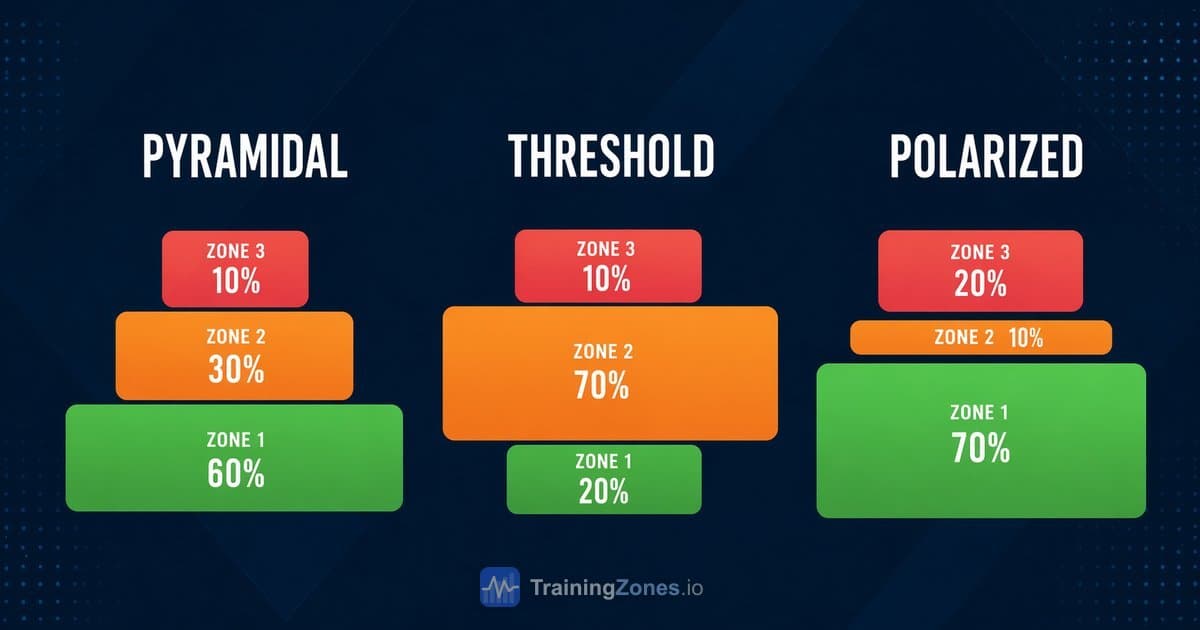
Pyramidal training is the most commonly observed intensity distribution among elite endurance athletes during regular training periods (Esteve-Lanao et al., 2005). The name comes from the pyramid-shaped distribution: most time at low intensity, less at moderate, least at high.
- Zone 1: approximately 75% of training time
- Zone 2: approximately 15%
- Zone 3: approximately 10%
This model builds a strong aerobic foundation while including enough threshold stimulus to drive adaptations. It works best for athletes training 8-15 hours per week who want consistent, sustainable progress without overtraining risk.
The pyramidal approach is particularly effective during the base-building phase of a season. It develops the cardiovascular system, improves fat oxidation, and creates the aerobic engine that all higher-intensity work depends on.
What Is Polarized Training (80/20)?
Polarized training dedicates approximately 80% of training volume to low intensity and 20% to high intensity, with minimal time at moderate intensity near the lactate threshold. Popularized by Stephen Seiler (2010), this model produced the greatest improvements in comparative scientific studies.
- Zone 1: approximately 80% of training time
- Zone 2: approximately 5% only
- Zone 3: approximately 15%
The insight behind polarized training: the tempo zone (between LT1 and LT2) generates significant fatigue for relatively little adaptation. By minimizing it, athletes recover better from hard sessions and accumulate more productive easy volume.
The landmark study by Stöggl & Sperlich (2014) compared four models over 9 weeks in trained athletes. The polarized group showed the greatest improvements in VO2max (+11.7%), time at threshold, and time-trial performance.
This model is especially effective in running, cycling, cross-country skiing, and rowing for intermediate to advanced athletes who can train 8-12+ hours per week. At TrainingZones.io, we recommend the polarized approach as a starting point for athletes looking to structure their intensity distribution based on science.
How Does Threshold Training Work?
Threshold training concentrates a significant portion of training at or near the lactate threshold (Zone 2 in the 3-zone model), aiming to raise the intensity at which lactate begins to accumulate. This is the "sweet spot" zone in cycling and half-marathon pace in running.
- Zone 1: approximately 40% of training time
- Zone 2: approximately 50%
- Zone 3: approximately 10%
For recreational athletes with limited training time (5-8 hours/week), threshold training may be more practical because it delivers results with fewer sessions than the polarized model requires.
Important caveat: according to Stöggl & Sperlich (2014), this model is effective short-term (4-6 weeks) but increases the risk of overtraining and plateau over the medium term. The body adapts to the stimulus and gains stall. Threshold blocks must be alternated with volume phases.
What Is Double Threshold Training?
Double threshold training, popularized by Norwegian distance runners like Jakob Ingebrigtsen, involves two threshold sessions in a single day — typically morning and afternoon — to maximize time at lactate threshold intensity without excessive fatigue from any single session.
A typical double threshold day:
- Morning session: 25-30 minutes at lactate threshold (guided by blood lactate of 2-4 mmol/L)
- Recovery between sessions: 4-6 hours
- Afternoon session: 25-30 minutes at lactate threshold
This approach allows athletes to accumulate 50-60 minutes at threshold in one day while keeping each individual session manageable. The Norwegian team typically performs 2-3 double threshold days per week, with remaining sessions at low intensity.
Double threshold training requires precise intensity control. A GPS watch with lactate threshold estimation like the Garmin Forerunner 265 helps you stay in the right zone without a blood lactate analyzer.
This method is most suited for advanced athletes training 12+ hours per week who already have a strong aerobic base. Learn more about this approach in our Norwegian Method guide.
Which Training Model Is Most Effective?
Training Intensity Distribution
Compare three popular intensity distribution models
⚡ Polarized 80/20: Lots of easy + lots of hard, almost nothing in between. Produced the best improvements in VO2max and time-trial performance (Stöggl & Sperlich 2014).
The TrainingZones.io team has compiled the key findings from the major comparative studies. According to research by Stöggl & Sperlich (2014), polarized training produced the greatest improvements in VO2max and time-trial performance compared to threshold, pyramidal, and high-volume training in trained endurance athletes.
Pyramidal
- Builds the strongest aerobic base
- Lowest overtraining risk
- Best for: base-building phases, 8-15h/week
- Science says: most commonly observed in elite athletes during regular training
Polarized 80/20
- Greatest measured performance gains
- Low overtraining risk despite high intensity
- Best for: breaking plateaus, race preparation, 8-12h/week
- Science says: best results in Stöggl & Sperlich (2014) across all metrics
Threshold
- Most time-efficient per session
- Highest overtraining risk
- Best for: time-crunched athletes, 6-8 week blocks
- Science says: effective short-term, diminishing returns after 6 weeks
Double threshold
- Maximizes threshold adaptation without single-session fatigue
- Requires precise intensity monitoring
- Best for: advanced athletes, 12+h/week
- Science says: used by Norwegian Olympic medalists since 2018
How to Determine Your Lactate Threshold
Knowing your lactate threshold is essential for applying any training model correctly. There are several ways to estimate it without a lab test.
- Use a GPS watch with built-in lactate threshold detection (Garmin, Polar, and COROS all offer this feature)
- Perform a 30-minute field test: run or ride at the hardest effort you can sustain for 30 minutes. Your average heart rate for the last 20 minutes closely approximates your LT2
- Use the talk test: LT1 is roughly where you can no longer hold a comfortable conversation. LT2 is where you can only speak a few words between breaths
- Get a lab-based lactate profile test for maximum accuracy
Once you know your thresholds, use the free TrainingZones.io calculators to get your personalized training zones: our Heart Rate Zone Calculator or our FTP Calculator for cycling.
Our pick for accurate threshold tracking: The Polar H10 chest strap provides lab-grade heart rate accuracy that wrist sensors cannot match, especially above 170 bpm. Essential for precise threshold training.
Which Training Model Should You Choose?
Training Model Recommender
Answer 3 questions to find your ideal training model
Experience Level
Elite endurance athletes, who can train 15-25+ hours per week, benefit most from polarized training because the high volume of easy sessions builds aerobic capacity while intense sessions drive adaptation.
Here are research-backed recommendations by profile:
Just starting? Begin with the pyramidal model. Build your aerobic base with 75% easy volume and some tempo work. This is the foundation everything else depends on.
Hitting a plateau? Switch to polarized. Cut the tempo, increase the intensity of your hard sessions. The science is clear: this is the best approach for breaking through.
Limited time (under 6h/week)? Threshold training works for 6-8 week blocks. Alternate with easy volume weeks to prevent overtraining.
Advanced athlete preparing for a race? Combine polarized distribution with block periodization. Start with an aerobic block, then a threshold block, then race-specific work.
TrainingZones.io offers free calculators for every endurance sport. Use our Running Zones Calculator to get pace-based zones for your runs.
Frequently Asked Questions About Threshold Training
What is threshold training?
Threshold training is a model where approximately 50% of training time is spent at or near the lactate threshold (Zone 2 in the 3-zone model). It raises the intensity at which lactate accumulates, improving endurance performance. It is most effective in short blocks of 4-6 weeks for time-crunched athletes.
What is double threshold training?
Double threshold training involves two lactate threshold sessions in a single day, separated by 4-6 hours of recovery. Popularized by Norwegian runners, it accumulates more threshold stimulus per day without the fatigue of a single long session. It requires precise intensity monitoring and is suited for advanced athletes.
How does the 80/20 rule work in training?
The 80/20 rule, also called polarized training, means spending 80% of training time at low intensity (below LT1) and 20% at high intensity (above LT2), with minimal time in the moderate tempo zone. Stöggl & Sperlich (2014) showed this produces the best VO2max and time-trial improvements.
How can you improve your lactate threshold?
You can raise your lactate threshold through consistent training at or near threshold intensity. Tempo runs of 20-40 minutes, cruise intervals (2x20 min at threshold), and steady-state rides at sweet spot power all target this adaptation. Consistency over 6-12 weeks matters more than any single session.
What is the best training model for beginners?
The pyramidal model is best for beginners: 75% easy volume, 15% moderate, 10% high intensity. It builds aerobic capacity safely, reduces injury risk, and creates the physiological base needed before more intense approaches. Most coaches recommend at least 6-12 months of pyramidal training before trying polarized or threshold models.
Is polarized training better than pyramidal?
In controlled studies, polarized training produced greater performance improvements than pyramidal in trained athletes. However, pyramidal is safer for building the initial aerobic base, and most elite athletes naturally follow a pyramidal distribution during regular training. The best approach is often to periodize between both models throughout the season.
References
- Seiler S (2010). What is Best Practice for Training Intensity and Duration Distribution in Endurance Athletes? Int J Sports Physiol Perform, 5(3):276-291.
- Stöggl T, Sperlich B (2014). Polarized Training Has Greater Impact on Key Endurance Variables than Threshold, High-Intensity, or High-Volume Training. Front Physiol, 5:33.
- Esteve-Lanao J et al. (2005). How Do Endurance Runners Actually Train? Med Sci Sports Exerc, 37(3):496-504.