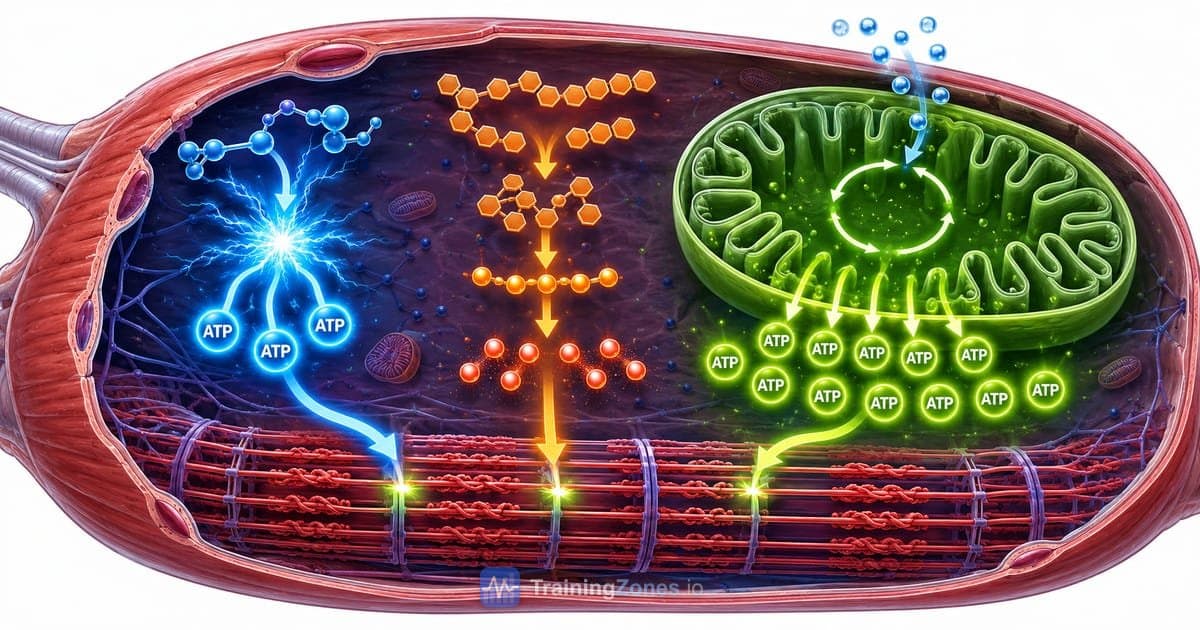
What are the 3 energy systems?
Your body has three energy systems that all do the same job: they rebuild ATP, the molecule your muscles actually spend to contract. The ATP-PC system delivers instant power for a few seconds, the anaerobic system produces fast energy for hard efforts up to about two minutes, and the aerobic system supplies a huge, steady stream of energy for anything longer. They never work alone. All three run at once, and the mix simply shifts with how hard and how long you go.
Here is the part most people miss. Your muscles store barely two or three seconds of ATP at any moment. So the real question is never "where do I get energy" but "how fast can I remake it". Each system is just a different production line for the same product, with its own fuel and its own speed-versus-capacity trade-off. Fast systems run dry quickly. The patient one, the aerobic system, is what endurance training is really about.
Energy Systems Visualizer
See which system fuels your effort, and with what
Energy system contribution
Fuel mix
HR zone
Zone 2 endurance pace. Still fully aerobic, with fat as the main fuel and a bit more carbs.
Play with the slider above and you'll see the logic straight away. Push the intensity up and the fast, anaerobic systems climb. Drop it back to an easy jog and the aerobic system carries almost everything. That single picture explains why a 100 metre sprinter and a marathoner train like they belong to different species. They are feeding completely different production lines. At TrainingZones.io, almost everything we publish, from your training zones to your race pacing, traces back to these three systems.
The ATP-PC system: instant, explosive power
The ATP-PC system (also called the phosphagen or anaerobic alactic system) is your fastest energy source, and it lasts roughly 10 seconds. It uses phosphocreatine, a compound stored right inside the muscle, to recharge ATP almost instantly. No oxygen needed, no waste product, no waiting. This is the system behind a maximal sprint, a heavy lift, a big jump, or the first few strides out of the blocks.
The catch is the tank size. You only store enough phosphocreatine for about 8 to 12 seconds of all-out work, and then it's empty. That's why nobody sprints a 400 metre race at true top speed. The fuel is simply gone. Recovery is quick though. Give it two to three minutes of rest and the tank refills, which is exactly why sprinters and strength athletes take long breaks between efforts.
For endurance athletes this system matters more than you'd think. It's what fires your final kick to the line, your surge over a short climb, or a fast start before you settle into rhythm. You won't build a marathon on it, but you'll want it there when the race gets tactical.
The anaerobic system: fast energy and the lactate burn
The anaerobic system (glycolytic, or anaerobic lactic) breaks down carbohydrate without oxygen to make ATP quickly, and it dominates efforts of roughly 10 seconds to 2 minutes. It's fast, but there's a price. Splitting glucose this way produces only 2 ATP per molecule, and it leaves behind lactate and hydrogen ions. That rising acidity is the burning, heavy-legged feeling you get on a hard 400, a steep hill, or the last lap of a 1500.
A quick myth to kill: "anaerobic" does not mean "without breathing". You're breathing hard the whole time. It just means this particular pathway doesn't use oxygen to make its ATP. And lactate itself isn't the villain people think it is. It's actually a usable fuel your body recycles once oxygen catches up, shuttled to the heart, the liver, and other muscle fibres to be burned. The real limiter is the acidity that piles up alongside it.
The good news is that this system is highly trainable. The fitter you are, the better you clear lactate and the higher the intensity you can hold before it swamps you. Two athletes with the same VO2max can perform very differently simply because one tips into that heavy anaerobic zone later. That's what a lot of quality training is quietly doing: pushing the boundary back, so more of your race stays on the efficient aerobic side.
This is the system you're training with short, sharp intervals. It also sets a very practical boundary: the point where you tip from mostly aerobic into heavy anaerobic territory is your lactate threshold, and it's one of the strongest predictors of endurance performance. If you race on feel or pace, mapping this out helps a lot. You can check where your effort levels sit with our running pace zones calculator, which lines your paces up against these transitions.
The aerobic system: your endurance engine
The aerobic system produces ATP by burning fat and carbohydrate with oxygen, and it powers virtually everything you do beyond about two minutes. It's slow to ramp up compared to the other two, but its capacity is enormous.
Where anaerobic glycolysis squeezes out 2 ATP per glucose, the aerobic system extracts roughly 30 to 32. That efficiency is why you can run for hours on it, and why building it is the whole point of base training. At TrainingZones.io we come back to this system constantly, because for endurance athletes it's the one that decides your ceiling.
The aerobic system also runs on real, physical hardware you can grow. The mitochondria that house the Krebs cycle multiply, and the tiny capillaries that deliver oxygen to your muscles get denser, when you train the system consistently over months. That's the quiet adaptation behind a long base phase, and it's why a well-built aerobic engine keeps paying off for years rather than weeks.
The aerobic system also has a trick the others don't: it can burn fat. Even a lean athlete carries tens of thousands of calories of fat, versus maybe 90 minutes of stored carbohydrate. Teaching your body to lean on fat at easy and moderate paces spares that precious carbohydrate for when you really need it. That's a big reason Zone 2 work is so valued, and why it feels almost too easy while it's quietly rebuilding your engine.
Inside the aerobic system: glycolysis, the Krebs cycle and the electron transport chain
Zoom in and the aerobic system is a three-stage assembly line inside your muscle cells. First, glycolysis breaks glucose down to pyruvate in the cell fluid. When oxygen is available, that pyruvate enters the mitochondria, the cell's power plants, where the real work happens.
Stage two is the Krebs cycle (also called the citric acid cycle), described by Hans Krebs in 1937, work that won him the Nobel Prize in 1953. It's a loop of eight reactions in the mitochondrial matrix that strips electrons off your fuel and loads them onto carrier molecules called NADH and FADH2. The Krebs cycle itself makes very little ATP directly. Its job is to feed those loaded carriers into the final stage.
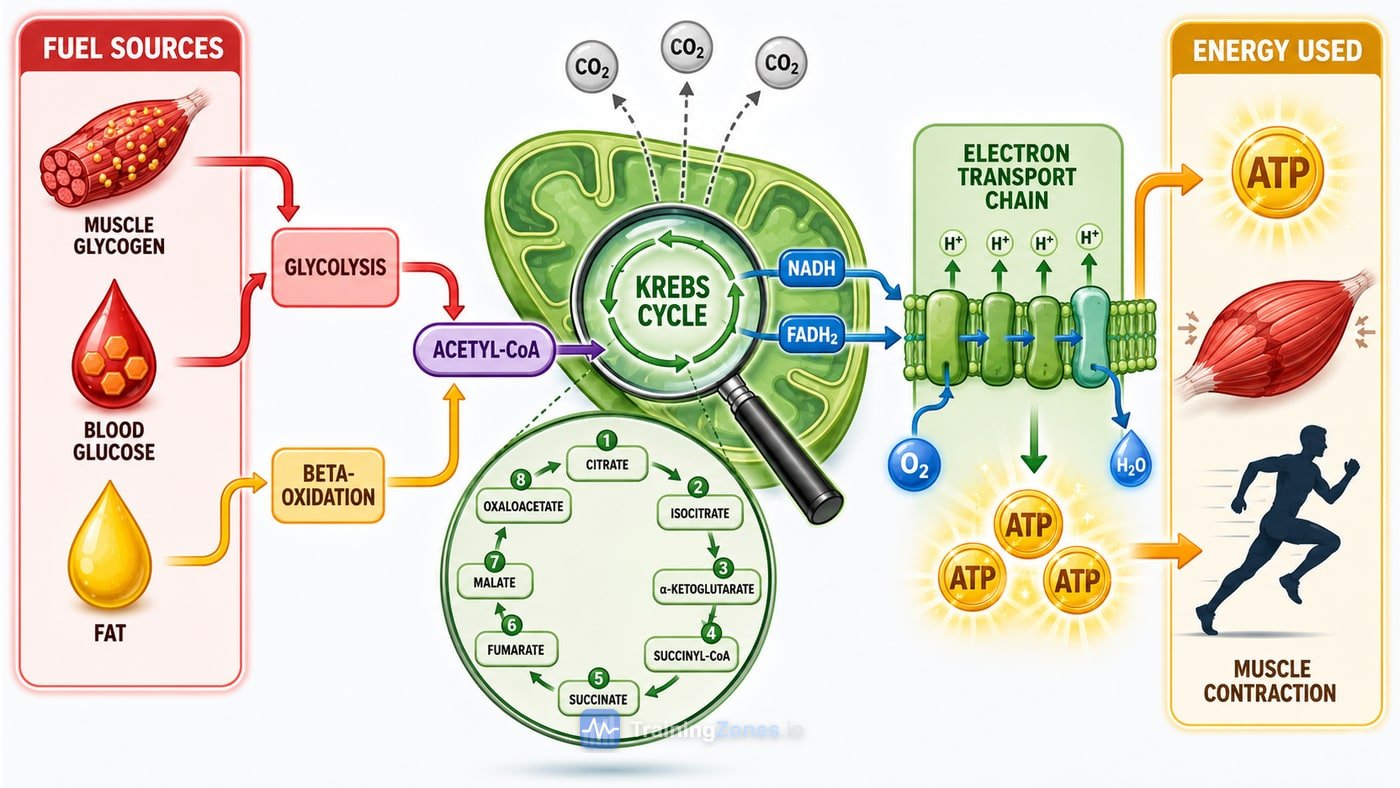
Stage three, the electron transport chain, is where most of your ATP is actually built, using oxygen as the final electron acceptor. This is the real reason the aerobic system needs oxygen. The Krebs cycle can only keep turning if that chain keeps pulling electrons away, and it can only do that with oxygen present. Run out of oxygen and the whole line backs up, forcing you onto anaerobic glycolysis and its lactate.
Fat gets into the same machinery, just through a different door. Your body first releases stored fat and splits it into free fatty acids, a step called lipolysis. Those fatty acids are then chopped into the same acetyl-CoA fragments through a process called beta-oxidation, and they feed straight into the Krebs cycle, right where the carbohydrate pathway also ends up.
That's why coaches say fat burns in the flame of carbohydrate: you need a steady carbohydrate supply to keep the cycle spinning fast enough to oxidise fat.
Fat or carbs: which fuel, at what intensity?
Both fat and carbohydrate feed your aerobic system, and the balance shifts with intensity. At an easy Zone 2 pace you might get 60 to 70 percent of your energy from fat. Push toward threshold and your body swings hard toward carbohydrate, because carbs deliver ATP faster when the pace demands it.
By the time you're at VO2max, you're running almost entirely on carbohydrate. This crossover is one of the most useful ideas in endurance training, and it's exactly what the fuel bar in the visualizer above is showing you.
There's a practical consequence. Glycogen (your stored carbohydrate) runs low after 90 minutes or so of hard effort, and when it does, the Krebs cycle slows and you can't oxidise fat fast enough to keep the pace. That's the physiological wall marathoners hit around 30 kilometres. Training your fat metabolism and fuelling smartly with carbohydrate during long efforts are the two ways around it.
This is what coaches mean by metabolic flexibility: the ability to switch smoothly between fat and carbohydrate as the effort demands, and to lean on fat whenever the pace allows. A flexible athlete spares carbohydrate at easy and moderate paces, then still has some in the tank when the race heats up.
It isn't something you fix in a single week. It responds to patient, consistent aerobic work, and it's one of the clearest markers of a deep endurance base. If your easy pace already feels sustainable for hours, that flexibility is quietly doing its job.
To actually see which system you're in while you train, you need a reliable signal, and heart rate is the most accessible one.
Our pick: the Polar H10 chest strap is the gold standard for accurate, real-time heart rate. It's far steadier than a wrist optical sensor during intervals, which matters when you're trying to hold a specific system in play.
How energy systems differ across running, cycling and swimming
The three energy systems are identical in every sport, but how you feel them and load them changes with the discipline. In running, your body weight is always along for the ride, so the aerobic system carries a huge share of the work and even easy mileage builds it steadily.
In cycling you can freewheel, spike the power on a climb, then recover on the descent, so you dip into the anaerobic system far more often within a single ride. Swimming adds its own twist: the breath-holding and the smaller upper-body muscle mass mean you reach that anaerobic, lactate-heavy zone sooner than your legs ever would on land.
For a triathlete this is a big deal. The same heart rate can sit in a different system depending on the sport, which is exactly why zones are set per discipline rather than shared across all three.
A swimmer leans on the anaerobic system early, a cyclist can bury a short anaerobic effort and then recover, and a runner spends most of a session deep in aerobic territory. Knowing which system a given workout targets, in each sport, is what turns a random pile of sessions into a coherent plan.
How the 3 energy systems map onto your training zones
Your training zones are really a practical map of which energy system dominates at a given effort. Zone 1 and Zone 2 sit firmly in aerobic, fat-burning territory. Zone 3 and Zone 4 sit around your lactate threshold, where the anaerobic contribution climbs. Zone 5 is VO2max work, heavily anaerobic and almost entirely carbohydrate-fuelled. And true sprints sit above all of it, in ATP-PC land.
That mapping is what makes zone-based training so powerful. When you do an easy run, you're deliberately loading the aerobic system so it adapts and grows. When you do a threshold session, you're pushing the boundary between aerobic and anaerobic higher. When you do short, flat-out reps, you're sharpening the anaerobic and ATP-PC systems. Every session is really a targeted stimulus to one production line. On TrainingZones.io we build our tools around exactly this idea.
Here's how that looks in a real week. Your easy runs sit in Zone 2, loading the aerobic system so it grows. A weekly tempo or threshold session nudges the boundary where anaerobic energy takes over. A short set of hill sprints sharpens the ATP-PC and anaerobic systems without piling on fatigue. Three different sessions, three different production lines, one coherent plan. That's the whole philosophy behind the tools at TrainingZones.io: match the session to the system you want to develop.
The simplest way to put it into practice is to know your personal heart rate zones and train inside them on purpose. You can work them out in a minute with our heart rate zones calculator, and for runners who prefer pace, the critical speed calculator pins down the aerobic-anaerobic boundary in your own numbers. Understand your energy systems, then train each one on purpose, and your endurance stops being a mystery and starts being something you can build.
Frequently asked questions about energy systems
What are the 3 energy systems?
The three energy systems are the ATP-PC (phosphagen) system, the anaerobic (glycolytic) system, and the aerobic (oxidative) system. They all produce ATP for muscle contraction, but over different time frames: seconds, minutes, and hours respectively. All three run at the same time, and intensity and duration decide which one supplies most of your energy.
Which energy system is used first during exercise?
The ATP-PC system is used first. It taps stored phosphocreatine to regenerate ATP instantly, with no oxygen and no lactate, and it powers roughly the first 10 seconds of all-out effort. As it fades, the anaerobic system takes over, and beyond about two minutes the aerobic system becomes dominant.
Is running aerobic or anaerobic?
Running is mostly aerobic once you go beyond a couple of minutes, which covers everything from a 5K to a marathon. Short, fast efforts like a 100 or 400 metre sprint are largely anaerobic. In practice you're always using a blend, and the faster you run, the more you shift from the aerobic toward the anaerobic side.
How long does the ATP-PC system last?
The ATP-PC system lasts roughly 8 to 12 seconds of maximal effort before its phosphocreatine stores are depleted. It refills within about two to three minutes of rest, which is why sprinters and strength athletes take long recoveries between reps.
What is the difference between aerobic and anaerobic energy?
The aerobic system uses oxygen to burn fat and carbohydrate, producing about 30 to 32 ATP per glucose slowly and sustainably. The anaerobic system makes ATP from carbohydrate without oxygen, producing only 2 ATP per glucose but very quickly, at the cost of lactate and acidity that force you to slow down.
Which energy system burns the most fat?
The aerobic system is the only one that burns fat, and it does so most at low to moderate intensities like Zone 2. At easy paces fat can supply 60 to 70 percent of your energy. As intensity rises, your body shifts toward carbohydrate because it delivers ATP faster.
References
- Gastin, P.B. (2001). Energy system interaction and relative contribution during maximal exercise. Sports Medicine, 31(10):725-741.
- McArdle, W.D., Katch, F.I., Katch, V.L. (2015). Exercise Physiology: Nutrition, Energy, and Human Performance, 8th ed. Wolters Kluwer.
- Nelson, D.L., Cox, M.M. (2017). Lehninger Principles of Biochemistry, 7th ed. W.H. Freeman.