What is VO2max and why does it matter for endurance athletes?
VO2max is the maximum volume of oxygen your body can absorb, transport, and use during intense exercise, measured in milliliters per kilogram of body weight per minute (mL/kg/min). It is widely considered the single best indicator of cardiovascular fitness and aerobic endurance capacity.
Think of VO2max as the size of your aerobic engine. A car with a bigger engine can produce more horsepower. An athlete with a higher VO2max can deliver more oxygen to working muscles, produce more energy aerobically, and sustain higher intensities before fatigue sets in. According to Bassett and Howley (2000), VO2max is one of the primary limiting factors for endurance performance, alongside lactate threshold and running economy.
There are two ways to express VO2max. Absolute VO2max is measured in liters per minute (L/min) and represents the total volume of oxygen consumed, regardless of body size. A 90 kg rower and a 55 kg runner might have similar absolute values. Relative VO2max is measured in mL/kg/min and normalizes for body weight, making it the standard for comparing fitness across individuals. When someone says "my VO2max is 55," they mean 55 mL/kg/min.
Elite endurance athletes reach extraordinary values. Male elite cyclists and cross-country skiers often measure between 75 and 85 mL/kg/min. Female world-class athletes typically range from 65 to 75 mL/kg/min. The highest ever recorded VO2max belongs to cyclist Oskar Svendsen at 97.5 mL/kg/min. For context, an untrained 30-year-old man averages around 35-40 mL/kg/min.
At TrainingZones.io, we use VO2max as a cornerstone metric because it connects directly to your training zones, your VMA (Maximal Aerobic Speed), and your potential in endurance sports. Understanding your VO2max is the first step to training smarter.
What is a good VO2max by age and gender?
A "good" VO2max depends entirely on your age, sex, and training background. The American College of Sports Medicine (ACSM, 2021) provides normative classification tables that rank VO2max values from "Very Poor" to "Superior" for each age group and gender.
Here is a general overview of what the numbers mean:
- Superior (top 5%): Above 50-55 mL/kg/min for men under 40, above 45-50 for women under 40. These are competitive endurance athletes or extremely fit individuals.
- Excellent (top 20%): 43-52 mL/kg/min for men, 38-45 for women. Regular exercisers who include structured training.
- Good (above average): 37-45 mL/kg/min for men, 33-40 for women. Active people who exercise several times per week.
- Fair (average): 33-40 mL/kg/min for men, 29-35 for women. Moderately active adults.
- Poor to Very Poor: Below 33 mL/kg/min for men, below 29 for women. Sedentary individuals or those with very low fitness.
After age 30, VO2max declines by approximately 10% per decade in sedentary individuals (Bouchard et al., 1999). However, active individuals who maintain their training can reduce this decline to around 5% per decade. This means a fit 50-year-old can easily have a higher VO2max than an untrained 25-year-old.
Use the interactive chart below to find your classification based on your age, gender, and VO2max value.
VO₂max Classification Chart
See where your VO₂max falls based on age and gender
Notable Reference Points
Full classification table (Male)
| Age | Very Poor | Poor | Fair | Good | Excellent | Superior | Athlete | Elite |
|---|---|---|---|---|---|---|---|---|
| 20-29 | < 33 | 33–36 | 37–41 | 42–45 | 46–52 | 53–59 | 60–69 | ≥ 70 |
| 30-39 | < 31 | 31–34 | 35–38 | 39–42 | 43–48 | 49–57 | 58–67 | ≥ 68 |
| 40-49 | < 28 | 28–31 | 32–35 | 36–40 | 41–45 | 46–54 | 55–64 | ≥ 65 |
| 50-59 | < 25 | 25–28 | 29–32 | 33–36 | 37–41 | 42–51 | 52–61 | ≥ 62 |
| 60+ | < 22 | 22–25 | 26–29 | 30–33 | 34–38 | 39–47 | 48–57 | ≥ 58 |
Based on ACSM's Guidelines for Exercise Testing and Prescription (2021) · Athlete/Elite thresholds from INSCYD & sport literature · Values in mL/kg/min
How is VO2max measured?
VO2max is measured by analyzing the volume of oxygen consumed and carbon dioxide produced during exercise that progressively increases in intensity until exhaustion. The gold-standard method is a laboratory test called ergospirometry (or cardiopulmonary exercise testing), but several field tests provide reliable estimates.
Laboratory testing: the gold standard
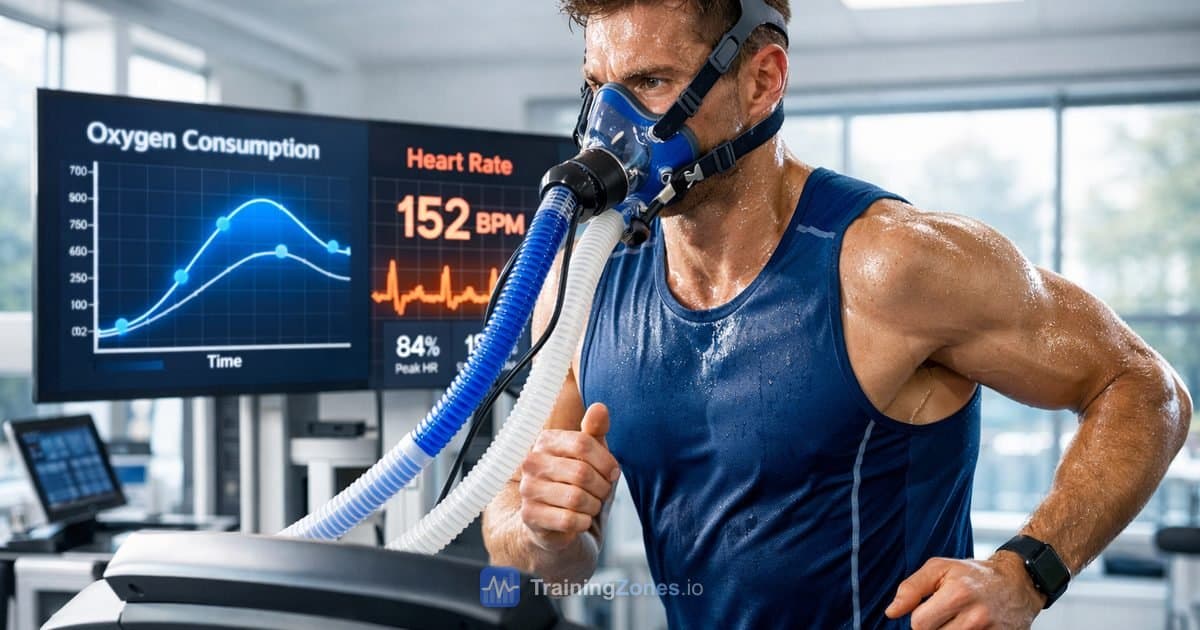
In a lab, you run on a treadmill or pedal on a cycle ergometer while wearing a face mask connected to a metabolic analyzer. The protocol increases intensity every 1-3 minutes (the Bruce protocol for treadmill, the ramp protocol for cycling). Technicians monitor your oxygen consumption in real time. VO2max is reached when oxygen consumption plateaus despite further increases in workload. The test typically lasts 8-15 minutes.
Lab testing costs between $100-300 at most sports science centers and provides the most accurate measurement, typically within 2-3% of your true VO2max. It also yields your ventilatory thresholds (VT1 and VT2), which correspond directly to your training zones.
Field tests: accessible alternatives
If a lab test is not available, several validated field tests can estimate your VO2max with reasonable accuracy (typically within 5-10%):
-
Cooper 12-minute test -- Run as far as possible in 12 minutes on a flat surface. VO2max (mL/kg/min) = (distance in meters - 504.9) / 44.73. This test was developed by Dr. Kenneth Cooper in 1968 and remains one of the most widely used field assessments.
-
VMA test (Luc Leger shuttle or continuous track test) -- Run at progressively increasing speeds until exhaustion. Your final completed stage determines your VMA (Maximal Aerobic Speed), from which VO2max is estimated using the formula: VO2max = VMA x 3.5 (Leger and Mercier, 1984). Calculate yours with our VMA Calculator.
-
1-mile walk test (Rockport) -- Walk one mile as fast as possible and record your finishing heart rate. Useful for beginners and older adults who cannot complete a running test.
Wearable estimates
Modern GPS watches from Garmin, Apple, COROS, and Polar estimate VO2max using proprietary algorithms that combine heart rate data, pace, and running dynamics. These are convenient for day-to-day tracking but carry a margin of error of approximately 5-7% compared to lab results (more on this in a later section).
How to calculate your VO2max without a lab
You can estimate your VO2max at home using simple formulas that require nothing more than a flat running surface and a stopwatch. The two most practical methods are the Cooper test and the VMA conversion.
Cooper test formula
Run as far as you can in exactly 12 minutes. Then apply this formula:
- VO2max (mL/kg/min) = (distance in meters - 504.9) / 44.73
Example: if you cover 2,400 meters in 12 minutes, your estimated VO2max is (2400 - 504.9) / 44.73 = 42.3 mL/kg/min.
For the most accurate result, warm up for 10 minutes before the test, run on a flat track (400m track is ideal), and give a maximal effort for the full 12 minutes. Pacing matters: start slightly conservative and increase speed in the second half rather than sprinting and fading.
VMA conversion formula
If you know your VMA (Maximal Aerobic Speed), you can convert it directly to VO2max using the Leger-Mercier formula:
- VO2max (mL/kg/min) = VMA (km/h) x 3.5
Example: if your VMA is 16 km/h, your estimated VO2max is 16 x 3.5 = 56 mL/kg/min.
Do not know your VMA yet? Use our VMA Calculator to estimate it from your race times or field test results, then convert it to VO2max.
Both formulas are estimates, not lab-grade measurements. They are accurate enough for training purposes and for tracking your progress over time. The key is consistency: use the same test and protocol each time you re-test, so you can reliably compare results.
Want to set your training zones based on your fitness? Use our Heart Rate Zone Calculator to translate your VO2max into actionable heart rate targets.
How to improve your VO2max
The most effective way to improve your VO2max is through high-intensity interval training (HIIT) combined with a large base of low-intensity aerobic training. Research by Midgley et al. (2006) confirms that intervals performed at or near VO2max intensity produce the greatest improvements in maximal oxygen uptake.
High-intensity interval training (most effective)
HIIT at 90-100% of your maximum heart rate (or 90-105% of VMA for runners) is the most potent stimulus for VO2max improvement. The key is spending enough total time at near-maximal oxygen consumption during the session. Studies show that 3-5 minute intervals are optimal because they allow your oxygen uptake to reach and sustain near-peak levels during each repetition.
Expected improvement: untrained individuals can increase VO2max by 15-20% within 8-12 weeks. Already-trained athletes typically see 3-5% gains over the same period. Elite athletes with years of training may improve only 1-2% per year, as they approach their genetic ceiling.
Zone 2 endurance training (the foundation)
While HIIT provides the sharpest VO2max stimulus, it cannot be performed daily. Low-intensity Zone 2 training builds the aerobic infrastructure (mitochondria, capillaries, cardiac output) that supports higher VO2max values. The 80/20 training principle applies: approximately 80% of your training volume should be easy aerobic work, and 20% should be high-intensity.
At TrainingZones.io, we recommend calculating your running training zones to make sure your easy days are truly easy and your hard days are hard enough.
Progressive overload
Like any fitness quality, VO2max responds to progressive overload. Gradually increase either the number of intervals, the duration of each interval, or the intensity. Do not change all three at once. A common progression over 8 weeks might look like: 3x3min at 95% HRmax in week 1, building to 5x4min at 95% HRmax by week 8.
Best VO2max workouts to try
The most effective VO2max sessions are short, hard intervals. The classic is the 4x4 (four efforts of four minutes at 90-95% of max heart rate, three minutes easy between), the format behind most of the Norwegian research (Wisloff et al., 2007) and consistent 5-8% VO2max gains over eight weeks. Other proven options are 5x3 minutes at VMA and the 30/30 (the Billat method), which keeps oxygen consumption elevated with very short recoveries.
Do one of these one to two times per week, always with a thorough warm-up and cool-down, and you will bank enough time near your ceiling to drive it up. For the full session library, with the exact structure, intensity targets and weekly placement across running, cycling and swimming, plus a pick-your-session tool, see our dedicated VO2max workouts guide linked below.
What factors influence your VO2max?
Your VO2max is determined by a combination of genetic potential and environmental factors. Understanding what you can and cannot change helps you set realistic expectations and focus your training where it matters most.
-
Genetics -- The HERITAGE Family Study (Bouchard et al., 1999) showed that VO2max response to training has a strong genetic component. Identical twins showed remarkably similar VO2max values and training responses. Roughly 40-50% of your VO2max is genetically determined. Some people respond dramatically to training (high responders), while others improve only modestly despite identical programs.
-
Age -- VO2max peaks around age 20-25 and declines by approximately 10% per decade in sedentary individuals. The decline is driven by reduced maximal heart rate (roughly 1 bpm per year), decreased cardiac output, and loss of muscle mass. However, trained individuals can slow this decline significantly.
-
Sex -- Men have, on average, 15-20% higher VO2max values than women of similar age and training status. This is primarily due to differences in hemoglobin concentration, heart size, blood volume, and body composition (higher percentage of body fat in women). The gap narrows when VO2max is expressed relative to lean body mass.
-
Altitude -- Living at altitude reduces VO2max because there is less oxygen available in the air. However, altitude training triggers adaptations (increased red blood cell production) that can improve sea-level performance. The "live high, train low" strategy exploits this: live at 2,000-2,500m and train at lower elevations.
-
Training history -- Someone who has trained consistently for 10 years will have a higher baseline VO2max than someone just starting. Years of aerobic training develop cardiac adaptations (larger heart, higher stroke volume) and muscular adaptations (more mitochondria, more capillaries) that compound over time.
-
Body composition -- Because relative VO2max is expressed per kilogram of body weight, excess body fat lowers the number even if absolute oxygen consumption stays the same. Losing 5 kg of body fat while maintaining muscle mass will increase your relative VO2max by roughly 5-7%.
VO2max vs VMA: what is the difference?
VO2max and VMA (Maximal Aerobic Speed) are closely related but measure different things. VO2max measures the maximum amount of oxygen your body can use, expressed in mL/kg/min. VMA measures the minimum running speed at which you reach your VO2max, expressed in km/h.
The relationship between the two is captured by the Leger-Mercier formula (1984):
- VO2max (mL/kg/min) = VMA (km/h) x 3.5
For example, an athlete with a VMA of 18 km/h has an estimated VO2max of 63 mL/kg/min. Conversely, an athlete with a VO2max of 56 mL/kg/min has an estimated VMA of 16 km/h.
Here is the key difference in practice:
- VO2max tells you how big your engine is. It is a physiological measurement of your aerobic capacity. Two runners can have the same VO2max but very different race performances because of differences in running economy, lactate threshold, and mental toughness.
- VMA tells you how fast that engine can move you. It translates your aerobic capacity into a running speed. VMA is more directly useful for setting training paces: your interval pace, your tempo pace, and your easy pace can all be derived from VMA.
For runners, VMA is often more practical for daily training because it gives you a speed target. VO2max is more useful for understanding your overall fitness level and comparing yourself across sports (a cyclist and a runner can both have a VO2max of 60, but their VMA is meaningless in cycling).
Find your VMA now -- the TrainingZones.io team built a free VMA Calculator to estimate your Maximal Aerobic Speed from race results or field tests.
How accurate is your Garmin or Apple Watch VO2max?
Modern sports watches estimate VO2max using algorithms developed by companies like Firstbeat Analytics (used by Garmin, Suunto, and others) and Apple Health. These algorithms combine heart rate data, GPS pace, and sometimes additional metrics like running power and running dynamics to predict your VO2max.
The accuracy of wearable VO2max estimates is approximately plus or minus 5% in well-calibrated conditions. A 2020 study comparing Garmin VO2max estimates to laboratory measurements found a mean error of 3.5 mL/kg/min, which is clinically meaningful but acceptable for training purposes.
Here is what affects the accuracy:
- Heart rate data quality -- Wrist-based optical sensors are less accurate than chest straps, especially during high-intensity running. Using a chest strap paired with your watch improves VO2max estimate accuracy.
- GPS signal quality -- Bad GPS (running in cities, under tree cover, on indoor treadmills) produces inaccurate pace data, which directly affects the VO2max calculation.
- Consistent conditions -- Temperature, wind, hills, and fatigue all affect heart rate at a given pace. The algorithm cannot fully account for these variables. For the most reliable estimates, run on flat terrain in moderate weather.
- Calibration time -- New watches need 2-4 weeks of consistent running data to calibrate properly. Early estimates are often inaccurate.
Our pick: The Garmin Forerunner 265 estimates your VO2max after every outdoor run using Firstbeat Analytics, displays trend graphs over weeks and months, and includes Training Readiness and Training Status features that help you balance hard and easy sessions. It is one of the most complete running watches for fitness-focused athletes.
The bottom line: Use your watch VO2max as a trend indicator, not an absolute number. If your watch says your VO2max went from 48 to 52 over three months, you have genuinely improved, even if the exact number is off by a few points. What matters is the direction.
Can you still improve VO2max after 40?
Yes, you can absolutely improve your VO2max after 40, 50, 60, and beyond. Research on masters athletes consistently shows that VO2max responds to training at any age, though the magnitude of improvement may be smaller than in younger individuals.
A landmark study by Pollock et al. (1997) followed competitive runners over 20 years and found that those who maintained or increased their training intensity preserved approximately 70% of their VO2max values, while those who reduced training intensity lost significantly more aerobic capacity. The key finding: it is the reduction in training intensity -- not aging itself -- that causes most of the VO2max decline.
Here is what the research tells us about improving VO2max later in life:
- Previously sedentary adults over 60 can improve VO2max by 10-15% with 12 weeks of structured aerobic training (Huang et al., 2005). This is a meaningful improvement that translates to better daily function and reduced cardiovascular disease risk.
- Recreational athletes over 40 can expect 5-10% improvement with a well-designed HIIT program, similar to younger adults at the same training level.
- Masters athletes (50+) who maintain high-intensity training typically have VO2max values 30-40% higher than sedentary peers of the same age. Some masters athletes in their 60s have VO2max values comparable to untrained 25-year-olds.
The practical takeaway: age is not a barrier, but training must include high-intensity work. Zone 2 alone will maintain your base, but VO2max-targeted intervals (1-2 sessions per week) are necessary to fight age-related decline. Start conservatively, recover fully between hard sessions, and prioritize consistency over intensity.
TrainingZones.io offers free calculators for VO2max, VMA, heart rate zones, and running zones — everything you need to train at the right intensity and track your aerobic progress.
Frequently asked questions about VO2max
What is a good VO2max score?
A good VO2max score depends on your age and sex. For men aged 20-39, a VO2max above 43 mL/kg/min is classified as "Good" by the ACSM, and above 52 is "Superior." For women of the same age, "Good" starts at 37 and "Superior" at 45. Recreational endurance athletes typically fall between 45-55 mL/kg/min for men and 40-50 for women. Elite athletes exceed 70 mL/kg/min (men) and 60 mL/kg/min (women).
How can I boost my VO2max?
The fastest way to boost your VO2max is through high-intensity interval training (HIIT) performed 1-2 times per week at 90-95% of your maximum heart rate, combined with a large base of low-intensity Zone 2 training. Sessions like 4x4 minutes or 30/30 intervals are the most studied and effective protocols. Untrained individuals can improve VO2max by 15-20% in 8-12 weeks. Already-fit athletes typically see 3-5% gains over the same period.
How is VO2max calculated?
VO2max can be calculated from field tests like the Cooper 12-minute run (VO2max = (distance in meters - 504.9) / 44.73) or from your VMA using the formula VO2max = VMA x 3.5 (Leger-Mercier, 1984). Lab testing using ergospirometry provides the most accurate measurement by directly analyzing inhaled and exhaled gases during maximal exercise.
What is a good VO2max for my age?
VO2max naturally declines with age at roughly 10% per decade in sedentary individuals. A "Good" VO2max for a 50-year-old man is approximately 36-41 mL/kg/min (ACSM), while a "Good" value for a 50-year-old woman is around 30-35 mL/kg/min. Active individuals who maintain regular training often exceed these values significantly.
How accurate is Garmin VO2max?
Garmin VO2max estimates, powered by Firstbeat Analytics, are typically accurate within plus or minus 3.5 mL/kg/min compared to laboratory testing. This means if the lab says 50, your Garmin might read anywhere from 46.5 to 53.5. The estimates are most reliable when using a chest strap heart rate monitor, running on flat terrain, and after 2-4 weeks of calibration. Use the number as a trend indicator rather than an absolute value.
Can VO2max be improved at any age?
Yes. Research consistently shows that VO2max responds to training at every age. Previously sedentary adults over 60 can improve by 10-15% in 12 weeks. Masters athletes who include high-intensity intervals maintain VO2max values 30-40% higher than sedentary peers of the same age. The key is maintaining or introducing intensity in your training, not just volume. Age slows the rate of improvement but does not stop it.
References
- Bassett DR, Howley ET. (2000). Limiting factors for maximum oxygen uptake and determinants of endurance performance. Medicine & Science in Sports & Exercise, 32(1):70-84.
- Midgley AW et al. (2006). Training to enhance the physiological determinants of long-distance running performance. Sports Medicine, 36(2):117-132.
- Bouchard C et al. (1999). Familial aggregation of VO2max response to exercise training: results from the HERITAGE Family Study. Journal of Applied Physiology, 87(3):1003-1008.