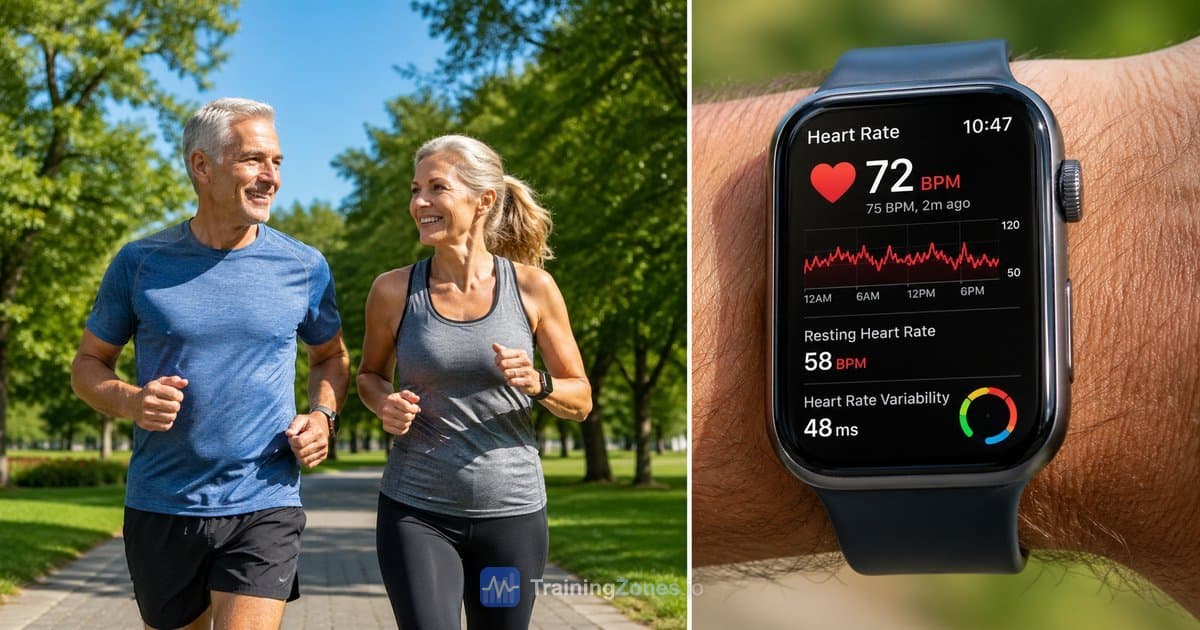
What is VO2 max and why does it matter for longevity?
VO2 max is the maximum amount of oxygen your body can use during intense exercise, measured in milliliters per kilogram per minute (mL/kg/min). It is the gold-standard measure of cardiorespiratory fitness, and a growing body of research shows it is one of the strongest predictors of how long you will live. Higher VO2 max means your heart, lungs, and muscles work together more efficiently, and that efficiency translates directly into lower mortality risk.
Here is the blunt truth. A sedentary 50-year-old with a low VO2 max faces a mortality risk comparable to a smoker. But a 50-year-old who trains consistently and maintains a high VO2 max has a risk profile closer to someone 15 years younger. That is not speculation. That is what the data shows.
At TrainingZones.io, we track VO2 max because it sits at the intersection of performance and health. Whether you are training for a marathon or simply want to play with your grandkids at 80, your VO2 max is the number that matters most. For a deep dive into VO2 max testing and norms, see our complete VO2 max guide.
The science: how VO2 max predicts mortality
Cardiorespiratory fitness is a stronger predictor of death than smoking, diabetes, or hypertension. The evidence is not ambiguous. Higher fitness equals longer life, with no upper limit to the benefit.
The landmark study came from Mandsager et al. (2018) in JAMA Network Open. Researchers tracked 122,007 patients who underwent treadmill testing, following them for a median of 8.4 years. Patients with "elite" cardiorespiratory fitness had an 80% lower risk of all-cause mortality compared to low fitness. The authors wrote that "there is no upper limit of benefit."
A quick word on MET (Metabolic Equivalent of Task): it's the unit researchers use to measure exercise capacity. 1 MET = 3.5 mL/kg/min of VO2 max, the energy cost of sitting still. Brisk walking ≈ 4 METs. Easy jogging ≈ 8-10 METs. Endurance athletes can reach 18-20 METs.
Kodama et al. (2009) published a meta-analysis covering 33 studies and 102,980 participants. Each 1-MET increase in fitness was associated with a 13% reduction in all-cause mortality and 15% reduction in cardiovascular mortality. So improving your VO2 max from 30 to 35 could reduce your mortality risk by roughly 18-20%.
Large cohort studies have also shown that exercise capacity is a stronger predictor of mortality than smoking, hypertension, or diabetes. If you could only measure one thing to predict lifespan, VO2 max would be it.
VO2 max longevity chart: risk by fitness level
The relationship between VO2 max and mortality follows a clear dose-response curve. The higher your fitness, the lower your risk, and the biggest gains come from moving out of the bottom 25%. Here is how mortality risk breaks down by fitness quintile, based on the JAMA data above.
How fitness reduces your risk of dying
Lower mortality risk by cardiorespiratory fitness level (122,007 patients)
Bar = reduction in all-cause mortality risk vs. low-fitness group
Reaching elite fitness = 5x lower risk of dying than staying sedentary.
The data shows a consistent pattern:
- Low fitness (bottom 20%): Highest mortality risk, comparable to chronic disease.
- Below average (20th-40th percentile): ~50% lower mortality. The single biggest risk reduction available.
- Above average (40th-60th percentile): ~60% lower mortality risk.
- High fitness (60th-80th percentile): ~70% lower risk. Regular exercisers, not elite athletes.
- Elite fitness (top 20%): ~80% lower risk. No plateau whatsoever.
You do not need to be an elite athlete to benefit. Getting from "low" to "above average" delivers most of the mortality reduction. But the data says there is no point of diminishing returns.
TrainingZones.io recommends using our heart rate zone calculator to find your personal training zones and start building toward a higher VO2 max today.
VO2 max by age and gender: where do you stand?
VO2 max naturally declines with age, peaking between ages 20-25 and dropping approximately 10% per decade in sedentary individuals. Trained athletes experience a slower decline of about 5% per decade. Women have VO2 max values roughly 15-20% lower than men of the same age and training status, primarily due to differences in hemoglobin levels, heart size, and body composition.
Here are key benchmarks by age for men and women, based on ACSM normative data:
- Men age 30-39: Good = 36-41, Excellent = 42-49, Superior = above 49 mL/kg/min
- Men age 40-49: Good = 34-38, Excellent = 39-45, Superior = above 45
- Men age 50-59: Good = 31-35, Excellent = 36-43, Superior = above 43
- Women age 30-39: Good = 32-36, Excellent = 37-44, Superior = above 44
- Women age 40-49: Good = 29-33, Excellent = 34-41, Superior = above 41
- Women age 50-59: Good = 28-32, Excellent = 33-38, Superior = above 38
The critical insight: you want to stay in the "Good" or "Excellent" category for your age group. A fit 60-year-old with a VO2 max of 35 mL/kg/min has the aerobic capacity of an average untrained 35-year-old, and likely the mortality risk to match.
What is a good VO2 max for your age? (percentile benchmarks)
A "good" VO2 max for longevity means staying above the 50th percentile for your age and gender. But if you want to truly optimize your lifespan, aim for the top 25% (75th percentile or higher). The large cohort data shows that individuals in the top quartile of fitness have approximately half the mortality risk of those in the average range.
Here is how to interpret your percentile:
- Below 25th percentile: Highest risk group, but also where modest training delivers the biggest mortality reduction.
- 25th to 50th percentile: Below average. Consistent training 3-4 times per week can move you up within 3-6 months.
- 50th to 75th percentile: The sweet spot for general health. Substantially reduced mortality risk.
- 75th to 95th percentile: Excellent. You are likley training regularly with structure. Mortality risk 60-70% lower than the bottom quartile.
- Above 95th percentile: Elite. The data shows even this group continues to benefit. There is no ceiling.
For a practical target, aim for the VO2 max of someone 20 years younger in the 50th percentile. For a 50-year-old man, that means targeting roughly 40-45 mL/kg/min rather than the age-matched average of about 33. It is an ambitious goal, but achievable with consistent training.
Want to know exactly where you stand? Use the TrainingZones.io heart rate zone calculator to build a training plan around your current fitness level, then retest in 8-12 weeks.
Each MET counts: the dose-response relationship
Every single MET of improvement in your cardiorespiratory fitness reduces your mortality risk by 12-15%. One MET equals 3.5 mL/kg/min of VO2 max, roughly the oxygen cost of sitting quietly. This dose-response relationship is one of the most consistent findings in exercise science, confirmed across multiple studies and populations.
What does this mean in practical terms? Consider a 45-year-old man with a VO2 max of 32 mL/kg/min (about 9.1 METs). He is in the bottom quartile for his age. After 12 weeks of structured training combining Zone 2 and HIIT, he improves to 38 mL/kg/min (about 10.9 METs). That is roughly a 1.7 MET improvement, which translates to approximately a 20-25% reduction in his all-cause mortality risk. Not bad for three months of work.
The same dose-response relationship holds across age, sex, and health status. More fitness equals less mortality, period.
The most impactful move is going from sedentary to moderatley active. That first 1-2 MET improvement delivers the biggest percentage reduction in risk. But even if you are already fit, pushing from "high" to "elite" continues to pay dividends. The data is clear: there is no point where more fitness stops being beneficial.
How to improve your VO2 max (evidence-based methods)
Improving your VO2 max requires high-intensity interval training combined with consistent aerobic base work. The 80/20 principle works best: roughly 80% of training at low intensity (Zone 2) and 20% at high intensity (Zone 4-5).
HIIT is the most potent stimulus. The classic 4x4 protocol (4 intervals of 4 minutes at 90-95% max HR, 3 minutes recovery, Norwegian protocol) improves VO2 max by 5-8% in just 8 weeks. Perform 1-2 HIIT sessions per week.
Zone 2 endurance training builds the aerobic infrastructure (mitochondria, capillaries, cardiac output) that supports higher VO2 max values. Aim for 3-4 sessions per week of 45-90 minutes at 60-70% max HR.
Proven HIIT formats:
- 4x4 minutes at 90-95% max HR, 3 min recovery
- 5x3 minutes at 95% max HR, 2.5 min recovery
- 30/30 intervals (Billat method): 20-30 reps of 30 sec hard, 30 sec easy
Expected gains: Untrained individuals can improve VO2 max by 15-20% in 8-12 weeks. Already-trained athletes typically see 3-5% gains.
Need precise training paces? Use the TrainingZones.io running zone calculator to find your optimal interval and recovery speeds based on your current fitness.
Zone 2 training: the longevity sweet spot
Zone 2 training, performed at 60-70% of maximum heart rate (below the first ventilatory threshold), is increasingly recognized as the foundation of a longevity-focused exercise program. It is the intensity where your body burns primarily fat for fuel, builds mitochondrial density, and improves metabolic flexibility without accumulating significant fatigue.
Research on metabolic flexibility has demonstrated that Zone 2 exercise maximizes fat oxidation and mitochondrial function. Healthy mitochondria are essential for energy production, insulin sensitivity, and cellular repair. Dysfunctional mitochondria are linked to aging, diabetes, and heart disease. Zone 2 is medicine for your mitochondria.
Longevity-focused physicians recommend 3-4 hours per week of Zone 2 as the cornerstone of longevity training. Running, cycling, swimming, or brisk walking all work. Sessions should last at least 45 minutes for mitochondrial adaptations to occur.
How do you know you are in Zone 2? The simplest test is the talk test. You should be able to speak in full sentences but feel slightly breathless. If you can sing, you are too easy. If you can only manage a few words, you are too hard. For more precision, calculate your Zone 2 heart rate range using our heart rate zone calculator at TrainingZones.io.
Combined with 1-2 HIIT sessions per week, Zone 2 training is the most evidence-based approach to improving both your VO2 max and your long-term health.
How to test your VO2 max (lab and field tests)
The gold standard for measuring VO2 max is a laboratory cardiopulmonary exercise test (CPET), where you exercise on a treadmill or bike while breathing into a mask that analyzes oxygen consumption and CO2 production. These tests cost between $150-300 at sports science labs and provide exact measurements within 2-3% accuracy, plus your ventilatory thresholds for precise training zones.
If a lab test is not accessible, several field tests provide reliable estimates:
- Cooper 12-minute test: Run as far as you can in 12 minutes. VO2 max = (distance in meters - 504.9) / 44.73. Accurate within 5-10% for motivated runners.
- Rockport 1-mile walk test: Walk one mile as fast as possible and record your finishing heart rate. Best for beginners or older adults.
- 20-meter shuttle run (beep test): Run between two markers 20 meters apart at progressively increasing speeds. Your final completed level estimates your VO2 max.
Wearable estimates from watches like the Garmin Forerunner 265 provide convenient daily tracking with approximately 5-7% accuracy compared to lab results. These algorithms use heart rate, pace, and running dynamics to estimate VO2 max after every outdoor run. The Forerunner 265 is our top pick for runners who want to track VO2 max trends over time, with Firstbeat Analytics, Training Readiness features, and a bright AMOLED display.
Use a chest strap for best accuracy and treat the number as a trend indicator, not an absolute measurement.
VO2 max as a longevity metric: aim above your age
VO2 max has moved from a performance number to a mainstream health conversation. The book Outlive: The Science and Art of Longevity (Peter Attia, 2023) argues that VO2 max is "perhaps the single most powerful marker for longevity," surpassing traditional metrics like blood pressure, cholesterol, and even smoking status.
The practical recommendation: aim for the top 2% for your age, roughly the 50th percentile of someone 20 years younger. For a 50-year-old man, that means above 46 mL/kg/min. For a 50-year-old woman, about 40 mL/kg/min.
Why so aggressive? If a 50-year-old man starts at 46 and loses 10% per decade, he will still be at about 33 mL/kg/min at 80, enough to live independently. If he starts at 33, he might be functionally limited by his mid-70s.
The message is clear: VO2 max is not just a fitness metric. It is a longevity metric. And unlike your genetics, it is something you can actually change through training. TrainingZones.io shares this philosophy: your training zones are not just about race performance, they are about how well you will live in the decades ahead.
VO2 max vs other health markers (blood pressure, cholesterol, BMI)
VO2 max outperforms nearly every traditional health marker as a predictor of mortality. Studies have compared exercise capacity against smoking, hypertension, diabetes, and cholesterol in thousands of patients. Exercise capacity was the strongest predictor, beating every other variable. The American Heart Association now recommends cardiorespiratory fitness be treated as a "clinical vital sign."
Here is how VO2 max compares:
- Blood pressure: Does not capture aerobic fitness. You can have normal BP and still be profoundly unfit.
- Cholesterol: Predicts cardiovascular events but says nothing about exercise capacity or functional ability.
- BMI: A blunt tool that does not distinguish muscle from fat. A muscular athlete may have an "overweight" BMI but excellent VO2 max.
- Resting heart rate: An indirect measure. VO2 max captures how your systems perform under stress, which is what matters for survival.
- HRV: Complements VO2 max but does not replace it. Tracking both gives the fullest health picture. Check yours with our max heart rate calculator.
If you are only going to optimize one number for longevity, VO2 max gives you the most return on investment. It is the single variable that, when improved, pulls nearly every other health marker in the right direction.
Frequently Asked Questions About VO2 Max and Longevity
What is a good VO2 max for my age?
A good VO2 max depends on your age and sex. For a 40-year-old man, 34-38 mL/kg/min is considered "Good" by ACSM standards, while above 45 is "Superior." For a 40-year-old woman, "Good" starts around 29-33 and "Superior" above 41. For longevity specifically, large cohort research suggests you want to be in at least the top 50% for your age group. Being in the top 25% cuts your mortality risk roughly in half compared to the average.
Can you increase your VO2 max after 40?
Yes, VO2 max is highly trainable at any age. Studies show that previously sedentary adults over 40 can improve their VO2 max by 15-20% within 8-12 weeks of structured training. The most effective approach combines high-intensity interval training (1-2 sessions per week of 4x4 minutes at 90-95% max heart rate) with consistent Zone 2 endurance work (3-4 sessions per week). Masters athletes who maintain intensity in their training routinely have VO2 max values 30-40% higher than sedentary peers of the same age.
How much does VO2 max decline with age?
VO2 max declines approximately 10% per decade after age 25 in sedentary individuals, and about 5% per decade in trained athletes. By age 60, an untrained person may have lost 35% of their peak. Regular endurance training cuts this decline in half, meaning a consistently active 60-year-old can maintain the aerobic capacity of an untrained 40-year-old.
Is VO2 max genetic or trainable?
VO2 max is approximately 50% genetic and 50% trainable. Twin studies have shown a 2.5x variation in baseline VO2 max among untrained individuals. But the key finding is that virtually everyone improves with structured aerobic training, regardless of starting point. Your genes set the ceiling. Consistent training determines how close you get to it.
What VO2 max do you need to live longer?
There is no single magic number, but the data is clear on thresholds. Large cohort studies show that moving from the bottom 20% to the 20th-40th percentile of fitness cuts mortality risk by approximately 50%. Being in the top 25% for your age reduces risk by about 70% compared to the bottom quartile. A practical target is the top 2% for your age, which roughly equals the 50th percentile of someone 20 years younger. For a 50-year-old man, that means aiming for above 46 mL/kg/min.
Is VO2 max or resting heart rate a better health marker?
VO2 max is a significantly stronger predictor of mortality. Resting heart rate is indirect and imprecise, while VO2 max captures your full cardiovascular capacity under stress. Large cohort studies have shown exercise capacity was the strongest predictor of death among all variables tested. That said, both are worth tracking: resting heart rate for daily readiness, VO2 max as your long-term health benchmark.
References
- Mandsager K et al. (2018). Association of Cardiorespiratory Fitness With Long-term Mortality Among Adults. JAMA Network Open, 1(6):e183605.
- Kodama S et al. (2009). Cardiorespiratory Fitness as a Quantitative Predictor of All-Cause Mortality. JAMA, 301(19):2024-2035.
- Myers J et al. (2002). Exercise Capacity and Mortality among Men Referred for Exercise Testing. New England Journal of Medicine, 346(11):793-801.
- Ross R et al. (2016). Importance of Assessing Cardiorespiratory Fitness in Clinical Practice. Circulation, 134(24):e653-e699.