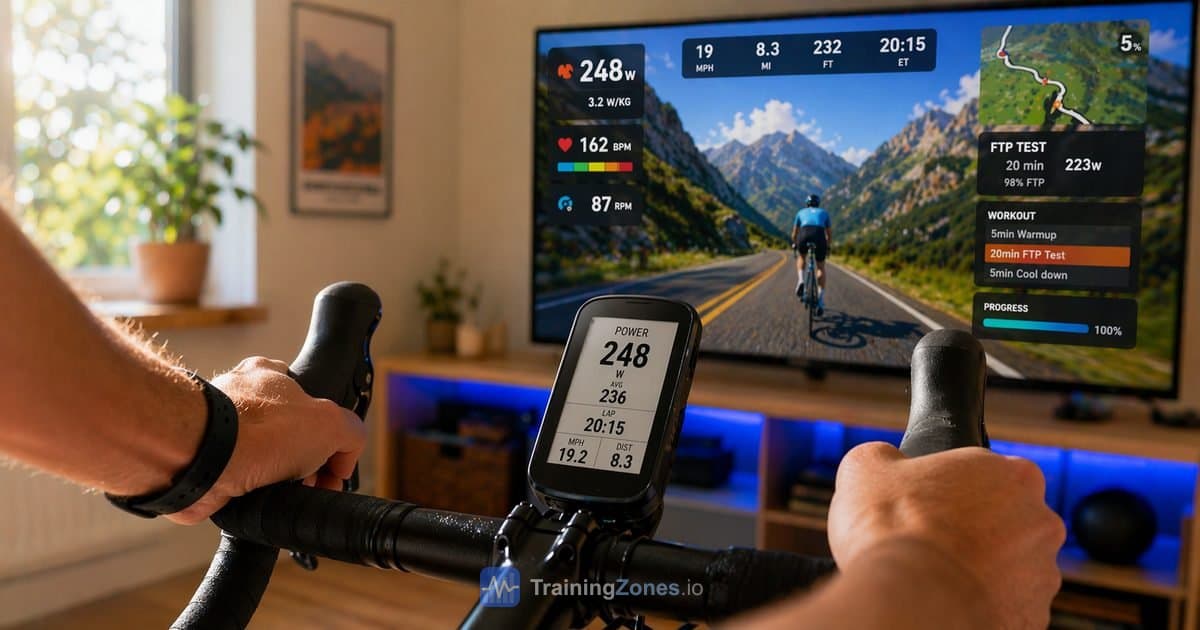
What is FTP in Cycling? Definition and Why It Matters
Functional Threshold Power (FTP) is the maximum average power output, measured in watts, that a cyclist can sustain for approximately one hour. Defined by Allen & Coggan (2006) in Training and Racing with a Power Meter, FTP serves as the anchor point for cycling's 7-zone training model and is the single most important metric in power-based training.
Without knowing your FTP, you are training blind. Every training zone, race target, and fitness benchmark derives from this number. According to Coggan's model, your 7 power zones are calculated as percentages of FTP, from easy recovery (Zone 1, below 55%) to neuromuscular sprints (Zone 7, above 150%). Calculate your personalized zones with our Power Zones Calculator.
The good news? You don't need an expensive laboratory test with gas exchange analysis. Several validated field tests can estimate your FTP with remarkable accuracy, typically within 3-5% of lab values according to Borszcz et al. (2018). At TrainingZones.io, we have compiled the most reliable protocols so you can test your FTP at home and immediately calculate your training zones.
How to Calculate FTP from a 20-Minute Test
The 20-minute test is the gold standard field test for estimating FTP. It works on a simple principle: most trained cyclists can sustain approximately 5% more power for 20 minutes than for a full 60 minutes. To calculate FTP from a 20-minute test, ride at maximum sustainable effort for 20 minutes and multiply your average power by 0.95.
How to perform the 20-minute FTP test
- Warm up for 20 minutes with easy spinning, including 3 x 1-minute efforts at increasing intensity (80%, 90%, 100% perceived effort) with 1 minute easy between each
- Ride hard for 5 minutes at high but not maximal effort to deplete anaerobic stores (this step is crucial, skip it and your FTP will be overestimated)
- Spin easy for 5 minutes to recover
- Ride as hard as you can sustain for exactly 20 minutes at a steady effort
- Record your average power for the 20-minute effort
- Multiply by 0.95 to get your estimated FTP
The formula
FTP = 20-minute average power x 0.95
Example: If your 20-minute average is 280W, your estimated FTP is 280 x 0.95 = 266W. For a 70 kg rider, that's 3.8 W/kg, a solid "racer" level according to Coggan's classification.
Pacing strategy
The first 5 minutes are critical. Start at what feels like 8/10 effort, not 10/10. You should feel like you could go slightly harder at the beginning. By minute 10, you should be at your limit. In the final 5 minutes, give everything. If you had to slow down significantly in the last 5 minutes, you started too hard.
How Does the Ramp Test Work to Find Your FTP?
The ramp test is a progressive protocol where power increases incrementally until exhaustion. It has become extremely popular on indoor platforms like Zwift, TrainerRoad, and Wahoo SYSTM because it is short, simple, and requires zero pacing skills. FTP is estimated as 75% of the highest 1-minute average power achieved during the test.
How to perform the ramp test
- Start at a low wattage (typically 100W for men, 75W for women)
- Increase by 20W every minute (some protocols use 25W)
- Continue pedaling until you physically cannot maintain the target power
- Record your highest completed 1-minute power
- Multiply by 0.75 to get your estimated FTP
The formula
FTP = best 1-minute power x 0.75
Example: If you completed the 320W step and failed during the 340W step, your best full minute was 320W. Your FTP estimate is 320 x 0.75 = 240W.
Who is the ramp test best for?
The ramp test works well for cyclists with a balanced power profile. However, research by Morgan et al. (2019) shows it can underestimate FTP by 5-10% for "diesel" riders with excellent endurance but lower anaerobic capacity. Conversely, it overestimates FTP for sprinter types with strong anaerobic capacity but lower endurance.
Our pick: For the most accurate ramp test experience, a direct-drive smart trainer like the Wahoo KICKR automatically controls resistance so you can focus purely on the effort.
Is the 2x8-Minute Test Accurate for Beginners?
The 2x8-minute test is an excellent alternative for riders who struggle with pacing a sustained 20-minute effort. By splitting the effort into two shorter intervals with recovery between them, this protocol gives you two chances to get the effort right. FTP is estimated by averaging both efforts and multiplying by 0.90.
How to perform the 2x8-minute test
- Warm up for 15 minutes with easy spinning and 2-3 short accelerations
- Ride as hard as you can sustain for 8 minutes and record average power
- Spin very easy for 10 minutes until heart rate returns to Zone 1-2
- Ride as hard as you can sustain for another 8 minutes and record average power
- Average both 8-minute efforts and multiply by 0.90
The formula
FTP = average of both 8-minute efforts x 0.90
Example: If effort #1 averaged 295W and effort #2 averaged 285W, your average is 290W. FTP = 290 x 0.90 = 261W.
Why 0.90 and not 0.95?
The correction factor is larger (10% instead of 5%) because 8 minutes is significantly shorter than 20 minutes. At 8 minutes, anaerobic energy contribution is higher, so a bigger correction is needed to estimate the 1-hour sustainable power.
If your two 8-minute efforts differ by more than 5%, the test is unreliable. It usually means you went out too hard on the first effort. Rest a day and retest.
Which FTP Test Should You Choose?
Each test has different strengths depending on your experience level, available equipment, and rider profile. Use this interactive comparison to find the right test for you.
FTP Test Protocol Comparison
Compare the three most popular FTP test methods
FTP = Avg Power × 0.95General recommendation from Allen & Coggan (2010): If you can pace yourself well and have 45 minutes available, the 20-minute test is the most accurate. If you are new to power training or simply dislike long sustained efforts, start with the ramp test and graduate to the 20-minute test later. If pacing is your weakness, the 2x8-minute test offers a good middle ground.
What is a Good FTP? Reference Values by Level
A "good" FTP depends on your body weight, gender, and training experience. The standard way to compare cyclists is watts per kilogram (W/kg), which normalizes power output for body weight. According to Coggan's power profiling, a recreational male cyclist typically produces 2.0-2.5 W/kg, while a professional WorldTour rider exceeds 5.0 W/kg.
Use the classifier below to find your level. Enter your FTP and body weight to see where you stand on the Coggan scale.
FTP Level Classifier
Enter your FTP and weight to see your cycling level
Key benchmarks to aim for
- 3.0 W/kg is the threshold where most riders transition from recreational to structured training
- 4.0 W/kg is considered competitive amateur level (Cat 3-4 racing)
- 5.0 W/kg separates elite amateurs from professionals
- 6.0+ W/kg is WorldTour Grand Tour contender territory (climbing specialists like Pogacar and Vingegaard)
Common myth: "I need 300 watts to be a good cyclist." Reality: A 60 kg rider at 250W (4.17 W/kg) will climb faster than a 90 kg rider at 300W (3.33 W/kg). W/kg matters more than raw watts for everything except flat time trials.
Use the free TrainingZones.io FTP Calculator to enter your test results and get your personalized 7 power zones instantly.
FTP Test on Zwift, Peloton, and MyWhoosh
Indoor training platforms offer built-in FTP tests that make testing convenient and repeatable. Each platform uses slightly different protocols, but all rely on the same underlying formulas (0.95 for 20-minute, 0.75 for ramp).
Zwift
Zwift offers two FTP test options: a ramp test (starts at 100W, increases 20W/min until failure) and a 20-minute test with structured warm-up. Zwift also features auto-FTP detection, which estimates your FTP from your power data during regular rides. The auto-detect is convenient but can be 5-10% less accurate than a dedicated test.
Peloton
Peloton estimates FTP through a 20-minute PowerZone FTP test ride. The ride is guided by an instructor who coaches your pacing. After the ride, Peloton automatically calculates your FTP using the 0.95 multiplier and updates your PowerZone ranges.
MyWhoosh
MyWhoosh includes a ramp test and an auto-detected FTP based on your ride data. The platform is free and uses the same 0.75 multiplier for ramp tests. MyWhoosh FTP detection is particularly popular in Germany where the platform has a large user base.
Pro tip: Whichever platform you use, always calibrate your smart trainer before the test. ERG mode should be disabled during 20-minute tests so you control the effort, but enabled during ramp tests where the trainer controls resistance.
How Accurate Are Field FTP Tests Compared to a Lab?
Field FTP tests estimate laboratory values within ±3-5% accuracy when executed properly. According to a systematic review by Borszcz et al. (2018) published in the International Journal of Sports Medicine, the 20-minute test correlates strongly with laboratory-measured maximal lactate steady state (MLSS).
- 20-minute test: Most accurate field test, standard error ±3-5%. Slight tendency to overestimate in untrained cyclists and underestimate in well-trained athletes.
- Ramp test: Good correlation for average riders but ±5-10% deviation depending on rider profile (endurance vs. sprint phenotype).
- 2x8-minute test: Similar accuracy to the 20-minute test when both efforts are well-paced (within 5% of each other).
Important: No field test replaces a true laboratory assessment with blood lactate sampling. However, for the vast majority of amateur cyclists and triathletes, field tests are accurate enough to set effective training zones.
According to Coggan (2003), the margin of error in FTP-based zone calculations is typically smaller than day-to-day performance variation, which means field-tested FTP zones are perfectly adequate for structured training.
What Equipment Do You Need for an FTP Test?
The accuracy of your FTP test depends on your power measurement device. At minimum, you need a device that measures power in watts. Heart rate alone is not sufficient because it responds too slowly to power changes and is affected by temperature, hydration, and sleep quality.
Power meters (outdoor and indoor)
A power meter measures the force you apply to the pedals or cranks and converts it to watts:
- Pedal-based: Easiest to install, swap between bikes. Accuracy ±1%.
- Crank-based: Attached to the crank arm or spider. Accuracy ±1-2%.
- Hub-based: Built into the rear hub. Less common today.
Our pick: The Favero Assioma Duo pedal-based power meter offers dual-sided measurement, ±1% accuracy, USB rechargeable, and easy bike-to-bike swaps. It is the power meter most recommended by coaches for FTP testing at TrainingZones.io.
Smart trainers (indoor only)
A smart trainer has a built-in power meter and can automatically control resistance:
- Direct-drive: Remove your rear wheel, more accurate (±1-2%) and quieter.
- Wheel-on: Tire presses against a roller, less accurate (±3-5%), requires regular calibration.
How to Set Up the Perfect FTP Test Conditions
Test conditions significantly affect your results. Following these guidelines ensures reproducible and accurate results every time you test.
- Take 1-2 easy days before the test with no hard intervals in the 48 hours prior
- Test at the same time of day (performance varies 3-5% by time of day, typically best in late afternoon)
- Use an indoor setup on a smart trainer to eliminate wind, hills, and traffic variability
- Calibrate your power meter or run the trainer's calibration procedure before every test
- Eat a normal meal 2-3 hours before, drink 500 ml of water in the hour before
- Use a strong fan pointed directly at you when testing indoors (overheating is the number one performance killer)
- Use the same bike, trainer, and tire pressure every time
What Should You Do with Your FTP Results?
Once you know your FTP, it unlocks the entire power-based training ecosystem:
- Set your 7 power zones: The Coggan model divides intensity into 7 zones based on FTP percentage. Use our Power Zones Calculator to get your personalized zones instantly.
- Calculate your W/kg: Divide your FTP by your body weight in kg. This determines your rider level and predicts climbing performance.
- Plan race targets: For triathletes, cycling race pace is typically 68-78% of FTP for Ironman distance and 85-95% for Olympic distance.
- Structure your training: Sweet Spot (84-94% FTP) is the most time-efficient way to build aerobic fitness. Threshold intervals (100-105% FTP) push your FTP higher.
- Track fitness over time: Retesting every 6-8 weeks shows whether your training is working.
How Often Should You Retest Your FTP?
FTP changes as your fitness improves or declines. You should retest every 6-8 weeks during a structured training block, according to Coggan (2003). Look for these signs that it is time to retest:
- Your Zone 2 rides feel effortless and your heart rate is lower than expected
- You consistently finish interval sessions ahead of target power
- You have completed a training block focused on threshold or Sweet Spot work
- You return from a break or illness and feel your fitness has changed
Many cycling platforms (Zwift, TrainerRoad, Garmin Connect) now offer auto-FTP detection from your ride data. While convenient, auto-detected FTP can be 5-10% less accurate than a dedicated test. Use it as a confirmation tool, not a replacement for periodic formal testing.
Pro tip: Keep a log of your FTP tests with the date, protocol, conditions, and result. Over months, this becomes your most valuable training metric on TrainingZones.io.
Frequently Asked Questions About FTP Testing
What does FTP mean in cycling?
FTP stands for Functional Threshold Power. It is the maximum average power in watts that a cyclist can sustain for approximately one hour. FTP serves as the baseline for calculating all 7 cycling power zones according to the Coggan model.
How do I calculate FTP from a 20-minute test?
Ride at maximum sustainable effort for 20 minutes and record your average power. Multiply that number by 0.95 to account for the shorter duration. For example, if you average 260 watts, your estimated FTP is 247 watts (260 x 0.95).
What is a good FTP for a beginner?
A beginner cyclist typically has an FTP between 1.5 and 2.5 W/kg. For a 75 kg male rider, that means roughly 110-190 watts. After 6-12 months of structured training, most riders reach 2.5-3.5 W/kg.
Is 200 watts a good FTP?
It depends on your body weight. For a 60 kg rider, 200W equals 3.33 W/kg (sportive/racer level). For a 90 kg rider, 200W equals 2.22 W/kg (recreational level). Always compare W/kg rather than raw watts.
Which FTP test is most accurate?
The 20-minute test is the most accurate field test, with a standard error of ±3-5% compared to laboratory values (Borszcz et al., 2018). The ramp test is easier but can deviate ±5-10% depending on your rider profile.
Can I test my FTP on Zwift?
Yes. Zwift offers both a ramp test and a 20-minute FTP test. Zwift also has auto-FTP detection that estimates your threshold from regular ride data. For the most accurate result, use the structured 20-minute test with a calibrated smart trainer.
References
- Allen H, Coggan A (2010). Training and Racing with a Power Meter (2nd ed.). VeloPress.
- Borszcz FK et al. (2018). Functional Threshold Power in Cyclists: Validity of the Concept and Physiological Responses. Int J Sports Med, 39(10):737-742.
- Morgan PT et al. (2019). Road Cycle TT Performance: Relationship to the Power-Duration Model and Association with FTP. J Sports Sci, 37(8):902-910.