What Is Heat Training, and How Is It Different From Heat Acclimatization?
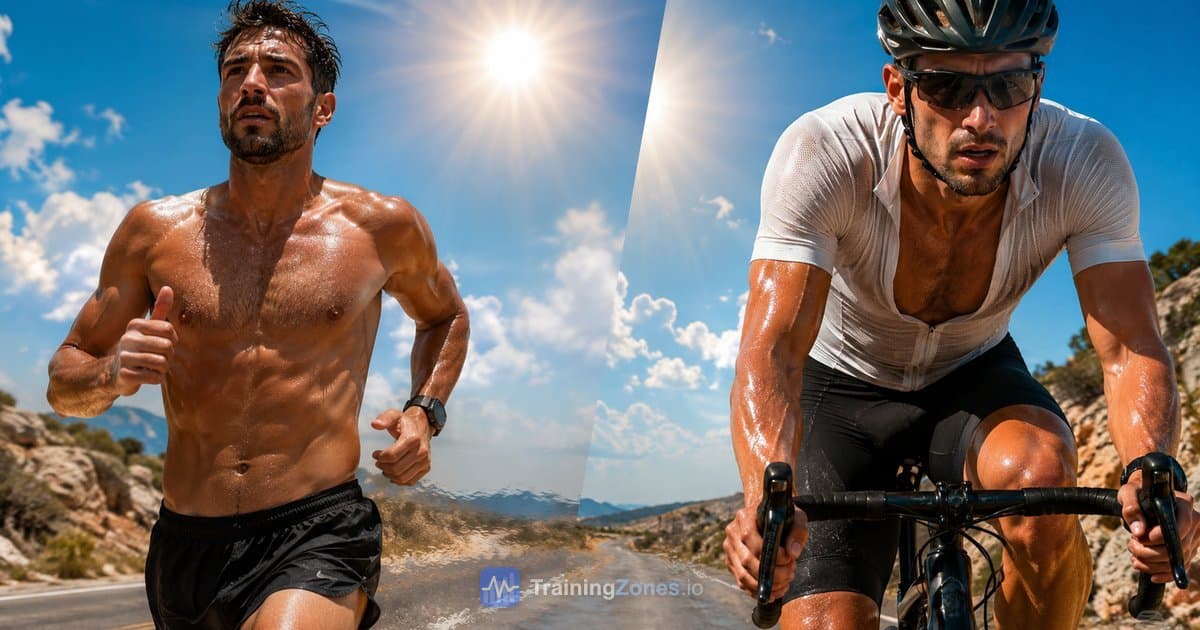
Heat training is deliberate exercise in hot conditions, done on purpose rather than tolerated by accident, to force your cardiovascular and thermoregulatory systems to adapt faster and race better when the temperature climbs.
It's the umbrella term for three related but distinct things, and mixing them up is where a lot of confusion starts.
Heat acclimatization is what happens naturally when you train repeatedly in a genuinely hot environment over one to two weeks: a summer training block, a training camp somewhere humid, a race-week arrival in a hot city.
Heat acclimation is the controlled, often indoor version of the same process: a trainer session in a warm garage, a sauna suit, deliberately overdressed intervals when the weather outside refuses to cooperate.
Both produce the same underlying adaptations. The difference is where the heat comes from, not what your body does with it.
Coaches sometimes use the words interchangeably, and honestly, for a recreational athlete planning a hot race, the distinction matters less than the practice itself.
What matters is exposure: enough hot sessions, spaced closely enough, for long enough, to trigger real physiological change. Skip that and you're just a fit athlete who happens to be uncomfortable in the heat, which is a very different thing from an athlete whose body has actually recalibrated for it.
This guide walks through what heat training does inside your body, a practical 10 day protocol you can run before a race or a summer block, how the demands differ across running, cycling, swimming, and triathlon, budget options if you don't have reliable hot weather to train in, and the safety thresholds that matter more than any performance number.
TrainingZones.io built this guide because most heat resources online cover one sport and skip the multi-sport reality that triathletes in particular deal with. If you already know your baseline splits and want to see how they hold up once the mercury rises, the heat pace calculator will translate a cool weather pace into a realistic hot weather target.
How Heat Training Works: What Actually Changes in Your Body
Heat training triggers four measurable adaptations: your blood plasma volume expands, your heart doesn't have to work as hard at a given pace, you start sweating sooner and more efficiently, and your body gets better at directing blood to your skin without stealing too much from your working muscles. None of this happens instantly, and none of it is permanent without upkeep.
Plasma volume is the fastest mover. Within the first 24 hours of consistent heat exposure, your blood plasma starts expanding, and it keeps climbing toward a peak somewhere around day three to day five, typically landing 10 to 15% above your baseline.
More plasma means more blood volume to route toward your skin for cooling without robbing your muscles of oxygen delivery, which is exactly the tug of war that makes hot workouts feel so much harder than the pace suggests. Leave the heat stimulus behind, though, and that expansion starts fading between day eight and day fourteen. It's a real adaptation, but a leased one, not an owned one.
The heart rate change is the one athletes notice first and trust the most, because it's visible on every watch. At the same pace, in the same conditions, a heat acclimatized athlete typically runs 10 to 12 beats per minute lower than they did before the block started. That's not a small effect. It's the difference between a run that reads as zone 3 in June reading as zone 2 by late July, purely because your cardiovascular system has adapted, not because your fitness suddenly changed overnight.
Some athletes and coaches track this shift directly with a wearable core temperature sensor like CORE instead of inferring it from heart rate alone, though that's a serious piece of kit built for elite and research use, not something you need for a summer road race.
Sweat response is the slowest adaptation and the one most people underestimate. Early in a heat block, your sweat glands are already reasonably active, but they're inefficient: you lose more sodium than you need to, and the onset of sweating lags behind your rising core temperature.
By the second week, sweating starts earlier relative to effort, spreads more evenly across your skin instead of pooling in a few spots, and loses less sodium per liter. This is the last piece to fall into place, which is one reason a five day heat block feels like a start rather than a finish.
Here's where honesty matters more than marketing. Lorenzo et al. (2010) reported roughly a 5% VO2max improvement in temperate conditions after a heat acclimation block, an appealing idea often nicknamed the poor man's altitude tent. It's a genuinely interesting hypothesis, and it's the reason some endurance coaches began prescribing heat blocks even for athletes with no hot race on the calendar.
But it hasn't held up consistently: Karlsen and colleagues (2015) failed to replicate a cool weather performance benefit in trained cyclists using a comparable protocol. Treat the cool weather transfer effect as an open, debated question, not a settled fact.
What's genuinely robust, confirmed repeatedly across studies, is that heat training makes you measurably better at performing in the heat itself. That's the claim worth building a training block around.
How to Run a 10 Day Heat Acclimatization Protocol
10 Day Heat Acclimatization Protocol
Build heat tolerance in about ten days, in any endurance sport
Day
Duration
60 min
Intensity
Easy aerobic (Zone 1 to Zone 2)
Target heat
35-38°C
Adaptations by day
Without a maintained stimulus, the adaptations start fading between day 8 and day 14, and are largely lost after about two weeks back in cool conditions.
Sport note · Run
This is the simplest exposure to set up: run in the middle of the day or on a treadmill with extra layers. Watch your cardiac drift, which increases in the heat.
A 10 to 14 day heat acclimatization protocol produces the full range of adaptations described above, while a shorter 5 to 7 day version delivers a partial but still useful benefit if a full block isn't realistic before your race. The core rule is simple: expose yourself to genuine heat stress, at low to moderate intensity, on most days, and let the adaptations compound.
- Pick your window. Ten to fourteen consecutive days works best; five to seven days is the minimum worth doing if that's all the calendar allows.
- Start easy. Days one through three should be short, easy sessions, roughly 60 minutes at an effort you could hold a conversation through, in genuinely hot conditions, not just a warm afternoon.
- Extend gradually. Days four through seven stretch to around 75 minutes at a moderate, still controlled effort. This is where sweat rate and sodium adaptations start catching up to the cardiovascular changes from the first few days.
- Add race specific work late, not early. Days eight through ten can include efforts closer to goal race pace, once your body has already banked several days of heat exposure and the risk of overheating on hard efforts is lower.
- Monitor resting heart rate and morning readiness daily. A block that's working shows a gradually dropping heart rate at matched effort; a block that's backfiring shows persistent fatigue, disrupted sleep, or a climbing resting heart rate, all signs to back off rather than push through.
- Hydrate and salt deliberately, not by habit. Heat sessions increase sweat losses well beyond what a normal training week demands, and guessing is a poor substitute for a real number from the sweat rate calculator.
- Taper the heat exposure into race week rather than stopping cold. A light heat session two to three days before the event helps hold the adaptation without adding fatigue on top of it.
Keep the intensity honest during that first week especially. The goal of early sessions isn't to prove fitness, it's to accumulate heat exposure safely enough that your body has the bandwidth to adapt instead of just surviving. TrainingZones.io treats this protocol as a floor, not a ceiling: athletes with a hot race on the calendar and enough lead time should stretch toward the full 14 days rather than stopping at the minimum 5 to 7.
Heat Training by Sport: Running, Cycling, Swimming, Triathlon
Heat stress hits runners, cyclists, and swimmers through genuinely different mechanisms, which means the practical adjustments differ by sport even though the underlying physiology, plasma volume, heart rate, sweat response, is identical.
Running in the Heat
Running generates the least self-made airflow of the three disciplines, since ground speed rarely exceeds a light breeze, so a runner relies almost entirely on ambient wind and evaporative cooling rather than the convective cooling a cyclist gets for free.
Pace adjustments matter more here than in any other sport: dew point, not air temperature, is the number that predicts how much you'll actually slow down, and the heat pace calculator turns that into an actual number instead of a guess.
Watch your heart rate zones closely during a heat block too, because heat inflated heart rate at a given pace is a normal, expected response, not a sign your fitness has collapsed overnight.
Our pick: for running in the heat, a headband beats a towel because it stays put and works at the source. The Compressport Headband wicks sweat away from your eyes without bouncing, while the OMIUS Cooling Headband uses patented evaporative panels to actively pull heat off your forehead as you run.
Cycling in the Heat
Cycling has a built in cooling advantage that running doesn't: airflow above roughly 2.8 meters per second across your skin meaningfully accelerates convective cooling, which is exactly why a fast descent feels refreshing even on a scorching day. That advantage disappears on slow climbs, in a paceline with no wind, or on an indoor trainer with a weak fan, which is when cyclists overheat fastest despite feeling like they're going easy.
Power output pays a real price once temperature climbs well above the thermoneutral zone: expect roughly a 6 to 7% drop in sustainable power for every 10 degrees Celsius above that comfortable range, purely from the added thermoregulatory burden.
Swimming in the Heat
Swimming flips the usual cooling logic on its head. Air temperature barely matters; water temperature does almost all the work, and water above roughly 26 degrees Celsius stops acting as a cooling medium and starts adding heat instead of removing it, because it's warmer than the skin it's supposed to be cooling. An outdoor pool or open water session on a hot afternoon can leave a swimmer heat stressed in a way that feels completely counterintuitive given they're submerged in water the entire time.
Triathlon: Stacking Multi-Sport Heat Stress
Triathlon stacks all three heat burdens in sequence, and the cumulative load is genuinely worse than any single discipline in isolation: a warm swim leg with no convective cooling, a bike leg where slow sections or drafting behind another rider cut the airflow advantage, then a run leg on already elevated core temperature and depleted fluid reserves.
Wetsuit rules add a wrinkle specific to the swim: under current World Triathlon age group rules, wetsuits are banned once water temperature reaches 22 degrees Celsius for swims of 1500 meters or shorter, and banned from 24.6 degrees Celsius for longer swims and for the 60 to 64 and older age categories, while wetsuits become mandatory at 15.9 degrees Celsius and below.
Check the actual water temperature forecast before race week, not just the air forecast, since the two numbers can tell very different stories.
Heat Acclimatization on a Budget: Sauna and Hot Bath Protocols
You don't need reliably hot weather to acclimatize; a sauna or a hot bath after training can produce real, measurable adaptations when outdoor heat simply isn't available. Both protocols work by extending your elevated core temperature well past the end of the workout that raised it in the first place.
The sauna protocol from Scoon et al. (2007) is the better documented of the two: competitive runners sat in a sauna at around 90 degrees Celsius for roughly 30 minutes, every other day, for three weeks, immediately after their normal training session.
The result was a 7.1% increase in plasma volume, alongside a meaningful bump in time to exhaustion. It's a serious time commitment and it demands real heat tolerance, but it's a legitimate substitute when a genuinely hot summer isn't on the calendar.
The hot bath protocol from Zurawlew et al. (2016) is more accessible for most athletes: a 40 minute easy run followed immediately by 40 minutes immersed up to the neck in 40 degree Celsius water, repeated for six consecutive days. Runners following that protocol improved their 5 kilometer time in hot conditions by about 4.9%, without ever training outdoors in real heat. A standard bathtub, a thermometer, and six days of discipline is genuinely all it takes.
Whichever route you take, treat post-exercise heat exposure the same way you'd treat a hard interval session: it adds real physiological stress on top of your training load, so schedule it on easier training days and expect it to eat into your overall recovery capacity, not sit on top of it for free. TrainingZones.io generally recommends the hot bath method for athletes without gym or sauna access, simply because a bathtub is easier to find consistently than a sauna at the right temperature and schedule.
Both of these deserve more room than a pillar guide allows. For the full method, the 2025 hot-water immersion study, and a week by week planner, see our dedicated guide to sauna and hot bath for endurance.
Heat Safety: Warning Signs and Go or No Go Thresholds
Heat Safety Thresholds
When to back off, and how to recognise heat stroke
From 28 °C WBGT (black flag), cancel or postpone hard training and racing.
WBGT combines air temperature, humidity, solar radiation and wind, so it reflects real heat stress far better than the temperature your weather app shows.
Flag thresholds: American College of Sports Medicine (Armstrong et al., 2007), the same scale as our heat pace calculator. WBGT index: Yaglou and Minard, 1957.
For education only, not medical advice. If heat stroke is suspected, start cooling immediately and call emergency services.
Heat safety in endurance sport comes down to one decisive question: is there central nervous system dysfunction, meaning confusion, loss of coordination, disorientation, or collapse? That single sign, not a number on a thermometer, is what separates a genuine medical emergency from ordinary heat discomfort, and it's the piece competitors and even some coaches routinely get wrong.
Exertional heat stroke is defined by that CNS dysfunction occurring alongside a markedly elevated core temperature, commonly cited as above 40 degrees Celsius by the American College of Sports Medicine (ACSM, 2021) or above 40.5 degrees Celsius by the National Athletic Trainers' Association (NATA, 2015).
Two things matter here that get glossed over constantly. First, that temperature has to be measured rectally; oral, forehead, and ear readings are not accurate enough to rule heat stroke in or out and should never be trusted for this decision.
Second, and more important for how you actually recognize it in the field: you do not need to confirm the exact number before acting. If someone is confused, stumbling, or losing consciousness in hot conditions, that's heat stroke until proven otherwise, full stop.
There's a persistent myth worth killing outright: the idea that heat illness progresses neatly through four ordered stages, cramps, then syncope, then exhaustion, then stroke, like a checklist you tick off in sequence. Both NATA and ACSM explicitly reject that framing.
Heat illnesses are a spectrum of distinct conditions, not a ladder you climb one rung at a time, and exertional heat stroke can strike suddenly, with little or no warning, even in an athlete who never showed the milder signs first. Waiting for a tidy progression before you take symptoms seriously is a genuinely dangerous habit to carry into a hot race.
Wet Bulb Globe Temperature, or WBGT, is the standard tool for deciding whether conditions are safe to race or train hard in. It combines air temperature, humidity, and radiant heat from the sun into a single number, and it was introduced by Yaglou and Minard back in 1957 for exactly this purpose: preventing heat casualties during military training.
The risk tier thresholds commonly used in endurance sport today, green through black flags, come from ACSM guidance, which is a separate contribution from the index itself.
Once conditions push into the red or black flag range, the right move isn't to grit your teeth through a fixed pace target, it's to shift to effort based pacing or, in the black zone, seriously consider stopping the hard efforts entirely. No workout is worth ending up in an ambulance, and no coach worth listening to will tell you otherwise. TrainingZones.io treats this section as the one part of heat training where erring cautious is never the wrong call.
Frequently Asked Questions About Heat Training
Why is heat acclimation important?
Heat acclimation lowers your heart rate at a given pace, expands your blood plasma volume, and improves your sweat response, all of which reduce the physiological strain of exercising in hot conditions. Without it, the same effort in the heat simply costs more: a higher heart rate, more fluid loss, and a much higher risk of heat illness for no extra fitness gain.
How long does it take to acclimate to heat?
Full heat acclimatization takes about 10 to 14 days of consistent daily heat exposure, while a shorter 5 to 7 day block still delivers a partial benefit if that's all the time you have. The fastest changes, plasma volume expansion and lower heart rate, show up in the first few days; sweat response adaptations take the longest to fully develop.
How to do heat training for running?
Run in genuinely hot conditions at an easy to moderate effort for 60 to 90 minutes most days over a 10 to 14 day block, building duration and intensity gradually rather than starting hard. Pair the block with the heat pace calculator so you're pacing off a realistic hot weather target instead of your cool weather splits.
What heat illnesses result from lack of acclimatization?
Unacclimatized athletes face a higher risk of heat exhaustion, marked by dizziness, nausea, and heavy fatigue, and exertional heat stroke, a medical emergency defined by central nervous system dysfunction alongside dangerously elevated core temperature. Both are far more likely when someone jumps straight into hard efforts in hot conditions without any prior heat exposure.
Does sauna help with heat acclimation?
Yes. A validated protocol using roughly 30 minutes in a sauna at around 90 degrees Celsius, every other day for three weeks after training, produced a 7.1% increase in plasma volume in competitive runners (Scoon et al., 2007). It's a genuine substitute for outdoor heat exposure when hot weather simply isn't available.
Does heat training increase VO2 max?
It might, in temperate conditions, according to one widely cited study (Lorenzo et al., 2010), but that finding hasn't been reliably replicated in later research (Karlsen et al., 2015). What's well established, and what TrainingZones.io recommends building a plan around, is that heat training reliably improves performance in the heat itself, which is a safer claim to train toward than a debated cool weather VO2max bump.
References
Lorenzo S, Halliwill JR, Sawka MN, Minson CT (2010). Heat acclimation improves exercise performance. Journal of Applied Physiology, 109(4):1140-1147.
Zurawlew MJ, Walsh NP, Fortes MB, Potter C (2016). Post-exercise hot water immersion induces heat acclimation and improves endurance performance in the heat. Scandinavian Journal of Medicine & Science in Sports, 26(7):745-754.
Scoon GSM, Hopkins WG, Mayhew S, Cotter JD (2007). Effect of post-exercise sauna bathing on endurance performance of competitive male runners. Journal of Science and Medicine in Sport, 10(4):259-262.
Yaglou CP, Minard D (1957). Control of heat casualties at military training centers. Archives of Industrial Health, 16:302-316.