Can a Sauna or Hot Bath Really Improve Endurance?
Yes. Passive heat exposure triggers the same blood adaptations as training in the heat, without adding a single hard session. In a 2025 study published in The Journal of Physiology, Jenkins and colleagues had trained runners take a post-run hot bath (45 minutes at 40°C, five times a week for five weeks). VO2max rose by 2.7 ml/kg/min, about a 4% jump, alongside a 33 g gain in haemoglobin mass. Their training never changed.
That last part is the whole point. You sit in hot water while your body is already warm, and you bank a real physiological gain that you did not have to run for. This is what coaches mean by passive heat acclimation, and it is the quiet edge behind a lot of summer race prep. At TrainingZones.io we treat it as a low-cost lever, not a magic trick, and this guide walks through exactly how it works and how to use it.
Who is this actually for? Anyone with a hot race on the calendar, obviously, but also runners and cyclists who have plateaued and want a stimulus that does not add running mileage or lifting load. If you are already training hard and cannot squeeze in more volume without breaking down, passive heat gives you a new adaptation to chase without touching your session count. Beginners can use it too, but honestly, if you are new, your biggest gains are still in consistent training, so treat the sauna as a nice extra rather than a priority.
What Passive Heat Does to Your Body
Passive heat raises your core temperature enough to force adaptations, but it splits them into two speeds. The fast ones are cardiovascular. The slow ones are haematological. Knowing which is which tells you how long to stick with it.
The quick wins show up in the first week. Your plasma volume expands, often by 10 to 25%, with roughly two thirds of that change happening in the first 24 hours. More plasma means more blood to pump, a lower heart rate at the same pace, and better sweating. The Jenkins study measured a plasma volume rise of about 250 mL and a 10 mL increase in the left ventricle's filling volume, which is basically a heart that moves more blood per beat.
There is a third adaptation that arrives last: your sweat itself changes. After a couple of weeks you start sweating earlier, more, and with less salt in it, which is your body getting better at dumping heat. You feel the cardiovascular side first, though. The tell is a lower heart rate at a pace that used to sit higher. Same effort, lower numbers, because there is simply more blood to go around. If you track your easy runs, that drift downward over a heat block is the adaptation showing up on your watch.
The slow win is the interesting one. Over four to five weeks, repeated heat sessions nudged haemoglobin mass up by 33 g. That is the same currency altitude training chases, and it is a big deal for endurance because more haemoglobin means more oxygen delivered to working muscle. Here is the catch: haemoglobin mass barely moves in the first two weeks. It needs the full block. So if you quit after a week, you get the plasma bump but miss the blood-building payoff.
- Fast (days 3 to 7): plasma volume up, heart rate down, sweating starts earlier
- Slow (weeks 3 to 5): haemoglobin mass up, VO2max up, sweat more dilute
The practical read: short blocks are fine for a heat race, but the VO2max and haemoglobin gains that carry over to cool weather need patience.
Why bother with heat instead of altitude? Access, mostly. A hot bath is in your bathroom and an altitude tent is not. Both chase the same haemoglobin gain, but one costs the price of hot water and 40 minutes you were going to spend recovering anyway. That is the case for passive heat in a nutshell: a big return on a stimulus that barely dents your week.
Sauna vs Hot Bath vs Training in the Heat
All three raise your core temperature. They differ in setting, comfort, and what they cost you. A hot bath transfers heat fast because water conducts far better than air, so you hit target temperature quickly and it is the method with the strongest recent evidence. A sauna is drier and heats you a bit slower, but it is easier to prolong and does not need a deep tub. Training in the heat builds heat tolerance too, but it also taxes your legs, so it competes with your real workouts.
- Hot bath: water around 40°C, 30 to 40 minutes, best evidence (Jenkins 2025, Zurawlew 2016), needs a deep tub
- Sauna: air around 80 to 90°C, 20 to 30 minutes, easy to access, high sweat losses
- Training in the heat: sport-specific, but costs recovery and session quality
If you only have a sauna, do not worry that you are missing out. The sauna simply asks for a little more time, because dry air warms you more slowly than water at the same effective temperature. Sit for 20 to 30 minutes rather than jumping out at 10, and go straight in after your session while you are still warm from the effort. The one thing to respect with a sauna is fluid loss: you can sweat out a lot in half an hour of dry heat, so weigh the trade against how easily you rehydrate.
The killer feature of the passive methods is that they add a heat stimulus after your session, when the training is already done. Nothing about your run or ride gets compromised. Use the planner below to see how a sauna or hot bath block builds week by week, and what to expect at each stage.
Passive Heat Planner
Sauna or hot bath, week by week, with the adaptations to expect
Target temp
40°C
Week
Sessions
3 per week
Duration
20 min
Goal
Trigger the fast adaptations
Expected adaptations
Adaptations fade without heat: roughly one day lost for every two days off.
How to do it · Hot bath
Post-exercise hot-water immersion is the most studied home method. Get into water at about 40°C within minutes of finishing an easy session, immerse to the neck, and stay in for up to 40 minutes. The warm body plus the warm water pushes core temperature toward 38.5°C without any extra training stress. This is the exact setup used by Jenkins (2025) and Zurawlew (2016).
How to Do the Post-Exercise Hot Bath Protocol
The post-exercise hot bath protocol is simple: finish an easy session, then immerse yourself in water at about 40°C for up to 40 minutes to push core temperature toward 38.5°C. Zurawlew and colleagues (2016) ran this on six consecutive days and improved 5 km time in the heat by 4.9%. Here is how to run it yourself.
- Do your easy session first. Keep it aerobic, nothing that leaves you wrecked. The heat is the extra stress, not the run.
- Get in within 10 minutes of finishing, while your core temperature is still elevated. This shortens the time you need in the water.
- Fill the bath to around 40°C and immerse to the neck. A cheap bath thermometer takes the guesswork out of it.
- Start with 15 to 20 minutes and build toward 40 over a week or two. Do not chase the hottest possible water, chase a sustained rise in core temperature.
- Sip fluid the whole time, and step out immediately if you feel dizzy, nauseous, or your head is pounding.
- Repeat 4 to 6 days a week for the induction block, then drop to 2 to 3 to maintain.
Our pick: a simple digital bath thermometer makes this protocol repeatable. Guessing the water temperature is how people either underdose the stimulus or scald themselves.
What does a week actually look like? For the first two weeks, the induction block, aim for four to six baths, each after an easy session. Keep your quality workouts in the week as normal, and slot the heat onto your recovery days and after your easy runs. From week three, you can drop to three or four baths while your training load ramps back up, since by then the fast adaptations are locked in and you are working on the slow ones. In the final week before a hot race, two or three short exposures are enough to top up. The planner above maps this out if you want to see it laid against your own race date.
You lose a lot of fluid in 40 minutes of hot water, so replacing it matters. Work out how much you actually sweat with our Sweat Rate calculator and drink to that number afterward.
Should You Sauna Before or After a Workout?
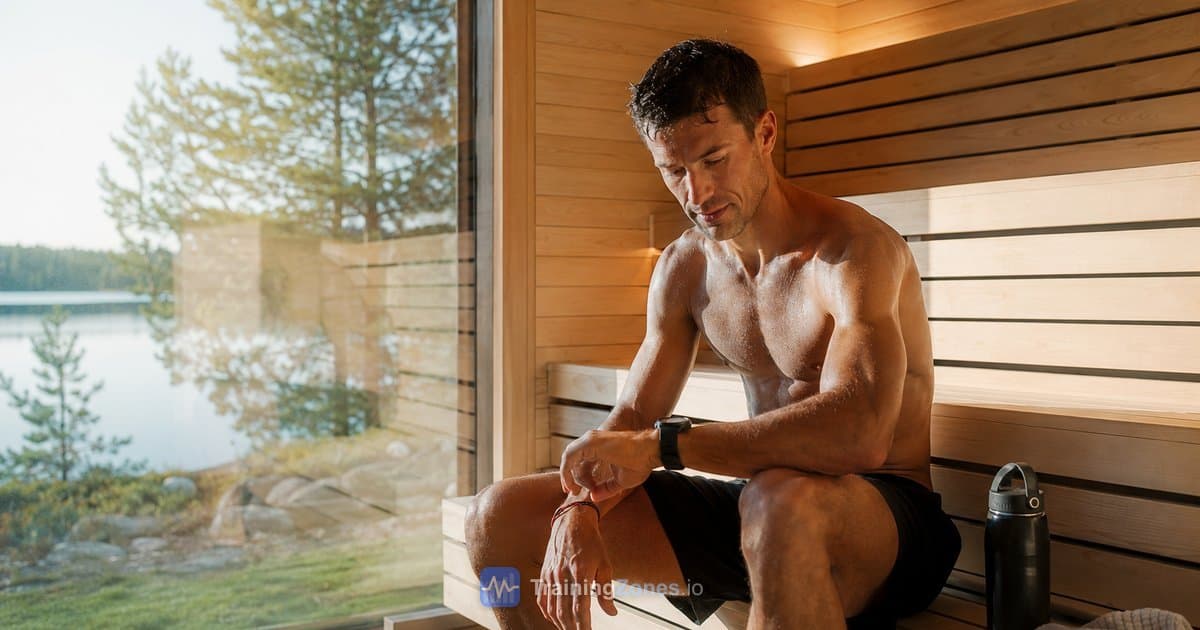
For endurance adaptation, use it after. A post-exercise sauna or hot bath adds a heat stimulus while your body is already warm, without compromising the quality of the session. Heat before a hard workout raises core temperature early and can drop the power or pace you are able to hold, which defeats the purpose of the workout.
How long should you sit? Research protocols use 30 to 40 minutes of post-exercise heat to reach and hold a core temperature around 38.5°C. If you are new to it, start at 15 to 20 minutes and build up. The goal is a sustained rise in core temperature, not the hottest possible room. Stay hydrated, and treat lightheadedness as your signal to stop, not push through.
One myth worth killing: the scale drop after a sauna is water, not fat. You will weigh less stepping out, and you will weigh the same again once you rehydrate. The real gains here are in your blood and your heart, not on the bathroom scale. At TrainingZones.io we would rather you chase the haemoglobin than the water weight.
How Long Do the Gains Last?
Passive heat adaptations fade once the heat stops, but slower than you might fear. Zurawlew and colleagues found that the adaptations from post-exercise hot water immersion were retained for at least two weeks after the last session. As a rough rule, you lose about one day of adaptation for every two days without heat exposure.
That retention window is what makes passive heat so practical for racing. You can run a full block in the weeks before a hot event, taper the heat down along with your training, and still arrive adapted. If your race is more than two weeks out from your last session, add a short top-up block, two or three exposures in the final week, to bring the adaptations back. Re-acclimation is much faster than the first time, so a couple of sessions restores most of it.
If you are stacking heat work into a hot-race build, it pairs naturally with pacing by conditions. Our Heat Pace calculator shows how much to slow down for temperature and humidity on race day, and our heart rate zone calculator helps you keep easy sessions genuinely easy so the heat is the only extra load.
Does Passive Heat Make You Faster in Cool Weather Too?
Here is where honesty matters. Heat adaptation clearly makes you faster in the heat, that part is settled. Whether it carries over to cool conditions is genuinely debated, and any coach who tells you it is guaranteed is overselling. The 2025 Jenkins study stands out because it measured a VO2max gain in temperate conditions, which is a stronger result than the cool-weather transfer that many studies fail to reproduce.
Older work is split. Lorenzo and colleagues (2010) reported a gain in cool conditions after heat acclimation, while Karlsen and colleagues (2015) found no transfer at all. The claim you can bank on is the one about the blood: more plasma and more haemoglobin are real, measured, and useful in any weather. Treat a cool-weather personal best as a bonus, not a promise. At TrainingZones.io we would frame passive heat as a strong bet for hot races and a promising, still-unproven bet for cool ones.
Is Passive Heat Safe, and Who Should Avoid It?
Passive heat is safe for most healthy athletes when you build up gradually, hydrate well, and stop at the first sign of trouble. But raising core temperature on purpose is a real stress, and it is not for everyone. A hot bath or sauna drops blood pressure and can cause fainting, especially standing up quickly afterward.
Skip passive heat, or clear it with a doctor first, if you are pregnant, have cardiovascular disease, uncontrolled blood pressure, or a condition that affects how you regulate temperature. Never do it after alcohol, never alone if you are prone to dizziness, and never fall asleep in a hot bath or sauna. Dizziness, nausea, confusion, or a pounding headache mean get out now and cool down. As with anything on TrainingZones.io, this is general education, not medical advice, and your own health situation comes first.
Frequently Asked Questions About Passive Heat Training
Does a sauna or hot bath really improve endurance?
Yes. A 2025 study in The Journal of Physiology found that five weeks of post-run hot-water immersion raised VO2max by 2.7 ml/kg/min and haemoglobin mass by 33 g in trained runners, with no change to their training. The gains come from a bigger blood volume and more oxygen-carrying capacity.
Should you use a sauna before or after a workout?
After. A post-exercise sauna or hot bath adds a heat stimulus while your body is already warm, without hurting the quality of the session. Heat before a hard workout raises core temperature early and can reduce the pace or power you can sustain.
How long should you sit in a sauna after a workout?
Research protocols use 30 to 40 minutes to reach and hold a core temperature around 38.5°C. Start with 15 to 20 minutes and build up. The goal is a sustained rise in core temperature, so stay hydrated and stop if you feel dizzy.
Is a hot bath as good as a sauna?
For endurance, the hot bath has the strongest recent evidence, largely because water heats you faster and more evenly than sauna air. A sauna still works and is easier to access if you do not have a deep tub. Both push core temperature high enough to drive adaptation.
How many weeks until it works, and how long does it last?
Plasma volume rises within the first week, while the haemoglobin and VO2max gains need four to five weeks. Once you stop, expect to lose roughly one day of adaptation for every two days off, though the adaptations hold for at least two weeks.
Does a sauna after a workout kill your gains?
No, not for endurance athletes. The concern about blunted muscle growth comes from strength training, and even there the evidence is mixed. For runners, cyclists, and triathletes, post-session heat adds an aerobic and blood-building stimulus, it does not undo your training.
References
- Jenkins EJ et al. (2025). Long-term passive heat acclimation enhances maximal oxygen consumption via haematological and cardiac adaptation in endurance runners. The Journal of Physiology.
- Zurawlew MJ et al. (2016). Post-exercise hot water immersion induces heat acclimation and improves endurance exercise performance in the heat. Scandinavian Journal of Medicine & Science in Sports, 26(7):745-754.
- Zurawlew MJ et al. (2019). Post-exercise hot water immersion elicits heat acclimation adaptations that are retained for at least two weeks. Frontiers in Physiology, 10:1080.
- Scoon GS et al. (2007). Effect of post-exercise sauna bathing on the endurance performance of competitive male runners. Journal of Science and Medicine in Sport, 10(4):259-262.