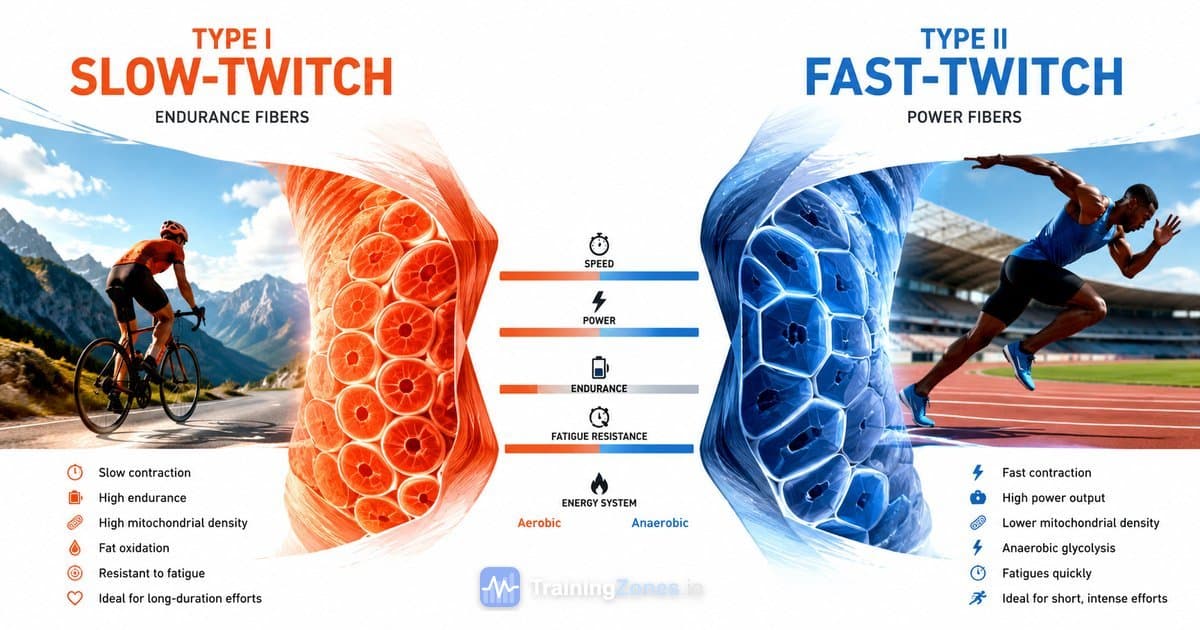
What are muscle fiber types?
Skeletal muscle fibers are classified into three types based on contraction speed, metabolic pathway, and fatigue resistance: Type I (slow-twitch oxidative), Type IIa (fast-twitch oxidative-glycolytic), and Type IIx (fast-twitch glycolytic). Most human muscles contain a mix of all three, with the ratio varying by muscle group and genetic makeup. This profile shapes almost everything about how you respond to training, from how fast you recover to which races you're naturally built for.
Here's the part that often surprises people: you don't have just one fiber type. Every muscle is a mosaic. Your vastus lateralis (the big quad muscle) might be 60% Type I and 40% Type II, while your gastrocnemius skews more Type II. Elite marathon runners typically have 70–80% Type I fibers in that quad; elite sprinters have 25–35%. Most recreational endurance athletes sit somewhere in the 50–65% Type I range, but the spread is wide. Genetics draws the starting line. Training moves it, but only so far.
Understanding your fiber type distribution isn't just academic. It tells you why you naturally gravitate toward certain event lengths, why your recovery looks different from your training partner's, and how to structure your zones for the biggest gains. TrainingZones.io exists precisely to bridge that gap between physiology and practical training decisions.
Type I muscle fibers: the endurance engine
Type I muscle fibers (slow-twitch) are characterized by high mitochondrial density, rich capillary supply, and elevated myoglobin content, which is what gives them their distinctive red color. They contract slowly, resist fatigue for hours, and rely primarily on aerobic metabolism, burning fat and carbohydrate through oxidative phosphorylation with oxygen present.
The practical numbers matter here. Type I fibers contain roughly three times more mitochondria than Type IIx fibers. That mitochondrial density is what allows them to produce ATP continuously for long efforts without accumulating metabolic waste products that would force you to slow down. They also have a high density of capillaries bringing oxygen in and shuttling lactate and CO₂ out. The result: a fiber that can fire repeatedly, thousands of times per hour, for hours on end.
This is why Zone 2 training, the foundational aerobic work done at a conversational pace, is specifically targeting these fibers. At Zone 2 intensity, Type I fibers are doing most of the work, and the training signal pushes them to build more mitochondria, denser capillary networks, and better fat oxidation. It's a slow process (12–16 weeks to see structural changes), but it's the bedrock of endurance adaptation.
If you're a marathon runner, triathlete, or long-distance cyclist, your Type I fibers are your biggest asset. According to Costill et al., elite endurance athletes show Type I proportions in the vastus lateralis well above the population average. You're not just training to push harder; you're training to keep these fibers firing efficiently at the edge of your aerobic capacity.
Use our heart rate zone calculator to find your personal Zone 2 boundary: it's the intensity that maximally stimulates Type I adaptation without tipping into anaerobic territory.
Type IIa muscle fibers: the hybrid fiber
Type IIa fibers (fast-twitch oxidative-glycolytic) are the chameleons of skeletal muscle. They contract faster than Type I but can still draw on aerobic metabolism, giving them a mix of speed and endurance that neither of the other types fully replicates. They sit midway on every relevant metric: contraction speed, mitochondrial density, fatigue resistance, and force output.
Think of them as the fibers that dominate the "middle ground" of sport: 5K and 10K running, criterium cycling, sprint triathlons, 400m to 800m swimming. At these intensities, you're going too hard for pure Type I aerobic metabolism, but not so hard that glycolytic Type IIx fibers carry the load. Type IIa fibers handle that zone.
What's particularly interesting about Type IIa fibers is their trainability. Research by Plotkin et al. (2021) confirmed what coaches had suspected for decades: endurance training consistently shifts Type IIx fibers toward the IIa phenotype. You can't easily convert Type II into Type I (that basic ratio is largely genetic), but within your fast-twitch pool, high-volume aerobic training moves IIx fibers toward IIa, making them more aerobically capable. This is one of the clearest adaptations that separates a well-trained athlete from an untrained one with the same genetic profile.
For endurance athletes, this matters practically. The more IIa (and less IIx) you have, the more aerobically efficient your fast-twitch fibers are. High-volume Zone 2 training, threshold work, and even long interval sessions at 10K to half-marathon pace all drive this shift. Over a training career, an athlete with a 50/50 Type I/II split can effectively train their IIa fibers to behave almost like Type I under certain conditions.
Type IIx muscle fibers: explosive power
Type IIx fibers (fast-twitch glycolytic) are the fastest and most powerful fibers in the human body. They contract at roughly twice the speed of Type IIa fibers, generate 2–3 times more peak force per cross-sectional area than Type I fibers, and are fueled almost entirely by glycogen through anaerobic glycolysis. The trade-off: they exhaust within 10–30 seconds of maximal effort, and they accumulate metabolic byproducts quickly.
These are the fibers that fire when you sprint to the finish line, throw a heavy deadlift, or launch out of the blocks. In terms of tissue color, Type IIx fibers are white or pale pink, low in myoglobin, low in capillarization, low in mitochondria. They don't need oxygen for their brief, explosive purpose.
A common misconception is worth addressing here. "Slow-twitch" does not mean weak, and "fast-twitch" doesn't mean better. Type I fibers can generate sustained force for hours. They're not weaker; they're optimized for a completely different job. Similarly, having lots of Type IIx fibers isn't an athletic advantage if your sport is a marathon. For an endurance athlete, undertrained IIx fibers are essentially idle potential that may even impair recovery efficiency.
Endurance training reduces the proportion of pure IIx fibers (they shift toward IIa), while sprint and strength training preserves them. For most endurance athletes, a small pool of Type IIx fibers is useful for surges, kicks, and hill attacks, but the goal isn't to maximize them.
Type I vs Type II: a direct comparison
The three fiber types sit on a continuous spectrum rather than being entirely separate categories. Here's how they compare across key performance properties:
Contraction speed:
- Type I: slow (time to peak force ~110 ms)
- Type IIa: fast (~50 ms)
- Type IIx: very fast (~25 ms)
Fatigue resistance:
- Type I: very high, can sustain activity for hours
- Type IIa: moderate, fatigues in minutes to tens of minutes
- Type IIx: low, exhausted in 10–30 seconds at maximum output
Mitochondrial density:
- Type I: high, the aerobic engine
- Type IIa: moderate, trainable upward with endurance training
- Type IIx: low, relies on glycolytic pathways
Primary fuel source:
- Type I: fat and carbohydrate (aerobic oxidation)
- Type IIa: mixed, aerobic + glycolytic depending on intensity
- Type IIx: glycogen (anaerobic glycolysis)
Force output:
- Type I: low-to-moderate
- Type IIa: moderate
- Type IIx: very high
Best suited for:
- Type I: marathon, triathlon, long cycling, ultra-distance events
- Type IIa: 5K–10K, criterium, sprint triathlon, middle-distance swim
- Type IIx: sprints, jumps, Olympic lifts, surges under 30 seconds
Muscle fiber types explorer
Compare Type I, IIa and IIx, then estimate your dominant profile
Tap a fiber type to see its properties
Which muscle fiber type do I have?
The definitive method is a muscle biopsy, a small needle extraction from a target muscle analyzed under a microscope. Outside a sports science lab, that's not going to happen. But you can estimate your fiber type dominance from performance patterns, and the self-assessment above gives you a starting point.
The most reliable behavioral indicators:
- Natural event affinity: if you feel at home running marathon pace for hours but struggle to hold 5K pace for more than a minute, Type I likely dominates. If short fast efforts feel more natural than long slow ones, you lean Type II.
- Recovery speed: Type I-dominant athletes typically recover faster from aerobic efforts. Fast-twitch athletes (especially IIx-rich) often need more time between hard sessions, not less.
- 1RM strength relative to body weight: high relative strength with limited endurance capacity suggests a Type II lean; the inverse suggests Type I.
- Response to Zone 2 training: athletes with high Type I proportions often see heart rate stabilize quickly at Zone 2 intensity, with minimal cardiac drift. Those with more Type II often see drift start earlier.
None of these are diagnostic on their own. The pattern across all four is what gives you a reasonable picture. And importantly, none of this is fixed. Training changes the IIx/IIa balance over years, even if the Type I/II baseline is genetic.
Can you change your muscle fiber type?
Yes, partially. The short answer: endurance training reliably shifts Type IIx fibers toward Type IIa over months to years. The basic Type I/Type II ratio is largely genetic and doesn't change much over a training career. But the IIx/IIa balance within your fast-twitch pool is highly trainable.
Plotkin et al. (2021, Frontiers in Physiology) found significant IIx-to-IIa transitions in untrained individuals after just 6 weeks of moderate-volume cycling. In well-trained athletes, this shift has usually already occurred, which is part of why trained endurance athletes have almost no pure IIx fibers left in their primary locomotor muscles.
Strength training can also shift fibers, but in the opposite direction within the Type II pool: detraining from endurance work sees IIa fibers begin reverting to IIx. This is reversible with resumed training.
What you cannot meaningfully do: convert Type II fibers into Type I through training. The literature occasionally shows small percentage shifts, but these are at the edge of measurement error and take years. For practical purposes, you work with the Type I/II balance genetics gave you, and you optimize the IIa/IIx ratio through training.
The ACSM position stand on exercise and physical fitness notes that while fiber type transitions do occur, they are modest and slower than cardiovascular adaptations. Patience, consistency, and specificity of training are the real variables.
Training implications per fiber type
Understanding your fiber type profile shapes how you should structure training, set expectations for adaptation timelines, and interpret your response to different sessions.
If you're Type I dominant:
- You respond exceptionally well to high-volume, low-intensity Zone 2 training. Stack the aerobic miles.
- Your threshold pace may feel unsustainably hard at first: the fast-twitch fibers aren't well-conditioned aerobically. Consistent threshold work fixes this over months.
- Recovery is relatively quick after Zone 2 sessions, but high-intensity sessions still accumulate fatigue, so don't skip easy days.
- You are built for events of 90 minutes and longer. This is your natural terrain.
If you lean Type II (IIa-rich):
- Polarized training (80% easy, 20% hard) tends to work well: it trains both poles of your fiber distribution.
- Your aerobic base builds slower initially but your fast-twitch fibers respond well to quality intervals.
- Middle-distance events (5K–half marathon, sprint and Olympic triathlon) often suit you best.
- Monitor recovery carefully: fast-twitch fiber damage from hard sessions accumulates faster.
If you have significant Type IIx:
- You likely need more recovery time between hard sessions than your training peers.
- Repeated-sprint training converts IIx to IIa over time, which is often a better investment than trying to force aerobic volume your body isn't ready for.
- Short, focused quality efforts (e.g., 6 × 400m at max sprint pace) stress IIx fibers specifically and drive the adaptation you need.
In all cases, your fiber type profile influences which training zones produce the greatest adaptation. Use the power zone calculator if you're a cyclist, or the heart rate zone calculator for running and multisport, to personalize intensity targets around your physiology rather than generic percentage formulas.
At TrainingZones.io, every calculator is built on the principle that zone training is only useful if the zones actually match your individual physiology. Your fiber type profile is one part of that picture, a big, underappreciated one.
Our pick for heart rate monitoring: The Polar H10 chest strap gives you the most accurate real-time heart rate data for training in the right zone. Getting your Zone 2 boundary right is especially important when you're training to develop your aerobic fiber base, and a chest strap is significantly more accurate than wrist-based optical monitors during exercise.
Frequently Asked Questions About Muscle Fiber Types
What are the three types of muscle fibers?
Human skeletal muscles contain three main fiber types: Type I (slow-twitch oxidative), which resist fatigue and rely on aerobic metabolism; Type IIa (fast-twitch oxidative-glycolytic), a hybrid that combines moderate speed with reasonable endurance; and Type IIx (fast-twitch glycolytic), the most powerful and explosive type, which fatigues within seconds. Most muscles contain a mix of all three, with the ratio varying by muscle group and individual genetics.
What is a characteristic of a Type I muscle fiber?
Type I muscle fibers (slow-twitch) are characterized by high mitochondrial density, rich capillary supply, and elevated myoglobin content that gives them their red color. They contract slowly, resist fatigue for hours, and rely primarily on aerobic metabolism. Endurance athletes tend to have a higher proportion of Type I fibers in their primary locomotor muscles.
What is a characteristic of a Type II muscle fiber?
Type II muscle fibers (fast-twitch) contract quickly and generate high force, but fatigue more rapidly than Type I. Type IIa fibers use both aerobic and anaerobic metabolism and can sustain moderate-duration efforts of several minutes. Type IIx fibers are purely glycolytic, firing explosively for sprints and heavy lifts but exhausting within 10–30 seconds.
How do I know if I have type 1 or type 2 muscle fibers?
The definitive method is a muscle biopsy, which requires a sports science lab. Without one, you can estimate from performance patterns: if you naturally excel at long, steady efforts and recover quickly from aerobic work, you likely have more Type I fibers. Strong sprint performance and fast recovery from short hard efforts point toward more Type II. The quiz on this page combines five behavioral indicators for a practical starting estimate.
Which muscle fiber type is best for endurance sports?
Type I fibers are best suited for endurance sports. They are aerobically efficient, fatigue-resistant, and capable of sustaining effort for hours. That said, Type IIa fibers also play a key role in endurance performance, a high proportion of well-trained IIa fibers (which have shifted aerobically through training) can be a significant asset at distances from 5K to half marathon.
Which muscle fiber type is best for a 1RM test?
Type IIx fibers are the primary drivers of a 1-repetition maximum (1RM) strength test. They generate 2–3 times more peak force per cross-sectional area than Type I fibers and are recruited maximally during very high-force, low-speed efforts. Athletes with a higher proportion of Type II fibers typically outperform Type I-dominant athletes on 1RM tests, even at the same body weight.
References
- Costill DL et al. (1976). Skeletal muscle enzymes and fiber composition in male and female track athletes. Journal of Applied Physiology, 40(2):149–154.
- Plotkin DL et al. (2021). Muscle Fiber Type Transitions with Exercise Training. Frontiers in Physiology, 12:734282.
- Scott W et al. (2001). Human skeletal muscle fiber type classifications. Physical Therapy, 81(11):1810–1816.