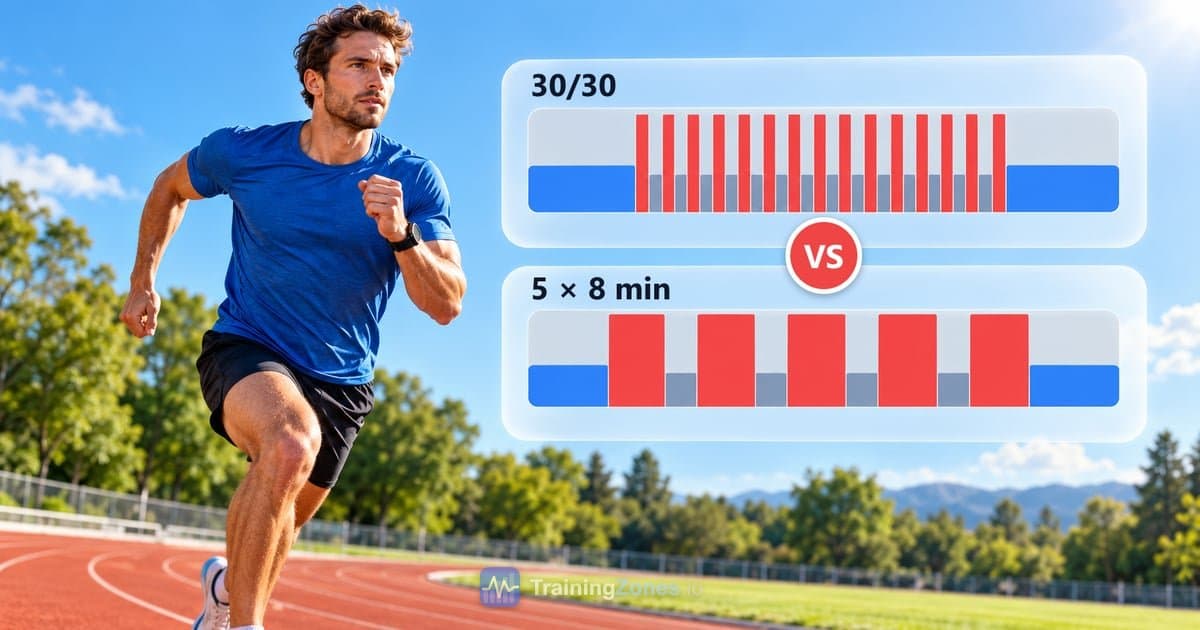
What is the 30/30 interval method?
The 30/30 interval method, developed by French exercise scientist Véronique Billat, alternates 30 seconds at 100-105% of your VO2max pace (vVO2max, or VMA in French) with 30 seconds of easy jogging recovery. Repeated for around 15 minutes, it keeps you close to your VO2max without the muscular fatigue of a long effort. It's the best known short VO2max session in running.
If you've searched for 30/30 intervals, you've probably noticed that every article explains the same thing: how to do the workout. That's useful, but it leaves out the real question. Is it better than the classic long intervals of 5 to 8 minutes?
This guide answers that head to head. You'll get the science, the paces, a step by step session, and a 6 week block that uses both formats. It all starts from your VO2max pace, so if you don't know it yet, work it out first with our VMA calculator.
At TrainingZones.io, we treat 30/30 as a tool, not a religion. Sometimes it's exactly what you need, and sometimes a long rep does the job better.
What are long VO2max intervals?
Long VO2max intervals are continuous efforts of 3 to 8 minutes run at or just below your VO2max pace, separated by 2 to 3 minutes of easy jogging. Classic examples are 5×5 minutes, 4×6 minutes and 3×8 minutes. They chase the same goal as 30/30: as many minutes as possible near your VO2max.
The difference is how you get there. At the start of each rep, your oxygen uptake takes one to two minutes to climb towards its ceiling. After that, a long rep keeps you up there in one unbroken block.
There's a catch, though. You can't hold 100% of your VMA for 8 minutes: the time to exhaustion at that speed is roughly 4 to 8 minutes depending on the runner. So the longer the rep, the lower the pace. Aim for about 95-100% of VMA on 3 to 5 minute reps, and 92-95% on 6 to 8 minute reps.
Don't confuse this with threshold work, though. Threshold runs sit around 80-90% of VMA in blocks of 10 to 20 minutes, with blood lactate holding steady. Long VO2max reps are faster: your oxygen uptake keeps climbing toward its ceiling during each rep.
These sessions are tougher in the head. Every rep asks you to keep going while your legs burn, which is exactly why they're so useful when you prepare for a race.
Think of a 5 minute rep as a mini race. You have to settle into the pace in the first 30 seconds, resist the urge to surge, and keep your form when fatigue creeps in. That's a skill, and it only improves with practice.
The flip side is the cost. After a session of 5×5 minutes, most runners feel it in their legs for a couple of days, so you can't stack these every other day. That's the main reason we don't recommend them as your only VO2max session.
What are the best intervals for VO2max running?
Neither format wins on every count: both 30/30 and long intervals can get you a lot of time near your VO2max, and the real difference is how much fatigue each one costs. 30/30 is easier to absorb and repeat. Long reps build more tolerance for sustained hard running, and more mental toughness.
To answer properly, you need to look at the right metric. According to Buchheit and Laursen (2013), the key variable is the accumulated time near VO2max, not the length of each effort. Both short and long formats can reach it. They differ in their anaerobic and neuromuscular load, which is higher with long intervals and lower with short ones.
Here's what the studies actually say. Billat and colleagues (2000) found that running 30 seconds at the speed associated with VO2max, alternated with 30 seconds at 50% of that speed, kept runners at VO2max for several minutes longer than a continuous run at a high but submaximal speed.
Rønnestad and colleagues (2015) compared two programs in well trained cyclists over 10 weeks. Three series of 13×30 s/15 s produced larger gains in VO2max and power output than 4×5 minutes.
One caution: those were cyclists. Transfer to running is likely, but it isn't proven, so don't treat it as the final word on short versus long.
Gunnarsson and Bangsbo (2012) tested the 10-20-30 method on moderately trained runners. They improved their 5K time with about half the training volume. It's a close cousin of 30/30, built on the same idea of short, lively efforts.
Here's the head to head, criterion by criterion:
- Effort duration: 30 seconds for 30/30, versus 5 to 8 minutes for long intervals.
- Intensity: 100-105% of VMA for 30/30, versus 90-100% for long intervals (95-100% on 3 to 5 minute reps, 92-95% on 6 to 8 minute reps).
- Time near VO2max: high for both, as long as the session is built well.
- Muscular fatigue: lower for 30/30, higher for long intervals.
- Mental demand: lower for 30/30 (the end of each effort is always close), higher for long intervals.
- Recovery: usually 24 to 48 hours after 30/30, 48 to 72 hours after long reps (a coaching observation, not a study).
- Best for: beginners, base periods and busy weeks with 30/30; experienced runners and race specific phases with long intervals.
So which one should you pick? It depends on your situation, and we'll get to that in a moment. In the meantime, play with the comparator below to get a feel for how the two formats stack up.
Interval Session Comparator
30/30 vs 10-20-30 vs 5 × 8 min: same goal, three very different sessions
2 sets of 10 × (30 s hard, 30 s jog), 3 min easy jog between sets. 15 min warm-up and 10 min cool-down included.
Not sure of your VMA? Use the VMA calculator on TrainingZones.io.
Your target paces
- Hard 30 s efforts100-105%3'49" - 4'00" min/km
- Recovery jog50-60%6'40" - 8'00" min/km
How the session feels
Total duration: 48 min
Typical recovery before the next hard session: 24-48 h
A qualitative guide from 1 to 5, not a measurement. Individual response varies.
How fast should you run 30/30 intervals?
In 30/30 intervals, you run the efforts at 100-105% of your VMA and jog the recoveries at around 50% of your VMA, never stopping. The formula is simple: VMA × 1.00 to 1.05. You can go slightly above your VMA because each effort lasts only 30 seconds.
Here's a worked example. With a VMA of 14 km/h, you run your efforts between 14 and 14.7 km/h, which is about 4'17" to 4'05" per kilometre. The recoveries sit around 7 km/h, a very slow jog, but a jog all the same.
Why not stop completely during the recovery? Because oxygen uptake drops when you do, and you lose part of the benefit. A slow jog keeps it high enough for the next effort to climb back to the ceiling quickly.
What if you start too hot? That's the classic mistake. Nine times out of ten, the runner who falls apart at rep 12 ran the first three at 110% of VMA. Stay in the window: the last rep should look like the first.
For long intervals, the scale shifts. With the same 14 km/h VMA, a 5 minute rep at 95-100% means about 13.3 to 14 km/h (4'31" to 4'17" per km). An 8 minute rep at 92-95% means about 12.9 to 13.3 km/h (4'40" to 4'31" per km).
Your exact paces depend on your own VMA, of course. Enter it in our VMA calculator and you'll get your 30/30 paces in minutes and seconds per kilometre. If you prefer to train by zones, our running zones calculator breaks down every intensity.
How to do 30/30 intervals
To do a 30/30 workout, you warm up, run series of 30 seconds at 100-105% of your VMA with 30 seconds of jogging between each effort, then cool down. Here's the basic session, step by step.
- Warm up for 15 minutes at an easy pace, finishing with two or three progressive strides to wake up your legs.
- Run 30 seconds at 100-105% of your VMA, roughly your 3K to 5K pace.
- Recover for 30 seconds by jogging gently, without stopping and without walking.
- Repeat in series of 8 to 10 reps, with 3 to 4 minutes of slow jogging between series (beginner: 2 series of 8; more advanced: 2 or 3 series of 10 to 12).
- Hold the same pace from start to finish: if you slow down by more than a few seconds per kilometre, end the series.
- Finish with 10 minutes of very easy cooldown jogging.
A GPS watch makes this far more pleasant, because you don't have to stare at your wrist every 30 seconds. You program the interval, the watch beeps, and you focus on your stride.
Our pick: The Garmin Forerunner 265 lets you build your 30/30 as a structured workout, with an alert at every change of pace.
What about heart rate? It helps, but remember that on 30 second efforts your heart rate takes a while to climb and lags behind your pace. A chest strap like the Polar H10 reacts faster than an optical wrist sensor, which struggles with short efforts. You can then set your zones with our heart rate zones calculator.
What are the benefits of 30/30 intervals?
30/30 intervals improve your VO2max and your VMA, make you more economical, and fit into a busy week, all with less muscular fatigue than long intervals. They're also easier to dose and repeat from one week to the next, which matters for consistency.
Here's what that looks like in practice:
- More time near VO2max: the active recoveries keep your oxygen uptake high through the whole block, which is the principle behind Billat's method.
- Less muscle damage: the efforts are short, so your legs cope better and you usually recover in 24 to 48 hours.
- A session that goes fast: you always know the effort ends in 30 seconds, which makes it easier to stay focused.
- Easy progression: add a series or a few reps and you see straight away where you stand.
- It fits busy weeks: you don't need two recovery days behind it.
Now for the most common myth. Common myth: "30/30 isn't hard enough to improve." Reality: what counts is the accumulated time near VO2max, not how hard it feels. A well run 30/30 feels moderate in the moment, yet it keeps you near the ceiling just as long as a format with a scarier reputation.
Another benefit people overlook: 30/30 teaches pacing. Because the efforts are so short, you get dozens of chances per session to practise running fast and relaxed, then settling back into an easy jog. That rhythm carries over to race surges and hilly courses.
If you finish a session feeling "almost too good", that's not a sign of a wasted workout. It's often a sign you paced it right, and that you'll be able to repeat the same session three days later.
At TrainingZones.io, the classic trap is judging a session by how wrecked you feel afterwards, instead of by the quality of the work. Don't fall for it.
Should you choose 30/30 or long intervals for your goal?
Choose 30/30 if you're a beginner, run four times a week or less, or are in a base period; choose long intervals when you're preparing a 5K or longer race and already have some experience. The right answer depends on three things: your level, your target distance and how often you train.
By level:
- Beginner or intermediate: start with 30/30. Same stimulus, much less fatigue, and you learn to run fast without burning out.
- Experienced runner: add long reps to work on sustained effort and pacing.
By race distance:
- 5K and 10K: long intervals become useful in the race specific phase, because they look like the demands of the race.
- Half marathon and marathon: 30/30 remains a great way to keep some top end speed without wrecking your legs.
By weekly frequency:
- Four runs or fewer: 30/30 is the format to favour, because you recover faster.
- Five runs or more: you can afford one long rep session every one to two weeks, as long as the rest of your running stays truly easy.
Honestly, most beginners overthink this choice. If you're unsure, start with 30/30 for a few weeks, see how your legs respond, and add long reps only when the short ones feel comfortable.
Here at TrainingZones.io, we follow a simple rule: 30/30 is the entry point, and long reps arrive once the base is solid. Closer to race day, keep one specific long session, no more than one every one to two weeks.
On the gear side, two things really change the experience. A GPS watch to time your 30 seconds without thinking about it, like the Garmin Forerunner 265, and a heart rate strap for a reliable signal, like the Polar H10.
One last warning: this advice doesn't replace medical advice. If you're returning after a long break or have a heart condition, talk to your doctor or coach before you ramp up the intensity.
Can you combine 30/30 and long intervals in one block?
Yes, and it's the best approach for most runners: start with 30/30 to build your speed base, then move to long reps as your race gets closer. The two formats don't compete, they follow each other. Here's a 6 week block built on that logic.
Your 6-week VO2max interval plan
Start with 30/30, finish with long intervals
Week 1
BaseSession 1
30/30, 2 × 8
44 min
100-105% VMA
2 sets of 8 reps (30 s at 100-105% VMA, 30 s jog), 3 min easy jog between sets. 15 min warm-up, 10 min cool-down.
Session 2
Easy run + strides
45 min
Easy, zone 2
Easy zone 2 run, then 4 to 6 strides of 20 s, relaxed and fast, with full recovery in between.
Session 3
Long run
60 min
Easy, zone 2
Steady, easy long run in zone 2. It builds the aerobic base that supports the intervals.
Three runs per week with at least one rest day between hard sessions. Percentages are of your VMA.
Get the full 6-week plan as an Excel file
General guidance only, adjust it to how you feel. Check with a doctor if in doubt. Privacy policy
The first three weeks set up the 30/30. You go from 2×8 to 2×10 and then 3×8, and in week 3 you add 4×4 minutes at 95-100% of VMA to get a first taste of longer reps. Week 4 is lighter (30/30 at 2×8), and it's the week where you absorb everything.
Then long reps take over. In week 5, you run 5×5 minutes at 92-97% of VMA plus a 30/30 session at 2×10. In week 6, you run 4×8 minutes at 92-95% and a final 30/30 at 1×12.
Around all of that, each week keeps easy runs and a long run of 60 to 75 minutes. That part matters definately: intervals only work when they're surrounded by plenty of easy running.
A quick word on how to read this block. The 30/30 weeks are about rhythm and repeatability, so don't chase faster paces, chase cleaner reps. The long rep weeks are about patience, so start the first rep a touch slower than feels necessary.
Want the full 6 week plan as an Excel file? Enter your email in the block above and you'll receive it straight away.
To keep your paces accurate, always start from your current VMA, and retest if you improve. TrainingZones.io is built so you don't have to work out those paces by hand.
Frequently Asked Questions About 30/30 vs Long Intervals
What is the 30/30 interval?
A 30/30 interval is 30 seconds at 100-105% of your VMA followed by 30 seconds of easy jogging, repeated in series. It was developed by French exercise scientist Véronique Billat. The aim is to accumulate as much time near VO2max as possible with limited muscular fatigue.
What are the best intervals for VO2 max running?
Both 30/30 and long intervals of 3 to 8 minutes work, because what matters is the accumulated time near VO2max. Use 30/30 as your entry point and add long reps for race specific work. Elite guidance is to aim for roughly 10 minutes near VO2max per session.
Are shorter intervals better than longer ones?
Not always. Short intervals cost less fatigue and recover faster, and in well trained cyclists they produced larger gains than 4×5 minutes over 10 weeks. Long intervals prepare you better for sustained race effort, and the cycling result isn't proven for running.
How hard should 30-30s be?
Run the efforts at 100-105% of your VMA, roughly your 3K to 5K pace. They should feel hard but controlled, and your last rep should match your first. Jog the 30 second recoveries at about half your VMA speed.
Can you do 30/30 intervals on a bike?
Yes. The format works on a bike, and the Rønnestad study used 30 s/15 s efforts with cyclists. Use your power or heart rate targets rather than running pace, and keep the recoveries easy but pedalling.
How many 30/30 reps should I do?
Plan 8 to 10 reps per series and 2 to 3 series, so 16 to 30 reps in total. A beginner starts with 2×8, and an advanced runner can build to 2×12 or 3×10. If your pace drops noticeably during a series, stop there.
References
- Billat, V. L., et al. (2000). Intermittent runs at the velocity associated with maximal oxygen uptake enables subjects to remain at maximal oxygen uptake for a longer time than intense but submaximal runs. European Journal of Applied Physiology, 81(3):188-196.
- Buchheit, M., & Laursen, P. B. (2013). High-intensity interval training, solutions to the programming puzzle. Part I. Sports Medicine, 43(5):313-338.
- Rønnestad, B. R., et al. (2015). Short intervals induce superior training adaptations compared with long intervals in cyclists. Scandinavian Journal of Medicine & Science in Sports, 25(2):143-151.
- Gunnarsson, T. P., & Bangsbo, J. (2012). The 10-20-30 training concept improves performance and health profile in moderately trained runners. Journal of Applied Physiology, 113(1):16-24.