What Is Cadence in Cycling?
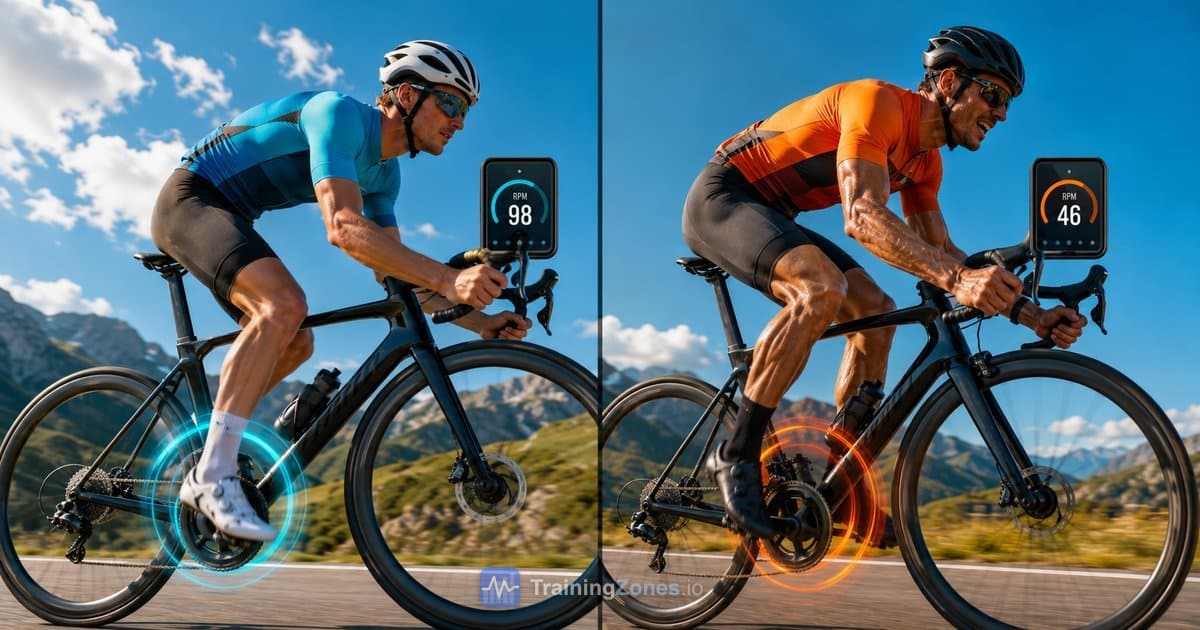
Cycling cadence is the number of complete pedal revolutions per minute (RPM). It measures how fast your legs spin, independent of how much force you apply to each stroke. Most recreational cyclists pedal between 60 and 80 RPM; trained endurance athletes typically self-select 85 to 100 RPM. Cycling power is the product of two inputs: torque and cadence. Power (watts) = Torque (N·m) × Angular Velocity, which means cadence and force are always in tension.
Here's what most people miss: cadence and gear selection are inseparable. Shift to a harder gear at the same speed and your cadence drops while your torque per stroke increases. Shift easier and your cadence rises, torque drops. Total power can stay identical either way. The question isn't which cadence produces more power. The question is which cadence produces that power more sustainably over hours of riding, and the answer is more complicated than any "90 RPM rule" suggests.
Understanding cadence properly requires separating two things that are often confused: metabolic efficiency (how much oxygen you use per unit of work) and muscular fatigue management (how long your legs can keep producing power). These two factors point in opposite directions, and that's the heart of the paradox.
The 90 RPM Myth: Where Does It Come From?
The "90 RPM rule" was popularized by Lance Armstrong and his coach Chris Carmichael in the early 2000s. Armstrong's naturally high pedaling cadence, often 100 to 110 RPM even on mountain climbs, was unusual for his era. Most climbers of the 1990s used 70 to 80 RPM on steep gradients, grinding in bigger gears. Armstrong's success with high cadence helped cement the idea that faster leg turnover was inherently superior.
The problem is that this was an observation about one athlete with exceptional cardiovascular capacity, not a universal physiological law. The research simply doesn't support a single optimal cadence. A 2004 meta-analysis found that freely chosen cadence among trained cyclists ranges from 53 to 105 RPM. That spread alone should tell you something: if 90 RPM were truly optimal, you'd expect clustering around that number, not a 50 RPM spread.
Yet the myth persists. You'll find it repeated in training apps, cycling forums, coaching software, and articles across the web. Coaches prescribe it without examining it. Beginners read it and feel like failures when 90 RPM feels terrible. Advanced riders hit 90 RPM and wonder why their power drops compared to their natural 80 RPM.
The 90 RPM figure became orthodoxy through repetition, not through science. And understanding why it's wrong actually tells you a lot about how cycling physiology really works.
The Biomechanical Paradox: Lower Is More Efficient, But Pros Pedal High
Here's the core contradiction. Lower cadences (60 to 70 RPM) are more metabolically efficient for most cyclists. At a given power output, pedaling slower requires less oxygen per unit of work because fewer muscle contractions occur per minute. From an energy-economy standpoint, slow and powerful should win.
But elite cyclists don't pedal slowly. In a landmark study by Lucia et al. (2001), professional Tour de France riders averaged 95 RPM during mountain climbs, far above the biomechanically predicted optimum of roughly 60 to 70 RPM. The gap between what's mechanically efficient and what world-class cyclists actually choose is large, consistent, and meaningful.
Why do professionals ignore the efficiency advantage of low cadence?
Because fatigue doesn't care about efficiency. At low cadences, each pedal stroke demands much greater force from your leg muscles. This high-force loading accelerates fatigue in your Type II (fast-twitch) muscle fibers and depletes local glycogen stores much faster than lower-force, higher-frequency contractions. On a flat criterium this might not matter much. On a 5-hour stage race or a 180 km ironman bike leg, it matters enormously.
High cadence distributes the same mechanical work across more contractions at lower force per stroke. The physiological result: the work shifts from your muscles toward your cardiovascular system. Your heart and lungs work harder (more oxygen consumed per minute), but your legs produce force for longer before fatigue sets in. For events lasting more than 60 to 90 minutes, this tradeoff is almost always worth it for trained riders.
That is the cycling cadence paradox: the biomechanically inefficient choice, pedaling faster and lighter, is often the physiologically smarter choice for endurance performance.
Cadence & the Endurance Paradox
Select a cadence zone to see the physiological tradeoffs
The paradox revealed
Lower cadence burns 3–5% less oxygen per watt — it is more efficient. Yet Tour de France riders deliberately spin at 90–100 rpm. Why? High cadence shifts fatigue from slow-recovering Type II muscle fibres to the cardiovascular system, which recovers between climbs. Legs stay fresh for the decisive attacks.
What the Science Actually Says
According to Foss and Hallen (2004), recreational cyclists are most efficient at 60 to 70 RPM, while trained cyclists show near-equal efficiency across 80 to 100 RPM. This is a crucial finding. As your aerobic fitness improves, the oxygen cost penalty of higher cadences decreases. Your cardiovascular system becomes capable enough to handle the increased demand, and the muscle fatigue savings of high cadence become the dominant factor.
Vercruyssen et al. (2001) extended this to triathlon, showing that cyclists who pedaled at higher cadences during the bike leg performed significantly better in the subsequent run. Even though their cycling economy was marginally lower, their legs were less fatigued from reduced muscular loading. For triathlon, the research is especially clear: optimize cadence for what comes after the bike, not just for the bike itself.
Takaishi et al. (1998) measured neuromuscular fatigue at different cadences using electromyography and found that EMG activity in the rectus femoris was minimized around 80 to 90 RPM in trained cyclists. This provides a neuromuscular explanation for why trained riders self-select higher cadences: it's the range where their legs accumulate fatigue most slowly.
The synthesis from TrainingZones.io: your optimal cadence is not a fixed number. It is a range that depends on your current fitness level, event duration, terrain, and individual muscle fiber composition. Beginners and riders with less aerobic conditioning tend to be more efficient at lower cadences. Well-trained endurance athletes tend to perform better at higher ones.
What Is the Ideal Cadence for Cycling? (It Depends on You)
Your optimal cycling cadence shifts depending on who you are and what you're doing. Here's a practical breakdown by rider profile and context.
By fitness level:
- Beginners (fewer than 2 years of consistent training): 70 to 80 RPM. Your cardiovascular system hasn't yet adapted to the oxygen demand of high-cadence pedaling. Forcing 90 RPM before you're ready increases perceived effort without much benefit. Focus first on smooth pedaling mechanics and building your aerobic base.
- Intermediate cyclists (2 to 5 years of regular riding): 80 to 90 RPM for most endurance training. You've built enough aerobic capacity that higher cadences stop costing extra energy, and the reduced muscle fatigue pays off on rides longer than 2 hours.
- Advanced and competitive cyclists: 85 to 100 RPM. Your cardiovascular system can handle the oxygen demand comfortably, so you capture the full muscular fatigue savings of high cadence on long events.
By effort type:
- Long endurance rides (Zone 1 to Zone 2): 80 to 90 RPM. Low force per stroke preserves your legs for the final hours.
- Threshold and tempo work (Zone 3 to Zone 4): 85 to 95 RPM. Matches what your aerobic system can sustain at higher intensities.
- VO2max intervals (Zone 5): 90 to 100 RPM. High-cadence, lower-torque intervals stress your cardiovascular system more directly.
- Sprints and anaerobic efforts: 100 to 130 RPM. Neuromuscular speed dominates; maximum power output requires rapid leg turnover.
- Climbs: Often drops to 70 to 85 RPM depending on gradient. Don't fight it. Cadence naturally decreases on steep terrain due to gravity and gear availability. Some elite climbers like Tadej Pogacar use 78 to 85 RPM on steep gradients, well below the 90 RPM dogma.
Use the TrainingZones.io Power Zones Calculator to get your 7 personalized power zones and the cadence ranges recommended for each one.
Cadence by Discipline: Road, MTB, Indoor, and Triathlon
Optimal cadence also varies by discipline, because the terrain, event structure, and what happens after the bike all differ.
Road cycling: 85 to 100 RPM for flat and rolling terrain. Most road cyclists naturally settle between 88 and 95 RPM at moderate effort. On sustained climbs, cadence drops to 70 to 85 RPM and this is completely normal. The data from pro pelotons shows huge variation: sprinters often pedal at 80 to 85 RPM in flat stages to maximize torque, while climbers push 90 to 100 RPM on hors-catégorie climbs to preserve their legs.
Mountain biking: Much lower on average. Technical singletrack, short punchy climbs, and the constant need for bike control mean MTB riders typically pedal 55 to 75 RPM on trail. On smoother fire roads or gravel, 80 to 90 RPM becomes achievable. Forcing high cadence on technical terrain is counterproductive and genuinely dangerous.
Indoor cycling and smart trainers: Higher cadences are easier to sustain indoors because there's no balance requirement and no terrain variation. Structured indoor sessions commonly target 85 to 95 RPM for pedaling smoothness development. High-cadence drills (100 to 120 RPM for short blocks) are a standard training tool for improving neuromuscular coordination that's much easier to do on a trainer than on the road.
Triathlon: This is where the science most clearly favors high cadence. Since you're running a half or full marathon directly off the bike, leg muscle preservation on the bike takes priority over pure cycling efficiency. 85 to 95 RPM is the recommended range for most triathlon distances. For long-course and ironman events, the upper end of this range is preferred because small differences in leg fatigue after 180 km compound significantly over a 42 km run.
How to Improve Your Cycling Cadence
If your natural cadence is 70 to 75 RPM and you want to shift it upward, the honest truth is that this takes months, not weeks. Forcing it too fast leads to a drop in power and an unpleasant riding experience. Here's an approach that actually works.
- Start with one dedicated cadence session per week on flat terrain or an indoor trainer. This keeps cadence work isolated from your other training goals.
- Select a power output you can sustain comfortably at your target cadence, say 85 RPM if your natural cadence is 78 RPM. You don't need to hit your normal training power right away.
- Ride 5 to 10 minute blocks at the target cadence with equal easy recovery time. The goal is neuromuscular adaptation, not fitness.
- Over 4 to 6 weeks, gradually extend the block duration. Your power will recover naturally as your nervous system learns the new movement pattern.
- Use high-cadence spin-outs (very easy gear, 100 to 120 RPM for 60 to 90 seconds) as a warm-up drill. This teaches your legs smooth, circular pedaling mechanics before harder work.
- Be patient and realistic. Changing your spontaneous cadence takes 3 to 6 months of consistent practice. Honestly, many recreational cyclists never fully shift their natural cadence, and that's fine as long as they understand the tradeoff between muscular fatigue and cardiovascular demand.
Pro tip: A cadence sensor makes this training significantly more effective. Without real-time feedback, you're guessing at your RPM and likely drifting from your target. With a sensor, you can see exactly when you drop below target and correct immediately.
Cadence Sensors: Tools to Track Your RPM
You can't optimize what you don't measure. A dedicated cadence sensor provides real-time RPM data to your cycling computer or smartphone app, making cadence-focused training sessions far more effective.
Modern magnet-free cadence sensors are small, durable, and simple to install. They attach to your crank arm, detect rotation via an accelerometer, and transmit simultaneously via ANT+ and Bluetooth. This means they work with Garmin cycling computers, Wahoo ELEMNT, and any cycling app including Zwift, TrainerRoad, and Strava.
Our pick: The Wahoo RPM Cadence Sensor is a reliable, affordable option for cyclists who want real-time cadence data without committing to a full power meter. It pairs instantly with any ANT+ or Bluetooth head unit and costs a fraction of what a power meter does. If you already have a power meter, it measures cadence automatically, so a separate sensor isn't needed.
For riders who want to track both cadence and power simultaneously, a power meter is the natural next step. Our FTP calculator helps you establish your baseline and calculate the zones where cadence management matters most.
Frequently Asked Questions About Cycling Cadence
What is a good cycling cadence for beginners?
For beginners, 70 to 80 RPM is a realistic and sustainable target. Don't chase 90 RPM right away. Your aerobic system may not yet be conditioned to handle the oxygen demand of high-cadence pedaling efficiently, so forcing it will just make rides feel harder for no benefit. As your fitness improves over 6 to 12 months, your naturally chosen cadence will likely rise on its own.
What cadence do Tour de France riders use?
Professional Tour de France riders average 85 to 100 RPM on flat and mountain stages, according to Lucia et al. (2001). Lance Armstrong famously pedaled 100 to 110 RPM in the mountains, but current GC leaders like Tadej Pogacar and Jonas Vingegaard often use lower cadences (78 to 88 RPM) on the steepest gradients, proving that individual variation exists even among the best.
Does higher cadence burn more calories?
Higher cadence at the same power output does not burn more calories, since total power determines caloric expenditure, not cadence alone. However, if higher cadence allows you to sustain a higher power output for longer by reducing muscular fatigue, then over a long ride you would produce more total work and burn more calories as a consequence.
What is the difference between cadence and gear ratio?
Cadence is how fast your legs spin, measured in RPM. Gear ratio determines how far the bike travels per pedal revolution. Your speed equals cadence multiplied by gear ratio multiplied by wheel circumference. To maintain the same speed on a climb, you shift to a lower (easier) gear, which lets you maintain your cadence as terrain resistance increases. This is why proper gear selection matters as much as cadence itself.
Is low cadence bad for your knees?
Very low cadences (under 60 RPM) combined with high power output increase the torque applied at the knee joint per stroke, which can elevate stress on the patellar tendon and cartilage over time. Riders with existing knee issues generally find that a slightly higher cadence of 75 to 85 RPM reduces joint loading and discomfort. If you experience knee pain while cycling, raising your cadence is often one of the first adjustments worth trying before changing bike fit.
How do I increase my cycling cadence?
Increase cadence gradually with dedicated cadence blocks during training: 5 to 10 minute efforts at your target RPM (start 5 to 8 RPM above your current natural cadence) with full recovery between each block. Do this once per week on a flat road or indoor trainer. Expect the new cadence to feel awkward and inefficient for the first 4 to 8 weeks. Adaptation takes 3 to 6 months before the higher cadence becomes your natural default. A cadence sensor provides the real-time feedback essential for this process.
References
- Lucia A et al. (2001). Preferred pedalling cadence in professional cycling. Medicine & Science in Sports & Exercise, 33(8):1361-1366.
- Foss O & Hallen J (2004). The most economical cadence increases with increasing workload. European Journal of Applied Physiology, 92(4-5):443-451.
- Vercruyssen F et al. (2001). Cadence selection affects metabolic responses during cycling and subsequent running time to fatigue. British Journal of Sports Medicine, 35(5):354-359.
- Takaishi T et al. (1998). Optimal pedaling rate estimated from neuromuscular fatigue. Medicine & Science in Sports & Exercise, 30(12):1778-1783.