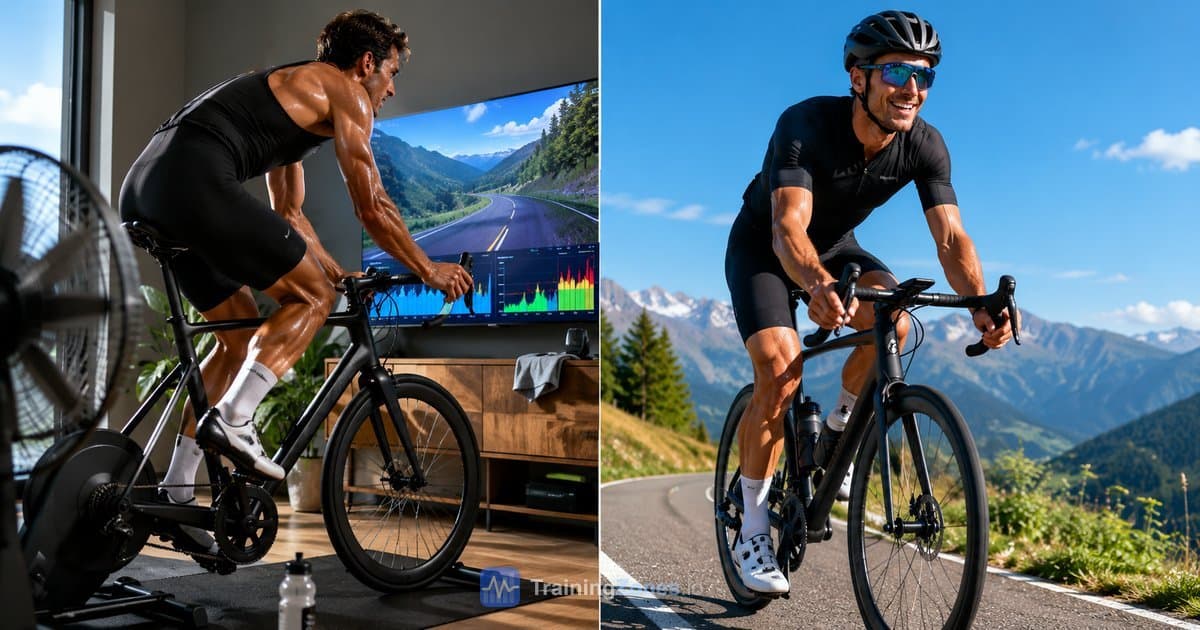
Is indoor cycling as good as outdoor cycling?
Indoor cycling is as effective as outdoor riding for building fitness, and it's often more time-efficient: a focused 60-minute session on a smart trainer delivers a training stimulus similar to about 90 minutes outdoors. The catch is that indoor and outdoor training build slightly different things, so the rider who uses both gets faster than the one who picks a side.
Here's the honest version most people won't tell you. Indoor cycling wins on control, safety and efficiency. Outdoor wins on bike handling, pacing instinct and plain enjoyment. Neither is "better." At TrainingZones.io we see the same mistake constantly: athletes treat it as a war when it's really a toolkit. Use the trainer for precision, use the road for the stuff a trainer physically can't teach you.
The real benefits of indoor cycling
The main benefit of indoor cycling is total control: no stoplights, no descents, no coasting, so every minute counts. That's why an hour indoors is worth more than an hour outdoors when the goal is a specific workout.
- Zero junk time. No freewheeling down hills or soft-pedalling through junctions. The watts are on the whole time.
- Precise intensity. ERG mode holds your target power whether you're fresh or cooked, which makes interval sessions ruthlessly accurate.
- Safety and weather-proofing. No traffic, no ice, no 5am darkness. You just train.
- Repeatability. Same effort, same setup, every week, so you can actually see progress instead of blaming the wind.
For structured work like VO2max intervals or threshold blocks, the trainer is genuinely the better tool. You hit the number and hold it. Want to set those targets properly? Build your zones with our power zones calculator before your next session.
Why you produce less power indoors
Most riders produce 5 to 10% less power indoors, and recreational cyclists sometimes 20 to 30% less. The single biggest reason is heat: indoors you lose the airflow that cools you outside, so your core temperature climbs, your heart rate drifts up, and your power sags for the same effort.
A few things stack up here:
- Reduced cooling. Without wind, sweat can't evaporate fast enough. You overheat, and a hot rider is a slower rider.
- Fixed position. Outdoors you rock the bike, shift around, and recruit stabilising muscles. Locked to a trainer, you lose some of that leverage.
- Lower cycling economy. Studies have measured economy roughly 11% lower indoors for the same oxygen cost, partly down to the heat and the static position.
So if your trainer numbers look depressing, you didn't get weaker overnight. Your body is just working in a harder environment. This is also why indoor sessions tend to feel brutal even at "easy" watts, and why your heart rate runs high (check what's normal with our heart rate zones calculator).
What outdoor riding gives you that the trainer can't
Outdoor cycling builds the skills a trainer simply can't: cornering, descending, pacing on real terrain, riding in a group, and reading the road. These are the things that make you a complete cyclist, not just a powerful one.
A trainer holds your wheel still and feeds you a number. The road throws cross-winds, potholes, sketchy descents and surges from the rider next to you. Jacob Tipper and plenty of coaches have made the point that too much indoor work leaves you fit but clumsy: great engine, shaky handling. There's also the small matter of motivation. Staring at a wall hurts in a way a sunny climb never does, and over a long season that mental cost is real.
The best indoor outdoor weekly split
For most cyclists, the best weekly split is 2 to 3 structured indoor sessions plus 1 to 2 outdoor rides, adjusted for your goals, season and the weather. Indoors handles the precise, intense work; outdoors handles endurance, skills and enjoyment.
A simple way to think about it:
- Hard intervals indoors. VO2max and threshold sessions where hitting exact watts matters.
- Long endurance outdoors. Where the social, scenic, skill-building ride lives.
- Recovery either way. Easy spins work fine indoors if the weather is grim.
- Flip it in winter or bad weather. Move more outdoors in summer, more indoors when it's dark and icy.
Most riders at TrainingZones.io find that this mix keeps both the legs and the head fresh. The exact ratio matters less than making sure you're not doing 100% of either.
Do indoor and outdoor FTP differ?
Yes, indoor and outdoor FTP often differ, and it's normal for your indoor FTP to read 5 to 10% lower than outdoors because of the heat and fixed position. Many riders set a separate, slightly lower indoor FTP so their trainer workouts land at the right intensity.
Use the tool below to estimate your indoor FTP from your outdoor number, then plug it into your training app or our power zones calculator so your trainer targets aren't accidentally too hard.
Indoor FTP Adjuster
Estimate your trainer FTP from your outdoor number
Indoor FTP
232 W
Watts lower
-18 W
Why lower?: Most riders hold 5-10% less power indoors because of reduced cooling, a fixed position and lower cycling economy. Set your trainer zones from this number.
If your numbers are wildly different (more than 10%), it's usually a cooling problem first, then a calibration or trainer-accuracy problem. Get a fan, recalibrate, and the gap usually shrinks. For more on testing FTP properly, the TrainingZones.io team covers the full protocol in our FTP testing guide (linked in the related articles below).
Which smart trainer should you buy?
The best smart trainer for most riders is a direct-drive model, where you remove the rear wheel and the bike mounts straight onto the unit. Direct-drive trainers are quieter, more accurate, and feel far more like the road than old wheel-on trainers.
Here's how to choose by budget:
- Best value: the Zwift Hub or Elite Suito range gives you accurate power and app control without the top-end price. This is where most people should start.
- Premium: the Wahoo KICKR is the long-standing benchmark for road feel, accuracy and durability.
Our pick: For a first smart trainer, the Zwift Hub hits the sweet spot of price and accuracy. If you want the best ride feel and plan to train indoors year-round, step up to the Wahoo KICKR.
Whatever you pick, a power-reading smart trainer pays for itself in training quality. If you also ride with a power meter outdoors, you can match the two and ride seamlessly between indoors and out.
How to make indoor training less miserable
The single best upgrade for indoor cycling is a powerful fan: it replaces the cooling airflow you lose indoors, drops your heart rate, and instantly makes hard sessions more bearable. After that, it's all about killing boredom.
- Get a proper fan. A strong cooling fan is the cheapest performance gain you'll ever buy. It directly attacks the overheating that saps your indoor power.
- Use an app. Zwift, Rouvy or similar turn a dull effort into a game with virtual roads and group rides.
- Towel and a mat. Sweat is corrosive; protect your bike and floor.
- Keep sessions purposeful. Indoors is for quality. A focused 45 to 60 minutes beats a soggy two-hour grind staring at the wall.
Sort the cooling first and you'll be amazed how much more power you can hold, which closes a lot of that indoor-versus-outdoor gap on its own.
Frequently Asked Questions About Indoor vs Outdoor Cycling
Is indoor cycling as good as outdoor cycling?
For fitness, yes, and it's more time-efficient: 60 focused minutes indoors roughly matches 90 minutes outside. Outdoor riding still wins for bike handling, pacing and enjoyment, so most cyclists benefit from doing both.
Why is my power lower indoors?
Most riders hold 5 to 10% less power indoors, mainly because of reduced cooling and airflow, a fixed body position, and lower cycling economy. The heat raises your heart rate and lowers sustainable power for the same effort.
Does indoor cycling translate to outdoor performance?
Yes. The aerobic fitness, threshold and VO2max gains you build indoors carry directly to the road. What doesn't transfer automatically is bike handling and pack skills, which only outdoor riding develops.
How many indoor vs outdoor rides per week?
A common split is 2 to 3 indoor sessions and 1 to 2 outdoor rides per week. Use indoors for structured intervals and outdoors for endurance and skills, adjusting for season and weather.
Do I need a smart trainer or is a basic one fine?
A smart trainer is worth it if you train indoors regularly. It gives accurate power, app control and automatic resistance, which makes structured workouts far more effective than a basic wheel-on trainer.
Is 30 minutes indoors equal to an hour outside?
Roughly, yes for a hard, structured effort. Because indoor riding has no coasting or stops, about 40 focused trainer minutes can match an easy hour outdoors. Long endurance rides are still better done on the road.
References
- Allen H, Coggan A, McGregor S (2019). Training and Racing with a Power Meter (3rd ed.). VeloPress.
- Périard JD, Racinais S, Sawka MN (2015). Adaptations and mechanisms of human heat acclimatization. Scandinavian Journal of Medicine & Science in Sports, 25(S1):20-38.
- Jeukendrup AE, Martin J (2001). Improving cycling performance: how should we spend our time and money? Sports Medicine, 31(7):559-569.