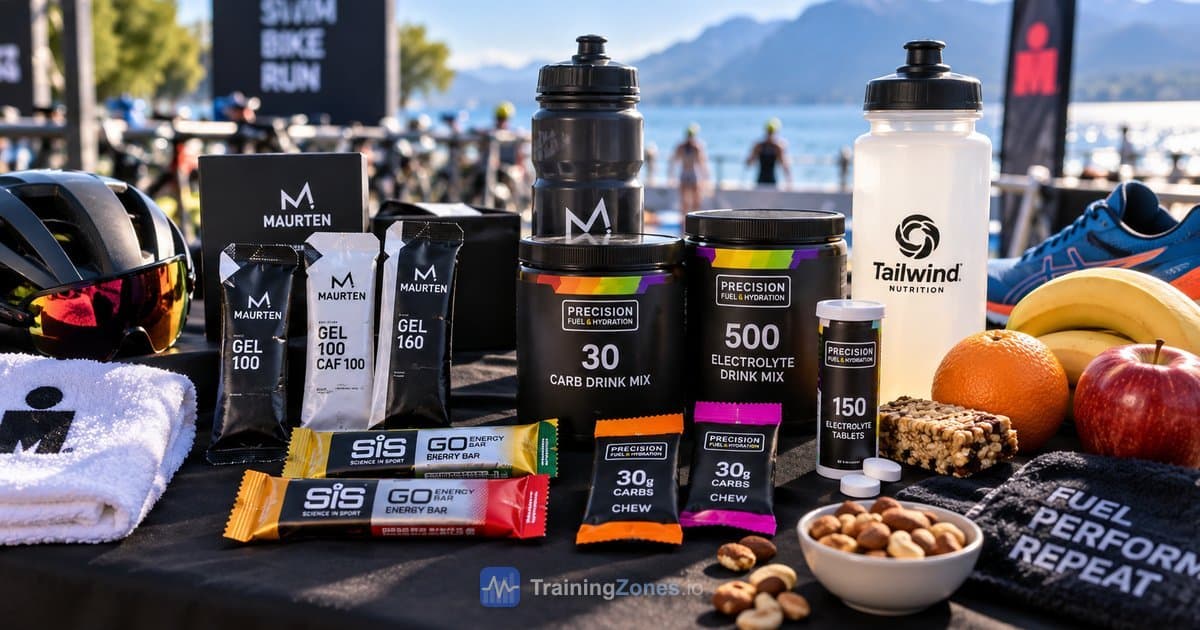
How triathlon fueling changes with race distance
Triathlon nutrition is the plan for what you eat and drink before and during a race so you finish strong instead of blowing up. The single biggest variable is distance. A sprint is over in about an hour, so it runs almost entirely on the fuel already in your muscles.
An Ironman can last twelve hours or more, and by the finish you will have eaten and drunk a small meal's worth of carbohydrate, fluid and salt while moving. Same sport, completely different fueling problem.
The rule of thumb is simple: the longer you race, the more the result depends on your stomach, not just your legs. Set your distance below and see roughly how much to take in per hour.
Triathlon Fueling by Distance
Pick your race and see how much to eat and drink per hour.
Estimates for guidance. Rehearse your plan in training and adjust to your gut and sweat rate.
At TrainingZones.io we treat fueling as a skill you rehearse, not a checklist you improvise on race morning. The numbers here are starting points. Your job over the training block is to test them, adjust, and lock in a plan you trust.
Want to line up your fueling against your projected splits first? Estimate your swim, bike and run times with our triathlon calculator.
Carbs per hour: the one number that matters
Carbohydrate intake per hour is the number that decides most triathlon races. For endurance work your body burns a mix of fat and carbohydrate, but the hard, race-pace efforts lean heavily on carbs, and your tank only holds around 90 to 120 minutes of them. After that, you either top up or you slow down.
Rough per-hour carbohydrate targets by distance:
- Sprint: 0 to 30 g. Often nothing solid needed.
- Olympic: 30 to 60 g.
- 70.3: 60 to 90 g.
- Ironman: 60 to 100 g, built up gradually over the race.
Going past roughly 60 g per hour is where it gets technical. A single sugar (glucose) maxes out around 60 g because your gut can only pull it across so fast. To absorb more, you need a mix of glucose and fructose, which use different transporters and push the ceiling toward 90 g and beyond.
That is why long-course fuels list "2:1" or "1:0.8" ratios on the label. The exact science of these intake rates is a rabbit hole, and going deeper than 60 g per hour is only worth it once your gut is trained for it.
Our pick: a multi-transportable-carb fuel like SiS Beta Fuel is built around that glucose-to-fructose ratio, which is exactly what lets you push toward 90 g an hour without your stomach staging a revolt.
Sprint triathlon nutrition: do you even need to fuel?
For a sprint triathlon, most athletes need no solid fuel at all during the race. The whole event lasts roughly an hour, which sits comfortably inside your existing glycogen stores. What you ate in the day or two before matters far more than anything you carry on the bike.
Keep it dead simple. Have a normal carbohydrate-focused dinner the night before and a familiar breakfast two to three hours out. During the race, a few sips of a carbohydrate drink on the bike is plenty, mostly to keep your mouth working and your head in the game.
If you are racing at the very front and going all-out, a single gel on the bike can give a small mental lift, but it is a nice-to-have, not a requirement. Sprint racing is short enough that gut problems from over-fueling cost you more time than under-fueling ever would.
Olympic distance nutrition
Olympic distance is where in-race fueling starts to earn its place. You are out there for roughly two to three hours, long enough that topping up carbohydrate keeps your pace from fading on the run. Aim for around 30 to 60 g of carbohydrate per hour, almost all of it taken on the bike where your stomach is calm and your hands are free.
A workable Olympic plan looks like this. Drink to thirst with a carbohydrate mix on the bike, and slot in one gel about halfway through the ride. On the run, one gel around the 5 km mark, chased with water at an aid station, usually covers it.
This is also the shortest distance where a caffeine hit pays off. A caffeinated gel taken 15 to 20 minutes before the run can sharpen a fading brain right when the race gets uncomfortable.
70.3 (half Ironman) nutrition
Half Ironman nutrition is the first real test of your gut. A 70.3 takes most age-groupers four to seven hours, and at that length under-fueling shows up as a grim, shuffling half marathon off the bike. Target 60 to 90 g of carbohydrate per hour, and treat the bike as the place you do the bulk of the eating.
Here is the pattern that works for most people:
- Bike (90 km): take in 70 to 90 g of carbohydrate per hour through a mix of drink, gels and maybe a chew or a small piece of a bar early on while your stomach can still handle texture.
- Run (21.1 km): switch to liquid and gels only. Aim for 60 to 80 g per hour, one gel roughly every 25 to 30 minutes, with water on top.
- Sodium: 500 to 800 mg per hour, more if you are a salty or heavy sweater.
The mistake to avoid is arriving at T2 already behind on fuel. You cannot claw back a 300-calorie deficit on the run, because your stomach shuts down as the pace and the pounding climb. TrainingZones.io readers who race well at 70.3 almost always front-load their fueling on the bike and start early, within the first 15 minutes.
How to build an Ironman race day nutrition plan
An Ironman nutrition plan is a full-day eating strategy executed at race pace, and it needs to be written down and rehearsed, not invented on the day. Total carbohydrate for the day can run past 800 g, so the plan is really about steady, tolerable intake over ten to fourteen hours. Here is how to build yours:
- Set your hourly carb target. Start at 60 g per hour and build toward 80 to 100 g only if your gut is trained for it. Write the number down.
- Load the bike. Plan 80 to 100 g per hour on the 180 km ride using a mix of drink mix, gels and some real food (banana, a bar) in the first few hours.
- Plan the run as damage control. Drop to 60 to 80 g per hour of liquid and gels only. Nothing new, nothing solid.
- Fix your sodium. Take 700 to 1,000 mg per hour, higher if you sweat heavily or race in heat.
- Set a drinking rhythm. Sip on a schedule, not just when thirsty, but never force fluid to the point of sloshing.
- Write the caffeine in. Save most of it for the back half of the marathon when it matters most.
- Rehearse it whole. Do at least one long brick session running your exact race-day fuel, in race-day amounts.
Our pick: Maurten Gel 100 is a race-day favourite for long course because its hydrogel texture sits lightly in the stomach, which is exactly what you want on hour eight of an Ironman.
Once you have your numbers, our race nutrition calculator turns them into an hour-by-hour plan you can tape to your top tube.
The bike is your feeding station, the run is damage control
The core tactic of triathlon fueling is simple: eat on the bike, survive on the run. Your stomach digests best when your body is stable and supported, which is the bike, and worst when you are pounding the pavement upright, which is the run. So you load the tank while you can, then spend the run topping up with only what goes down easily.
Two habits make this work. First, start fueling early, in the first 15 to 20 minutes of the bike, while your gut is fresh and absorption is high. Waiting until you feel hungry means you are already behind, because hunger lags real depletion by a good half hour.
Second, taper the texture as the race goes on: real food early, then gels and drink, then liquid only. By the time you are running, your gut is partly compromised, so the smart move is to ask less of it, not more.
Hydration and sodium: how much to drink per hour
Triathlon hydration means replacing enough fluid and sodium to hold performance without overdrinking. A good working range is 500 to 800 ml of fluid per hour, paired with 500 to 1,000 mg of sodium, adjusted for your body size, the heat and how much you sweat. Sodium matters as much as the water: it holds fluid in the right places and, in long races, guards against the low-blood-sodium problem called hyponatremia.
The catch is that sweat rate is deeply individual. Two athletes side by side can lose wildly different amounts of fluid and salt per hour. Guessing wrong in either direction costs you, so measure it.
At TrainingZones.io we would rather you race off your own sweat number than a generic chart built for someone else. Work out how much you actually lose with our sweat rate calculator, then build your race hydration around your own number rather than a generic chart.
Our pick: for salty and heavy sweaters, a strong electrolyte drink like Precision Hydration PH 1500 lets you match sodium to sweat instead of hoping the aid-station cups are enough.
What to eat before a triathlon: the night before and race morning
Your pre-race fueling is set the day before, not at the start line. Eat carbohydrate-focused meals the day before to top up glycogen, keeping fat and fiber moderate so nothing lingers in your gut overnight.
For 70.3 and Ironman, a light carbohydrate load of 8 to 10 g per kg of body weight across the final day or two makes a real difference. For a sprint or Olympic, a normal good dinner is enough.
Race morning follows a tight window:
- Eat breakfast 2 to 3 hours before your start.
- Make it 1 to 4 g of carbohydrate per kg of body weight, low in fat and fiber (oats, banana, toast, honey).
- Sip fluid steadily but stop chugging an hour out.
- Take about 30 g of fast carbohydrate, a gel or a sports drink, 15 minutes before the swim.
Nothing on race morning should be new. If you have not eaten it before a hard training session, do not eat it before the race.
Train your gut: rehearsing nutrition in training
Gut training is the practice of eating race-day amounts of carbohydrate in training so your stomach learns to absorb more without distress. The gut adapts like any other system. Athletes who deliberately practice high-carbohydrate fueling for several weeks can meaningfully cut the bloating, cramps and nausea that wreck races, and raise the carbohydrate they can take in.
Build it in over the last 6 to 8 weeks. On your long rides and key bricks, take in the exact fuel and the exact amount you plan to race with. Start toward the lower end, maybe 60 g per hour, and add roughly 10 g per hour every week or two until you hit your target comfortably.
This does two jobs at once: it trains the absorption machinery, and it tells you which products actually agree with you before it counts. Gut training is the most under-rated habit in age-group triathlon, and at TrainingZones.io we push every athlete toward it well before race week.
Caffeine strategy by distance
Caffeine is the most reliable legal performance booster in endurance sport, and it works dose-dependently: roughly 3 to 6 mg per kg of body weight improves both power and perceived effort. How you time it depends on the distance. For a sprint or Olympic, a single dose 45 to 60 minutes before the start, or a caffeinated gel just before the run, hits right when you need it.
For 70.3 and Ironman, spread it out and save the biggest hit for late. A common approach is a small amount before the bike, then caffeinated gels in the back third of the run, when your brain is begging you to ease off. One caution: if you never train with caffeine, do not debut a big dose on race day, because for some people it brings jitters or a nervous stomach at the worst possible time.
Common triathlon nutrition mistakes
Most triathlon nutrition failures come down to a handful of repeat offenders. Knowing them in advance is half the fix.
- Starting too late. Waiting until you feel hungry means you are already in a hole you cannot climb out of.
- Trying something new on race day. New gel, new bar, new drink: the race is the one place to never experiment.
- Over-fueling a sprint. Short races punish too much food, not too little.
- Ignoring sodium. Water alone in a long, hot race is how you end up cramping or hyponatremic.
- Eating solid food on the run. Your gut cannot handle it once you are pounding; go liquid and gels.
- Copying a pro's plan. A 60 kg elite going sub-9 has different needs than a 90 kg age-grouper out there for thirteen hours.
Nail the basics, rehearse them in training, and race day becomes execution rather than guesswork. That is the whole philosophy behind the fueling tools at TrainingZones.io: know your numbers, practice them, then trust them when it counts.
Frequently Asked Questions About Triathlon Nutrition
How many carbs per hour do you need for a triathlon?
It scales with distance: 0 to 30 g per hour for a sprint, 30 to 60 g for Olympic, 60 to 90 g for a 70.3, and 60 to 100 g for a full Ironman. The longer the race, the more you rely on fueling and the more your gut must be trained to handle it.
How many gels do you need for a 70.3 or an Ironman?
For a 70.3, most athletes need roughly 8 to 12 gels' worth of carbohydrate across the race, depending on how much comes from drink mix. For an Ironman it is far more, often 20-plus gel equivalents, which is why long-course athletes lean on drink mix and some real food rather than gels alone.
Do you need to eat during a sprint triathlon?
Usually not. A sprint lasts about an hour, which your muscle glycogen already covers. A solid pre-race meal and a few sips of a sports drink on the bike are enough for most athletes.
What should you eat for breakfast before a triathlon?
Eat 2 to 3 hours before the start: 1 to 4 g of carbohydrate per kg of body weight, low in fat and fiber, such as oats, banana, toast and honey. Then take about 30 g of fast carbohydrate 15 minutes before the swim.
How do you avoid stomach problems during a triathlon?
Train your gut for 6 to 8 weeks by practicing race-day fueling in training, front-load carbs on the bike, switch to liquid and gels on the run, and never try a new product on race day. Most GI distress comes from doing too much, too late, with untested fuel.
How much should you drink per hour in a triathlon?
Aim for 500 to 800 ml of fluid per hour with 500 to 1,000 mg of sodium, adjusted for your size, the heat and your sweat rate. Measuring your own sweat rate beats guessing, since losses vary hugely between athletes.
References
- Jeukendrup, A. (2014). A step towards personalized sports nutrition: carbohydrate intake during exercise. Sports Medicine, 44(Suppl 1):S25-S33.
- Thomas, D.T., Erdman, K.A., Burke, L.M. (2016). ACSM Position Stand: Nutrition and Athletic Performance. Medicine & Science in Sports & Exercise, 48(3):543-568.
- Costa, R.J.S. et al. (2017). Gut-training: the impact of two weeks repetitive gut-challenge during exercise on gastrointestinal status. Applied Physiology, Nutrition, and Metabolism, 42(5):547-557.