What is lactic acid? (and why you've never had it in your muscles)
Lactic acid is a molecule (C₃H₆O₃) that, in the human body, barely exists for more than a heartbeat. At the pH inside your muscles and blood (around 7.4), lactic acid splits apart almost instantly into lactate (C₃H₅O₃⁻) and a hydrogen ion (H⁺). So when people talk about "lactic acid burning in my legs", the chemistry says otherwise: your working muscles produce lactate, not lactic acid.
Here's the thing that trips everyone up. The term "lactic acid" is a leftover from very old science. Back in 1907, Fletcher and Hopkins showed that lactic acid piled up in frog muscle that was cut off from oxygen and stimulated to exhaustion, and the "oxygen debt" idea was born soon after. That framing (no oxygen, acid builds up, muscle fails) was tidy, memorable, and mostly wrong for how a living, breathing athlete actually works. Yet it never left the gym. Coaches still say it, gels still market against it, and half the internet still blames it for everything from the burn to next-day stiffness.
There's an important detail in that old experiment: the frog muscle was isolated and cut off from its blood supply, nothing like a living athlete with a heart, lungs, and a whole recycling system running. The "oxygen debt" model that grew out of it was later heavily revised, because in a real body lactate is cleared and reused, not just left to accumulate as a poison. Even so, the scary version of the story is the one that spread.
The problem is that a name shapes how you think. Call something an "acid" and a "waste", and you'll treat it like poison to be avoided or flushed out. Call it what it really is, a fuel and a signal, and your whole approach to hard training shifts. That shift is what this guide is about. Once you see why the old label is broken, the modern science of lactate is honestly pretty freeing.
What is lactate? The molecule your body actually produces
Lactate is the ionized form of lactic acid, and it's what your muscles genuinely make during hard efforts. Because lactic acid dissociates so fast at body pH, what actually piles up in your blood is lactate, a molecule that is neutral, not acidic, and far from being a waste product.
Your body produces lactate all the time, even while you're sitting reading this, and cranks it out faster as you push harder. During intense exercise, your fast-twitch muscle fibers break down glucose through glycolysis to make energy in a hurry. Glycolysis is fast but it needs a molecule called NAD⁺ to keep running, and converting pyruvate into lactate is what regenerates that NAD⁺. In other words, making lactate is not a failure of the system, it's the step that lets you keep producing energy quickly when demand is high. Without it, your hard efforts would stall almost immediately.
Think of lactate less like exhaust fumes and more like a portable battery: it stores energy your body can carry somewhere else and use later. That single change of metaphor, from "waste" to "battery", is most of the mental work here. At TrainingZones.io we lean on this modern view of lactate because it changes how you should read every hard session, every threshold test, and every so-called "burn".
Lactic Acid vs Lactate Myth Buster
Tap a common belief, then bust the myth
Your muscles fill up with lactic acid during hard exercise.
Lactic acid vs lactate: the chemical difference
The difference between lactic acid and lactate comes down to one hydrogen ion. Lactic acid (C₃H₆O₃) is the full acid molecule; lactate (C₃H₅O₃⁻) is what's left after the acid donates its H⁺. Since that donation happens almost the moment the molecule forms, your body deals in lactate, and the H⁺ goes off to do its own (troublemaking) thing.
Let's put the two side by side so it's crystal clear:
- Lactic acid (C₃H₆O₃): the full acid form, a proton donor, present only for an instant before it dissociates.
- Lactate (C₃H₅O₃⁻): the ionized form, neutral in charge terms, stable in blood, and usable as fuel.
- Where they live: lactic acid basically doesn't exist as such in your muscles; lactate is measurable in every drop of your blood.
- What they do: the released H⁺ lowers pH and drives the "acid" feeling; lactate itself gets shuttled off and burned for energy.
So the phrase "lactic acid vs lactate" is really a story about a molecule that splits the second it appears. The half everyone fears (the acid, the proton) is not the half that shows up on a lab test. That gap between what we measure and what we blame is the root of nearly every lactate myth, and it explains why "flush out the lactic acid" is such a stubborn piece of gym folklore. You can't flush out something that only exists for a fraction of a second. Keep that one distinction in your head and the rest of this article basically writes itself.
The myth: does lactic acid cause muscle soreness?
No, lactic acid does not cause muscle soreness. Delayed onset muscle soreness (DOMS), the deep ache you feel 24 to 72 hours after a hard or unfamiliar session, comes from microscopic damage to muscle fibers and the inflammation that follows, not from lactate or lactic acid.
The timeline alone busts this one wide open. Blood lactate returns to its resting level within about 30 to 60 minutes of stopping exercise. DOMS, by contrast, usually peaks a day or two later, long after every trace of lactate is gone. You can't blame a molecule that cleared out on Monday for a soreness that shows up on Wednesday. It gets even clearer when you look at what triggers DOMS: eccentric, braking-type contractions like running downhill or lowering a heavy weight cause the worst soreness, yet they often produce relatively little lactate. Meanwhile a flat-out track session can send lactate through the roof and leave you barely sore at all. The two simply don't track together.
This is also why "flushing out the lactic acid" with a cooldown is a bit of a myth in itself. An easy cooldown and gentle active recovery genuinely help you feel better, mostly by keeping blood moving and easing stiffness, but not by clearing lactic acid that isn't sitting there in the first place. If DOMS is your main worry, the fix is boring but real: build up new or harder work gradually, and don't jump your volume or intensity too fast. That steady progression is exactly what a smart training plan is designed to protect.
What actually causes the burn: hydrogen ions, not lactate
That searing burn during an all-out effort comes from hydrogen ions (H⁺) accumulating faster than your muscles can buffer them, which drops the pH inside the muscle cell from about 7.4 toward 6.8. Lactate rides along with those protons, so it gets the blame, but lactate itself is neutral and isn't what's making you hurt.
During very hard exercise, glycolysis runs flat out and the surrounding reactions release H⁺ faster than your buffering systems (mainly bicarbonate) can mop them up. As the protons build up, the acidic environment interferes with the enzymes and contractile machinery in your muscle, and your body waves a red flag: back off. That's the burn. It's a protective signal, not damage, and it fades within minutes once you ease up. Researchers like Robergs and colleagues (2004) laid out the biochemistry clearly: it's the proton accumulation, not lactate production, that drives exercise acidosis.
Here's the twist that really flips the story. Producing lactate actually consumes a proton in the process, so making lactate slightly slows the drop in pH rather than causing it. The molecule everyone painted as the villain is closer to a buffer. That's one more reason the old "lactic acid poisons your muscles" line never held up.
Your ability to tolerate the burn is trainable too. Hard intervals push your muscles to build up more buffering capacity and more of the transporters that move H⁺ and lactate out of the cell, so a fit athlete can hold a higher intensity before acidity forces a slowdown. That's part of why repeated exposure to threshold and VO2max work pays off. The science team at TrainingZones.io treats the burn as useful information about intensity, a real-time read on how deep you're digging, rather than a poison to fear or a badge to chase.
Lactate as fuel: the lactate shuttle
Lactate is a fuel, not a dead end. The lactate shuttle, a theory developed by physiologist George Brooks at UC Berkeley from 1984 onward, describes how lactate is constantly carried from where it's made to where it's needed, then oxidized for energy. Your heart, brain, and slow-twitch muscle fibers happily burn lactate, and at moderate-to-high intensities it becomes a preferred fuel.
Picture it as an internal delivery network working on two scales at once. In the cell-to-cell shuttle, fast-twitch fibers churning through glucose spill lactate into the blood, and that lactate is picked up by nearby oxidative fibers, by the heart, and even by the brain, then turned back into usable energy. There's also an intracellular shuttle, where lactate is fed straight into the mitochondria of the same muscle. On top of that, some lactate travels to the liver and gets rebuilt into glucose through the Cori cycle, ready to be used again. Far from clogging you up, this recycling lets you sustain harder efforts for longer and keeps your blood sugar stable.
The numbers are striking: during hard exercise, the heart can draw a large share of its fuel from lactate, and the brain readily takes it up too. Brooks spent nearly four decades refining this model, from the first papers in the 1980s through major updates as recently as 2018, and it's now mainstream exercise physiology, taught in the same textbooks that once called lactate a waste product. That flip in understanding is the single biggest reason we talk about lactate the way we do at TrainingZones.io.
What does a blood lactate test actually measure?
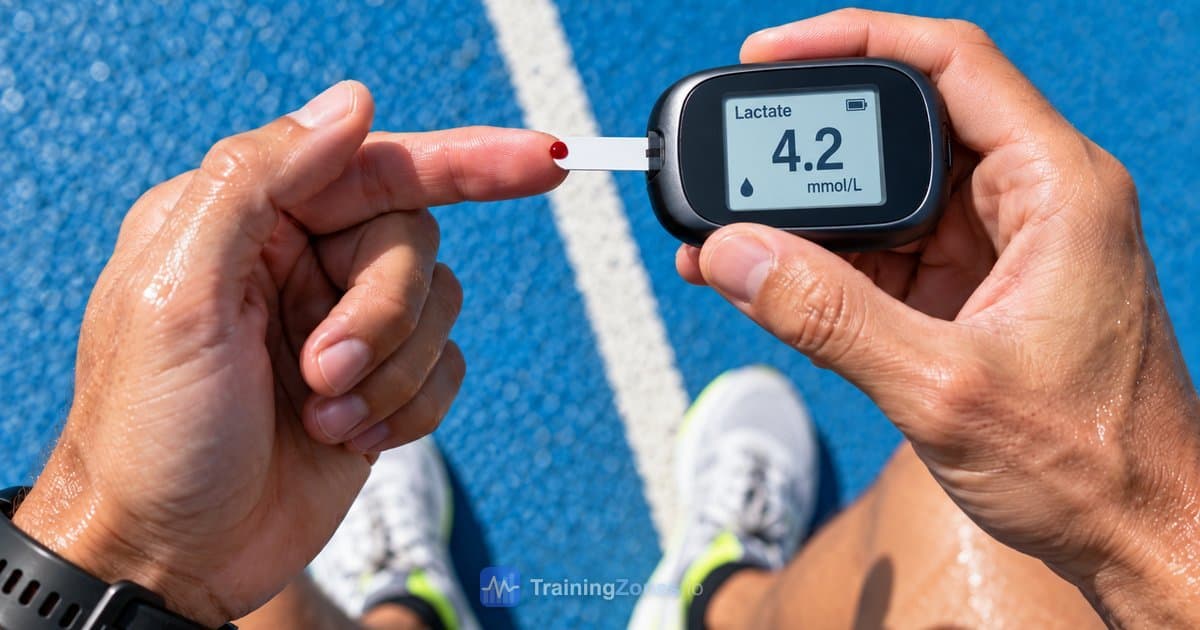
A blood lactate test doesn't measure fatigue or "waste". It measures the balance between how fast you produce lactate (which tracks your glycolytic rate, and therefore intensity) and how fast you clear it (which tracks your aerobic, oxidative capacity). Watch the two tip out of balance and you've found something genuinely useful.
Here's how it plays out in a step test. A technician takes a tiny fingertip blood sample at increasing intensities, and the lactate reading barely moves at easy efforts, then starts to lift, then shoots up like a hockey stick. Two bends in that curve matter. The first, often called LT1 and sitting near 2 mmol/L, is where lactate first rises above rest; it marks the top of truly easy training. The second, LT2 or the maximal lactate steady state, sits near 4 mmol/L for many athletes and marks the highest intensity you can hold while production and clearance still balance. Push past LT2 and lactate climbs relentlessly until you have to slow down. That inflection is your lactate threshold, and it's one of the strongest predictors of endurance performance we have, often better than VO2max.
A blood lactate analyzer is the tool coaches use to map this out precisely, sample by sample.
Our pick: if you want to test at home, a portable blood lactate analyzer lets you build your own lactate curve from a fingertip sample, the same principle a lab uses. It's a niche bit of kit, but for data-driven athletes it's the most direct window into your metabolism.
Reading the curve is simpler than it looks. Suppose your lactate sits near 1.5 mmol/L on easy efforts, ticks up to about 2 mmol/L as you reach a comfortable aerobic pace, then jumps toward 4 mmol/L and beyond once you press into "comfortably hard" territory. The pace or power just before that steep climb is the intensity you can defend for a long time; the numbers above it are where the clock starts ticking. Retest every 6 to 8 weeks and, if your pace at the same lactate value keeps improving, your engine is getting better even when the scale on the meter looks the same.
You don't need a lab to act on this, though. You can estimate the same threshold intensity from heart rate and pace, then anchor your training to it. At TrainingZones.io we treat that threshold as the anchor for your zones, from easy runs all the way to race pace. Turn your numbers into usable zones with our heart rate zones calculator, and if you're a runner, cross-check the pace side with our critical speed calculator.
What this means for your training
Once you accept that lactate is fuel and not poison, threshold training stops being about "surviving the acid" and becomes about training the intensity where your body clears lactate best. That reframing is the whole point, because it tells you to train the balance, not just the suffering.
A few practical takeaways fall straight out of the science:
- Easy days build your clearance engine. Low-intensity aerobic volume grows the mitochondria and slow-twitch fibers that consume lactate, which raises the intensity you can hold before it starts to accumulate.
- Threshold work sharpens the ceiling. Tempo efforts and cruise intervals right around your threshold teach your body to produce and clear lactate at higher outputs, which directly lifts your race pace.
- The burn is a gauge, not an enemy. When your legs light up, that's a pacing signal about H⁺ buildup, not a sign you're doing damage. Use it to hold the right intensity instead of blowing up early.
- Don't chase soreness. DOMS isn't proof of a good session, and it isn't leftover lactic acid; it's just tissue rebuilding after unfamiliar load.
This is exactly the logic behind modern methods like the Norwegian double-threshold approach, where athletes do controlled threshold volume while keeping lactate in check, and behind polarized training, where most work stays easy so a smaller dose of hard work really counts. Both live or die on managing lactate, not fearing it. Before your next hard block, map your zones on TrainingZones.io so every session lands at the intensity you intended, not by feel alone.
Also useful: for threshold work by heart rate, a proper chest strap beats a wrist sensor for accuracy. The Polar H10 is the reference for steady, lab-grade heart rate during hard efforts.
Frequently Asked Questions About Lactic Acid and Lactate
Are lactate and lactic acid the same thing?
No. Lactic acid (C₃H₆O₃) is an acid that dissociates almost instantly at body pH into lactate (C₃H₅O₃⁻) and a hydrogen ion (H⁺). Your muscles produce lactate, which is neutral and usable as fuel, while the released H⁺ is what drives the "acidic" feeling.
Does lactic acid cause muscle soreness?
No. Delayed onset muscle soreness (DOMS) is caused by microscopic muscle fiber damage and inflammation, felt 24 to 72 hours after exercise. Blood lactate returns to resting levels within 30 to 60 minutes of stopping, long before soreness appears.
What actually causes the burning sensation during exercise?
The burn comes from hydrogen ions (H⁺) building up and lowering the pH inside your muscle cells, not from lactate. Lactate is produced alongside those protons but is neutral itself. The sensation is a protective signal that fades within minutes once you ease off.
What comes first during exercise, lactate or lactic acid?
Effectively lactate. Lactic acid forms for only an instant before it dissociates at physiological pH, so what your muscles accumulate and what a blood test measures is lactate, along with the separate hydrogen ions.
Is lactate a waste product?
No. Lactate is an important fuel. The lactate shuttle carries it to the heart, brain, and slow-twitch muscle fibers, where it is oxidized for energy, and it can also be converted back into glucose in the liver.
What is a normal blood lactate level at rest?
At rest, blood lactate typically sits around 1 to 2 mmol/L. It rises with intensity, and the point where it climbs sharply, often near 4 mmol/L in many athletes, marks the lactate threshold used to set training zones.
References
- Brooks, G. A. (2018). The science and translation of lactate shuttle theory. Cell Metabolism, 27(4):757-785.
- Robergs, R. A., Ghiasvand, F., & Parker, D. (2004). Biochemistry of exercise-induced metabolic acidosis. American Journal of Physiology, 287(3):R502-R516.
- Gladden, L. B. (2004). Lactate metabolism: a new paradigm for the third millennium. Journal of Physiology, 558(1):5-30.
- Cairns, S. P. (2006). Lactic acid and exercise performance: culprit or friend? Sports Medicine, 36(4):279-291.